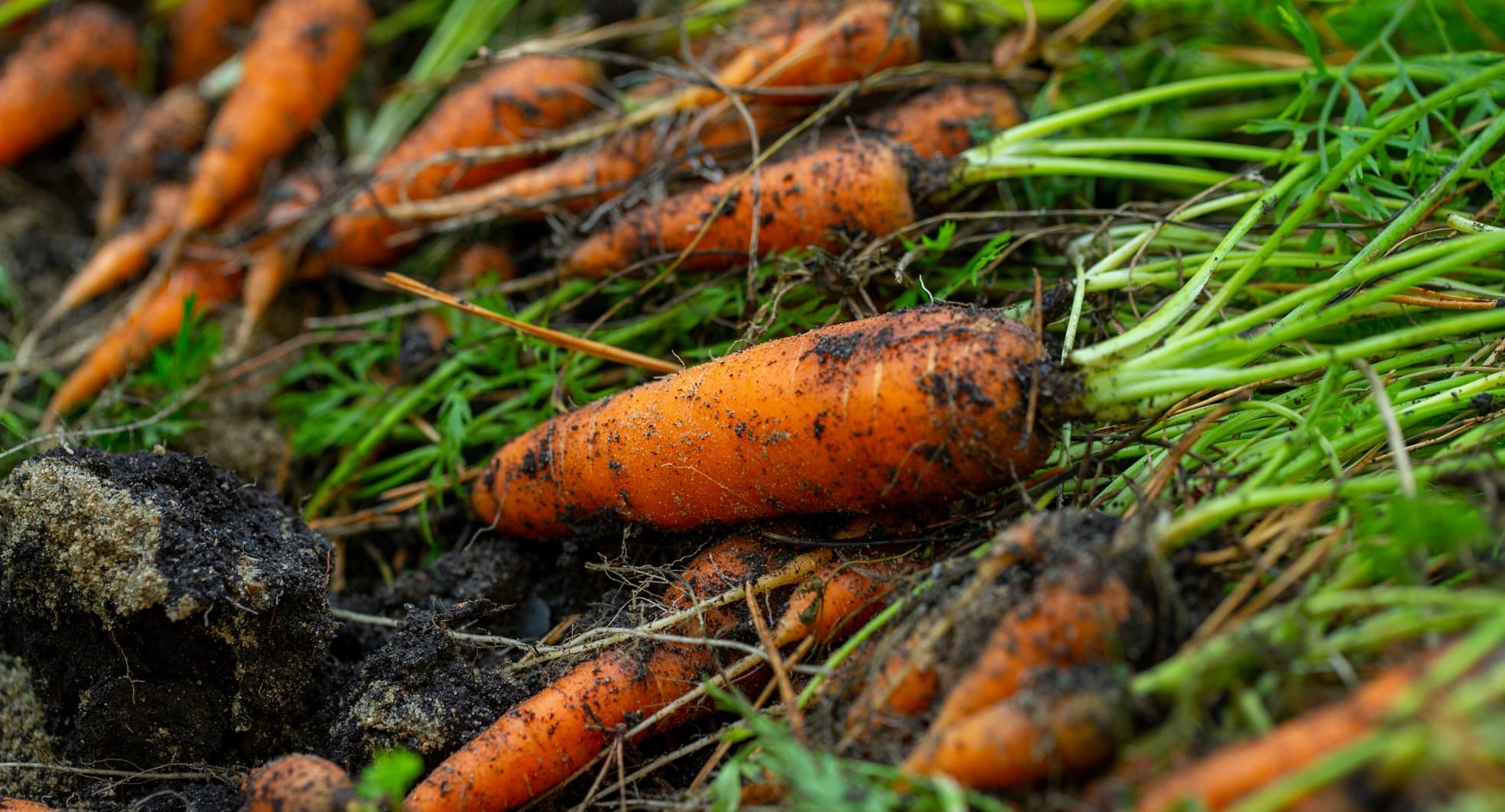
Carrots are cheap, versatile, and delicious.
Originally hailing from Asia and since taking the entire world by storm, carrots can be found at the heart of almost every global cuisine.1
Whether used as a centrepiece in a salad, or as an aromat, like in a mirepoix at the heart of a rich spaghetti Bolognese, carrots bring a unique and distinct flavour to any dish they grace with their presence.
“Although biennial, this plant has a delicate lacy flower that changes in colour from white to red once it’s completed flowering, turning inwards,” says Garden Designer Anca Panait.
“It self-seeds and is best used in naturalistic wild combinations along grasses, chicory and cornflower.”
They’re easy to grow, too – as you’d expect from a plant which has been a staple in cuisine around the world and within all socioeconomic levels for generations.
Getting carrots established in your garden requires minimal time and effort, and practically guarantees a bountiful harvest.

This guide will tell you everything you know to get your carroty cornucopia overflowing.
Overview
| Botanical Name | Daucus carota subsp. Sativus |
| Common Name(s) | Carrot |
| Plant Type | Vegetable |
| Native Area | Europe, South-West Asia |
| Hardiness Rating | H2 |
| Foliage | Rosette of edible leaves |
| When To Sow | March, April, May, June, July |
These root vegetables, most often orange but also available in an exciting array of other colours, are formally known as Daucus carota subsp. sativus.
They hail from the Umbelliferae family, making carrots close genetic cousins to celery, parsley, and other such aromatic plants.2
The name ‘carrot’ derives from the ancient Indo-European word ker, meaning horn: Implying that their most identifying characteristic is a vague resemblance to an animal’s horn.3
Carrot Varieties
Most people think of the standard orange carrot when the vegetable is mentioned.
These are far and away the most commonly encountered carrot here in Britain, but don’t let that fool you into thinking it’s your only option when growing your own.
“I love growing Daucus carota ‘Dara’,” says Horticulturist Ann-Marie Powell.
“It is such an amazing plant for growing in pots.”

Growing carrots at home gives you access to many exciting varieties in an array of colours that will impress your friends and liven up your cooking.
Below we’ll introduce a few of these, along with the only carrot to receive the Royal Horticultural Society’s Award of Garden Merit.
D. carota ‘Flyaway’
‘Flyaway’ is a proud recipient of the RHS Award of Garden Merit: recognition that it grows exceptionally well in the UK.4
These compact orange carrots pack a sweet punch, and are a fantastic introduction to gardeners looking to grow their own carrots.
They enjoy full sun, a west- or south-facing aspect, and shelter. In terms of soil, they won’t thrive in chalk, but aren’t fussy with pH.
D. carota ‘Purple Haze’

Jimi Hendrix sang about purple haze, but it’s unlikely that song alluded to the joys offered by carrots.
While this variety probably won’t make you want to kiss the sky, it will make a fine introduction to growing carrots that aren’t orange.
The bold purple colouration is even brighter when you peel away the skin, making these great for cooking.
‘Purple Haze’ enjoys the same growing conditions as ‘Flyaway’, but avoid clayey soil as well as chalk.
D. carota ‘Nutri-Red’

Here’s another variety offering a slightly different colour to the default orange.
The red tint found in ‘Nutri-Red’ intensifies when cooked, giving an exciting visual element to any dish that contains them.
Conditions are the same as ‘Purple Haze’.
D. carota ‘White Satin’

We’ve had orange, purple, and red – why not white?
These carrots are low in carotenoid, the chemical that gives carrots their familiar hue, making them great for people with allergies, or for people just wanting yet another colour of carrot to play with when cooking.
Why Grow Them?
While carrots are cheap to buy, growing your own is fun and rewarding.
They’re easy to grow, making them a great introduction for fledgling gardeners.
They’ll last a long time once harvested, giving you a plentiful supply of carrots to use in your kitchen.
How To Grow Carrots

The first step when growing carrots is to prepare the soil, to ensure their roots can grow unobstructed into the ground.
You’ll want to till about 30cm of topsoil, taking care to remove rocks, clumps, and other obstacles.
“My top tip is not to apply manure to the soil you grow roots like carrots, as it can cause them to grow misshapen normally with multiple tap roots,” says Dan Ori, a Horticultural Instructor.
“This misshaping of roots is called forking.”
If it’s not possible to till this much soil because of obstructions, consider growing our carrots in a raised bed.

“Carrots can be grown outside year-round, but they will need some protection from frost,” adds Dan.
“You may get away with just horticultural fleece, but something more substantial might be required if you expect snow.
“The soil will need to be warm for seeds to germinate, but the plants themselves can normally survive during winter.
“My favourite thing is to sow carrots between 12-20 weeks before Christmas, then on Christmas day, like an excited child running downstairs to open their presents, I run into the garden and pull up my carrots to prepare for Christmas dinner.
“Plant out 4-10 weeks before the last frost of spring for harvests throughout the summer and autumn.”
Where To Grow Them
Grow your carrots in a spot with well-tilled soil, full sun exposure, shelter from wind, and with a south- or west-facing aspect.
Make sure the soil is loamy (a small amount of sand is tolerable, but avoid chalk or clay).
How To Plant Carrots
Simply sow seeds into the soil you’ve just tilled.
There’s no need to start carrots off indoors, and this disruption to their roots can actually hinder their growth.
Use a dibber to make holes about 1-2cm deep and 5-8cm apart, then place a carrot seed in each and cover back over.

Grow carrots in rows, with about 30cm between rows.
This spacing will give each carrot space to thrive – remember that while this may seem like excess space for the slim carrots you’re familiar with in the supermarket, the ones you grow will likely be much less consistent in shape and size.
Leaving enough space lets carrots grow into whatever shape they desire.

Propagation
Lots of kids will tell you that if you cut the top bit off a carrot and place it in shallow water, the shoots on top will grow.
Many parents have used a tupperware box with a carrot top in water vainly trying to grow into a new plant as a mini science project to demonstrate the principles of propagation to their children.

In terms of propagating carrots at home, however, this is as close as most people get.
Because adult carrots don’t produce easily-gettable seeds, the most viable option for growing carrots next season is simply to buy another packet of seeds.
References
1. Praciak, A. (2015). Daucus carota (carrot). CABI Compendium. https://doi.org/10.1079/cabicompendium.18018
2. Family Album: Carrot. (n.d.). Wild Flower Finder. Retrieved March 14, 2023, from https://wildflowerfinder.org.uk/Menu2/Family/FamilyInfo/Info_Apiaceae.htm
3. Origin and meaning of carrot. (n.d.). Etymonline. Retrieved March 14, 2023, from https://www.etymonline.com/word/carrot
4. Daucus carota “Flyaway.” (n.d.). Royal Horticultural Society. Retrieved March 14, 2023, from https://www.rhs.org.uk/plants/139299/daucus-carota-flyaway/details