The Primrose, that voiceless herald of spring, is strongly identified with the UK.
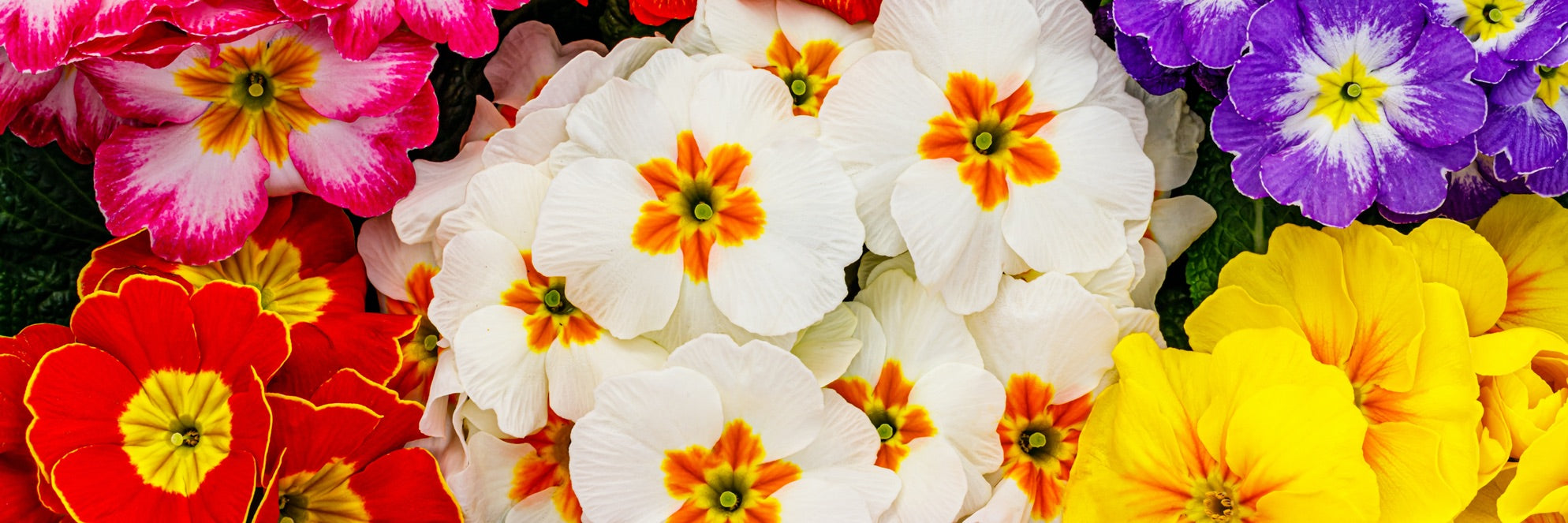
An abundance of relatively new cultivar series means that Primroses are available in numerous colours in tones pastel and saturated, in double forms, and even in variegated tones.
Overview
| Botanical Name | Primula vulgaris |
| Common Name(s) | Primula; Primrose |
| Plant Type | Perennial Flower |
| Native Area | West & Southern Europe |
| Hardiness Rating | H4-H7 |
| Foliage | Semi-evergreen |
| Flowers | Various colours – often yellow |
| When To Sow | March, April, September, October |
| Flowering Months | January, February, March, April, May |
Spring just wouldn’t be complete without primroses in an English country garden – correction, in any English garden.
Indeed, Primroses are so strongly identified with England that although P. vulgaris is native to – besides the British Isles – most of Europe it is called ‘English Primrose’ all over the world.
Its subspecies P. vulgaris subsp. vulgaris, also known as Common Primrose, extends its native range to near Asia.

Habitat & Growing Conditions
Moisture, shade, and cool temperatures – these three factors combine to make the ideal habitat for Primroses.
Thus, these plants are very often found in and around damp woodlands close to bodies of water.
And if there is one genus for which the virtually standard caution against heavy clay soils and wet soils can be dispensed with it, it is the English Primrose, Common Primrose, and most Primrose varieties, most particularly the Giant Cowslip.

The majority of Primrose varieties prefers moist-to-damp soils, the only difference between the varieties being one of degree.
Almost all varieties are somewhat acidophilic with the difference between varieties, again, being one of degree.
The suitable pH for these plants ranges from 6.1-7.0. rich humus- and compost-based soils are best for these plants.

Most Primrose species prefer shade or part shade, though there are exceptions.
Primrose varieties’ Hardiness Zones vary quite widely but most, including P. vulgaris and its subspecies, have a USDA Hardiness Zone from 4 to 8 (H4-H7 RHS hardiness).

Planting Primrose
When To Plant
Autumn and spring are the best seasons to grow Primroses by any method by which a particular variety can be grown (or planted or propagated).
Seeds are best sown in late autumn, otherwise in early spring.

Dividing the plants or separating offsets is another method of propagation.
Depending on the variety this is best done in spring, autumn, or either and both.
For example, you should divide P. denticulata in spring but P. vulgaris Belarina series cultiviars in autumn.
Where To Plant
Where you plant a Primrose plant depends fairly strongly on the particular variety.
P. vulgaris and its subspecies are great for mass plantings, are suitable for rock gardens, for growing on verges and slopes, and even as a delightful ground cover.
On the other hand, plants from the series that bear intensely-coloured and truly showy flowers, such as the ‘Danova’ series, are ideally suited as bedding display plants, for borders and edges, and as decorative container plants.

As for the highly striking varieties like ‘Perle von Bottrop’, ‘Zebra Blue’, and ‘Gold-Laced’ Group, these can be grown and displayed as true specimen plants in their own rights.
Plant Care
Soil Requirements
A very good soil in which to grow the vast majority of Primroses would be a slightly acidic fertile clay-based loam with humus and peat moss.
It should be kept moist and especially so in hot or dry weather.
As opposed to the species, particularly ‘Cowslip’, Primrose cultivars and series should be planted in soils with very good drainage.
Sunlight
Primroses are known as shade-loving plants and in the main this is true.

They will grow well in partial shade and dappled sunlight.
However, some varieties tend to one or another extreme.
For instance, ‘Perle von Bottrop’ prefers part shade to full shade whereas ‘Giant Cowslip’ prefers part sun to full sun.
Most mature plants will do very well in temperatures between 12.5-25°C.
“Primulas are great naturalised (particularly species) or grown in pots,” says Master Horticulturist Peter Lickorish.
“In my experience, pots can be placed in full sun positions because, in early spring, the intensity of the sunlight is unlikely to be a problem.
“If planting out afterwards, make sure to bear in mind that they will need more shade in the summer months and plant accordingly.”
Feeding
Primroses do not need fertiliser in British conditions particularly if the soil is rich, organic, and is amended with humus or organic manure.
That said, cultivars and series varieties will benefit from fertilising.

You can fertilise once every fortnight from the start to the close of blooming season.
Do so by lightly sprinkling a general fertiliser at the base of the plant.
Common Problems
As Primula Primrose varieties are so numerous and disparate, their resistance or susceptibility to pests varies quite widely.
Though they are healthy plants in general, quite a number of pests may attack them.

These include slugs, aphids, vine weevil, eelworms, leafhoppers and glasshouse red spider mite.
The diseases that can affect these plants are primula brown core, grey mould, and leaf spot.