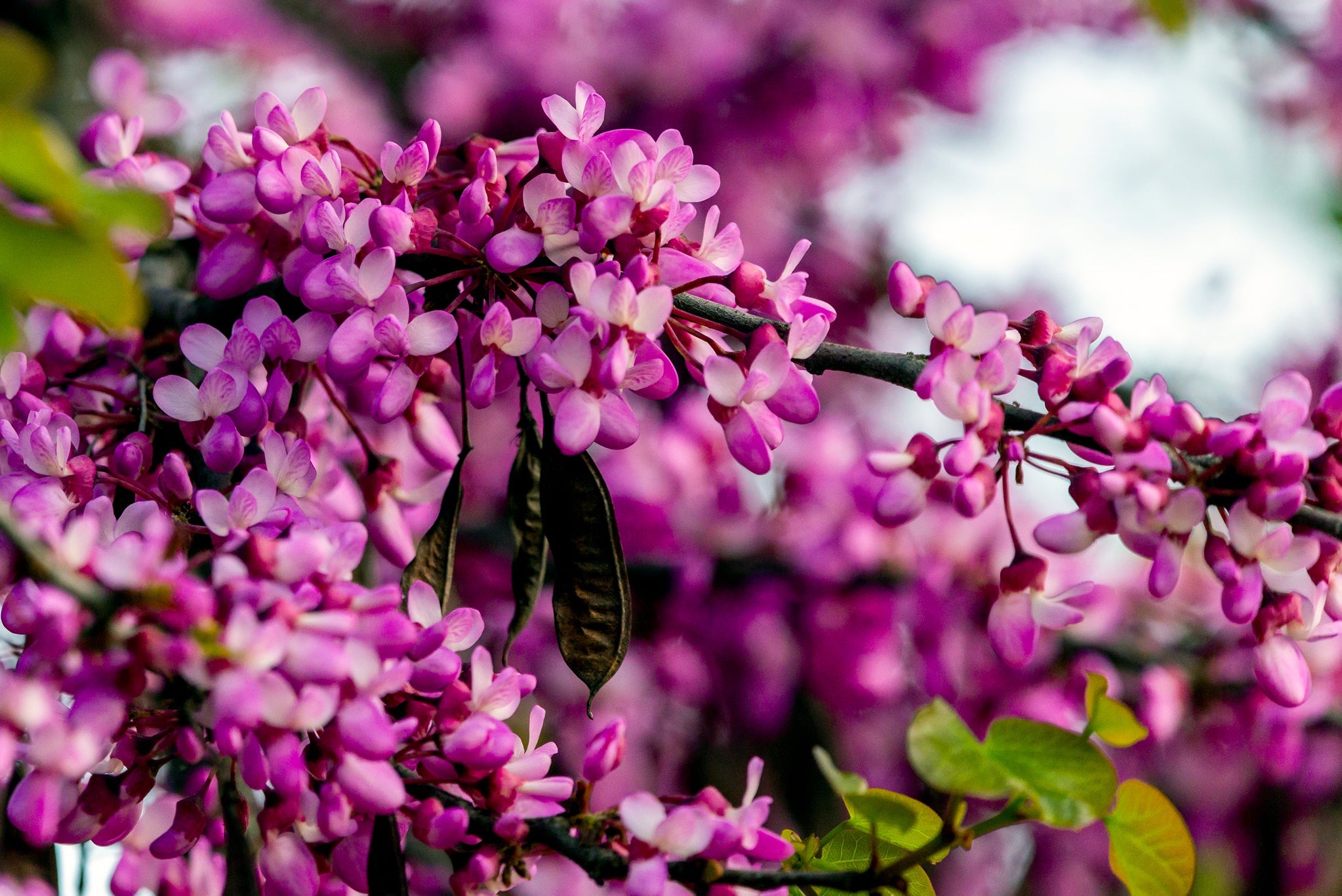
Cercis siliquastrum, the ‘Judas Tree’, is a wonderful choice for milder gardens in the south of the UK.
If you can provide relatively warm, sunny and sheltered conditions then this is an excellent ornamental and productive tree to consider.
Interestingly, though often grown merely as an ornamental specimen, this tree is also a very useful one.
As a member of the legume family along with peas and beans,, it is a tree that hosts bacteria which can take atmospheric nitrogen and make it available in the soil, commonly known as a ‘nitrogen fixer’.1
The blooms in spring are also beneficial in bringing in and providing nectar for bees and other pollinators, so, where suitable conditions can be provided for flowering, this might be a good choice for a wildlife-friendly garden.
“In the autumn an attractive feature of the Cercis are the masses of flat, purple seed pods hanging from its branches,” shares Master Horticulturist Roy Nicol.
Overview
| Botanical Name | Cercis siliquastrum |
| Common Name(s) | Judas tree |
| Plant Type | Tree |
| Native Area | France to East Mediterranean |
| Hardiness Rating | H5 |
| Foliage | Deciduous |
| Flowers | Rosy-pink pea flowers followed by purple pods |
| When To Plant | March-May or September-November |
| When To Prune | June |
Cercis siliquastrum, also known as the Judas tree or European Redbud, is closely related to other common garden trees.

The tree is native to the region between France and the Eastern Mediterranean, which gives some clues as to the environmental conditions that it prefers,namely warm and sunny without excessive rain or severe winter cold.2
Growing From Seed
Cercis siliquastrum is usually grown from saplings or young trees which are purchased.
However, if you are patient and up for a challenge, you could consider collecting the seeds from an existing tree to sow.
Seed is collected in the autumn and, after soaking in water for 24 hours, sown in a cold frame so that germination occurs in the spring.
Alternatively, they can be sown during spring in pots of peat-free, multi-purpose potting mix or a homemade equivalent in warm conditions at around 18°C.

The seeds do germinate fairly readily.
However, note that you should expect growth to be just 2-6 inches over the first year.
Patience is most certainly required because it will typically take 15 years before your tree grown from seed will begin to flower.
With this in mind, it’s clear to see why the majority of Judas trees are purchased as container-grown specimens.
Planting A Judas Tree
You can plant out one of these trees anytime, though the best times are typically spring or autumn when moisture levels and temperatures are such that transplantation shock should be reduced.

C. siliquastrum does not like much root disturbance, so you should take care to treat a new tree carefully and plant it out as quickly and smoothly as possible.
It can be beneficial to add mycorrhizal fungi to the hole where you are planting your tree to aid in the establishment.
Preferred Aspect
Judas trees prefer a site in full sun, where conditions are warm and sunny through the summer months, but they can cope with partial shade.

Although they are H5 hardy and can cope with winter conditions, they do need Mediterranean-like summer conditions to flower well.
For this reason, they tend to do better towards the southern end of the British Isles and will not do so well up north.
Soil Requirements
The soil can be of almost any type and pH but it must be free-draining and well-drained.
Growing C. siliquastrum amid other Mediterranean species, including Mediterranean herbs, could be an excellent choice for a sunny and sheltered spot, as it could bring that Mediterranean feel to your southerly UK garden.

You might also consider an olive tree for year-round appeal and shrubs like Teucrium fruticans to further complement this look.
Ongoing Care
Judas trees, when grown in a suitably sunny, warm location with free-draining soil, will require a little care until established, but should be fairly low-maintenance afterwards.
Feeding & Mulching
Upon planting, it is important to add an organic mulch of compost, well-rotted manure, or leafy greens and wood chips or bark.
This will add fertility as well as retaining soil moisture and suppressing weeds.
This mulch should be replenished each year in early spring.
Watering
Although these trees are reasonably tolerant of dry conditions once established, they do need to be watered well and regularly after planting until their root systems have developed.
Pruning
Cercis siliquastrum is in RHS pruning group 1, so not much pruning (if any) is required.

You may, however, give the tree a tidy-up and light prune after flowering.
When pruning, it is important to remember that this tree flowers on year-old wood, so don’t inadvertently miss out on the beautiful flowers due to incorrect pruning.
Common Problems
The most common issues that arise will be due to a problem with environmental conditions.
Further north, summer temperatures may not be high enough for the wood to ripen and the tree to flower successfully the following spring.

Problems with watering or soil drainage can cause verticillium wilt and other fungal issues.
Luckily, this tree is usually untroubled by pests.
“Scale insects are sometimes an issue and can normally be tolerated without causing ongoing damage to the tree, but if required, organic sprays containing natural pyrethrum could be used to control them,” adds Roy.
Dwarf Judas Trees
If you are looking for an even more compact tree for a small space, then cultivars of the related C. canadensis such as ‘Ruby Falls’ or ‘Lavender Twist’ could be good choices.
These types can remain less than 2m in height with a 1.5m spread.
References
1. Rhizobium: nitrogen fixing bacteria. (n.d.). Milne Library. Retrieved March 14, 2023, from https://milnepublishing.geneseo.edu/botany/chapter/rhizobium/
2. Cercis siliquastrum —The Judas Tree. (n.d.). Arboretum Foundation. Retrieved March 14, 2023, from https://www.arboretumfoundation.org/wp-content/uploads/2010/11/anderson_judas-tree.pdf