Dahlias are a popular perennial plant that has seen a huge resurgence in recent years and for good reason – they bring a variety of colours to the garden for months on end.
Whether you grow the large and ornate dinner plate or the bountiful single varieties loved by pollinators, all dahlias need deadheading to look their best and grow well.
“Dahlias are a show-stopping flower and are still a firm favourite for exhibiting on the show bench at National shows,” says dahlia expert David Hall, the director of specialist nursery Halls of Heddon.
“We are still seeing a regular attendance of dahlia enthusiasts from all over the country exhibiting their (hopefully) prizewinning blooms.”
| Difficulty | Easy |
| Equipment Required | Secateurs or snips, gloves |
| When To Deadhead | July, August, September, October, November |
Deadheading dahlias can keep them blooming from mid-summer right up until the first frosts, often as late as November here in the United Kingdom.
Deadheading dahlias is a straight-forward process and should be undertaken from when the first flowers finish onwards:
- Identify spent flower heads from the new blooms
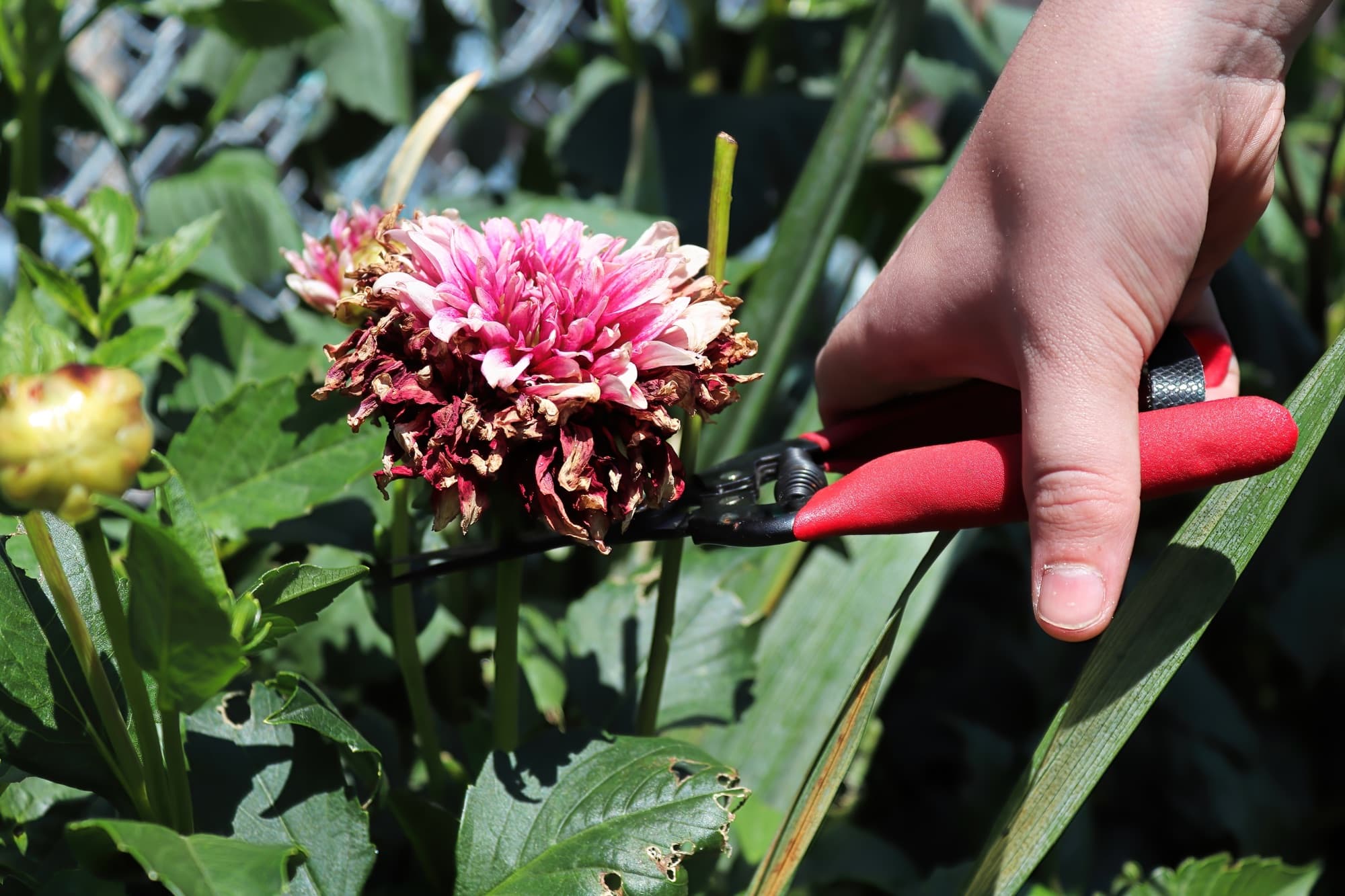
- Use a sharp implement such as secateurs to remove the spent flower heads
This process is explained in more depth below:
When To Deadhead Dahlias

Dahlias should be deadheaded as soon as the first flowers finish, which can be as early as July and until they finish flowering at the beginning of winter.
1) Identify Spent Flower Heads From New Buds

The trick to successfully deadheading dahlias is to first identify the spent flower heads from the new flower buds, as once the spent flowers’ petals have finished and dropped, they can look rather similar.
However, there is thankfully a sure-fire way to help differentiate between them.
New flower buds are slightly flat and round, a bit like a miniature satsuma, whereas finished flower heads are cone-shaped and almost pointed.
Remember, if you want to try growing dahlias from seeds, you should not deadhead your plants, as this will cut short this process.
However, note that “dahlias will not come true from seed,” David warns.
“For that, you either need to divide the tubers or take cuttings.”
2) Remove The Spent Flower Heads

Once the spent flower heads have been identified, use a clean and sharp pair of secateurs or snips and cut off the dead flower and its stem just above a leaf or where it joins a main stem.
Otherwise, the flower’s stem will be left in place to die back and look unsightly.
“You can distinguish a new Dahlia flower bud from a spent flower as new flower buds are tight balls on a stem that sometimes have a flat top to them, with the top gradually opening up into a bloom,” explains Dan Ori, a Master Horticulturist.

“With spent flowers, the petals droop and the sepals of the flower will close back up, looking very similar to new buds but more cone-shaped.
“So, new buds look like balls and spent flowers look like little strawberries.”
Tiny new buds may be seen just below where the cut is to be made, which will encourage these new buds to burst forth.

To promote continuous flowering, dahlias need to be deadheaded regularly, especially the smaller flowered varieties that produce copious amounts of blooms all at once.
Every 2 – 3 days is ideal or once a week at the very least.

Deadheading dahlias for months on end can seem a bit of a chore, especially when planted en masse.
However it’s worth it to have them bloom all season, especially into the autumn when most other perennials have finished, and the spent blooms are perfect for adding to the compost.