IN THIS GUIDE
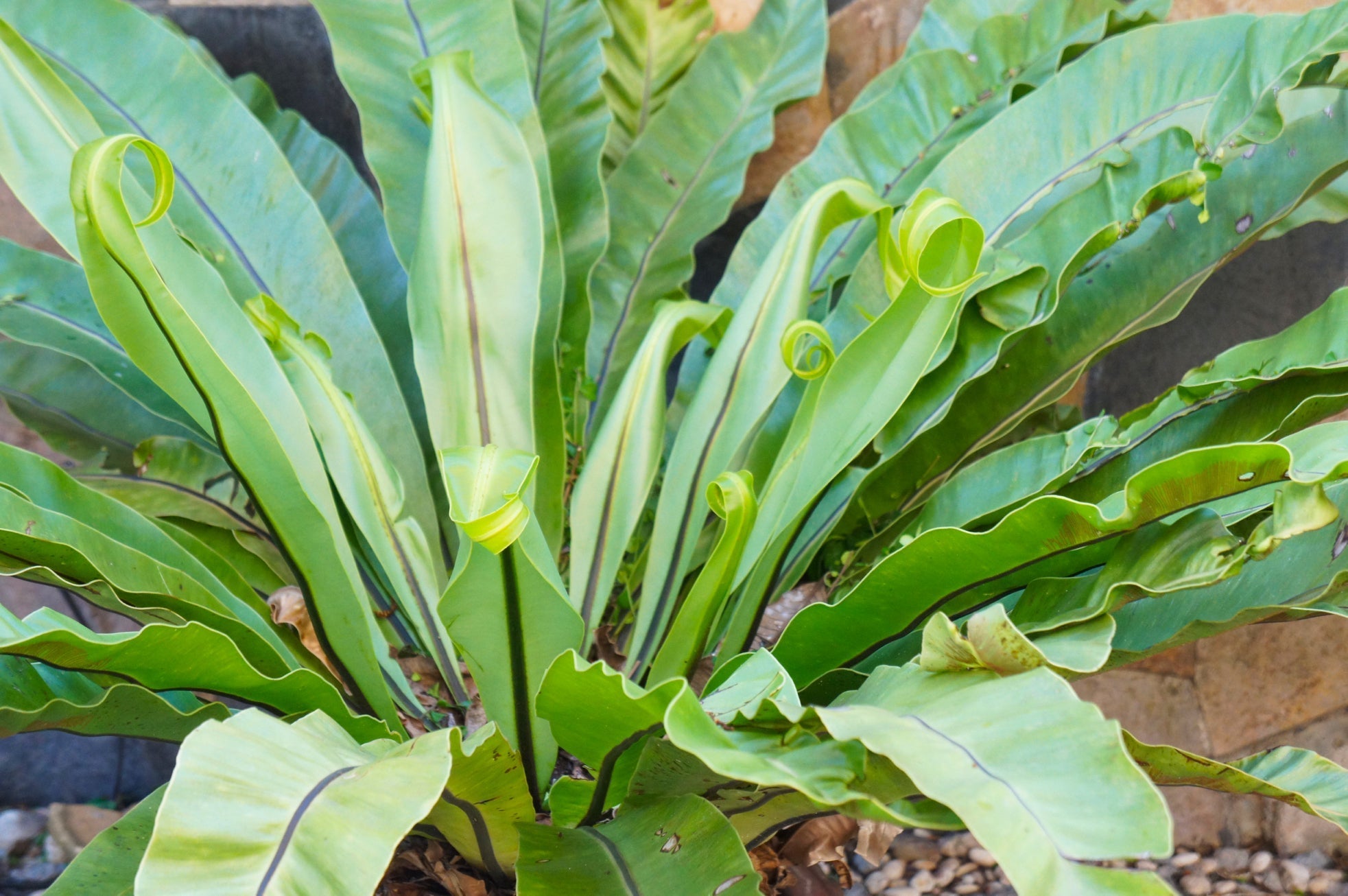
Bird’s Nest Fern is an attractive evergreen fern commonly grown as a houseplant here in the UK.
If you are looking for a lush houseplant for a warm and humid location inside your home then this could be a good plant to consider.
It is relatively easy to grow as long as suitable conditions are provided, and can look good within your home throughout the year.
Overview
| Botanical Name | Asplenium nidus |
| Common Name(s) | Bird’s Nest Fern; Spleenwort |
| Plant Type | Fern |
| Native Area | Southeast Asia, Eastern Australia, Pacific Islands, India & East Africa |
| Hardiness Rating | H1B |
| Toxicity | None |
| Foliage | Evergreen |
| When To Plant | Any time of the year |
This epiphytic fern is in the Aspleniaceae plant family.1
It is widely referred to as bird’s nest fern, or simply nest fern – a name which it shares with some other Aspleniums.
In its native habitat, it can survive either as an epiphyte or terrestrial plant, but usually grows from organic matter.2

It may be found on palms, where it collects water and nutrients in its leaf-rosette.
In Taiwan, bird’s nest fern is eaten as a vegetable, often cut into inch-long pieces and stir-fried with garlic and chillies.3
However, in the UK, it is commonly grown as an ornamental houseplant, prized for its long crinkled fronts.
Common Cultivars
Asplenium nidus has a Royal Horticultural Society Award of Garden Merit.
There is not a huge range of different types, but there are a few cultivars which differ from one another in their leaf shape.
‘Antiquum’

Has wavy, edged leaves.
‘Crispy Wave’

Has ruffled, sword-like leaves.
‘Osaka’

Has narrow leaves with rippled edges.
‘Victoria’

Has wavy, long, tongue-shaped foliage.
Asplenium Care
These ferns will usually be happy as long as you provide them with the conditions they need.
Soil Conditions
These plants thrive in a moist but well-drained growing medium with added grit.

The RHS recommends a mix of loam, coarse leaf mould or coir and charcoal for optimal results, but a typical peat-free compost of good quality with added grit can also work well.
The mix must be rich in organic matter and have excellent drainage that will still retain sufficient moisture.
Light
A. nidus requires bright but filtered light so should be placed out of direct sunlight which can burn the leaves.
An east or north-facing window can be the ideal place for one of these houseplants within your home.
Watering
This fern needs a moderately moist growing medium, but it will not do well if left sitting in waterlogged conditions.

You should water well whenever the top 2cm of the potting mix is dry.
Make sure you direct the water where it is needed and avoid aiming water at the centre of the rosette as, if water lingers there at the centre of the plant, this can cause fungal issues and rot.
Temperature & Humidity
Bird’s nest ferns will thrive in temperatures between around 15-25°C, though they can tolerate temperatures down to around 10°C.
Make sure that your plant is protected and is not subjected to colder temperatures, especially for prolonged periods.

Creating a suitable humid environment is also important and these ferns will thrive in a high-humidity location, such as a bathroom or kitchen.
If you cannot provide this, then you will need to mist the plant regularly to ensure that humidity is high enough for these plants to thrive.
Fertilising
It is a good idea to feed bird’s nest ferns with a balanced, organic liquid feed (such as a compost tea) diluted to half-strength to avoid any nitrogen burn.
This feed should be used every month or so when watering your plant throughout the growing season which is usually between April and September.

Make sure that you do not apply the feed to the leaves but directly into the soil, as direct contact can damage the leaves.
Common Issues
Fronds naturally turn brown and are replaced over time with fresh foliage as this is a natural part of the plant’s life cycle.
However, browning foliage may also be due to drafts or drying.
If leaves turn yellow, this can be a sign that you have applied too much fertiliser or a sign that the foliage has been damaged by direct sun.

Typically, bird’s nest ferns are not particularly prone to pest or disease problems, though they can have some issues with pests like scale insects with which houseplant owners may well be familiar.
However, growing these plants organically is particularly important, since the leaves are very fragile and can be damaged by products like chemical pesticides, and you should also be very careful not to touch the new fronds that form, as they can be damaged very easily.
Propagating
The propagation of ferns like this is not the easiest job for novice gardeners.
The plants propagate not by means of seeds but through spores, which form like fuzzy spots on the bottom of the fronds.
However, if you would like to give it a go, cut a frond with natural fuzzy spots and place it in a paper bag.

The spores will drop into the bag and a couple of days later, you can take those spores.
Place them on top of some moss in a dish of water, keeping the moss moist but not waterlogged and put it in a shaded spot.
New plants should appear within a few weeks.
References
1. Simpson, M. L. (2019b). Evolution and Diversity of Vascular Plants. Elsevier EBooks, 75–130. https://doi.org/10.1016/b978-0-12-812628-8.50004-3
2. Asplenium nidus. (n.d.). Ferns of Sulawesi. Retrieved March 9, 2023, from https://sulawesiferns.myspecies.info/taxonomy/term/7634/descriptions
3. (2020b, March 4). Ferns on your plate. Taipei Times. Retrieved March 9, 2023, from https://www.taipeitimes.com/News/feat/archives/2016/01/09/2003636762