

IN THIS GUIDE
An elegantly ornamental plant with great cultural significance in the Far East, the Camellia used to be a firm favourite of the European High Society in the mid-Nineteenth Century.1
Then the American South made the Camellia its own.
Camellias are – of course – highly valued in their native lands of East Asia and South-East Asia where they are not only popular but are an element of the cultures of the nations.2
In our Camellia guides, we feature:
- Patricia Short – UK Membership Representative of the International Camellia Society.
- Lorraine Summers – Owner of Trehane Camellia and Blueberry Nursery.
“By carefully selecting camellia varieties, you could have a garden full of blooms from October to May, when their colour can provide some much-needed happiness and pollinators can use them in abundance”.
“Additionally,” says Patricia: “camellias can be left to grow into trees – nice specimens for a garden – or pruned to suit one’s needs.
“One doesn’t have to fuss over camellias.”
Overview
| Botanical Name | Camellia |
| Plant Type | Shrub |
| Native Area | East / South Asia |
| Hardiness Rating | H5 |
| Foliage | Evergreen |
| Flowers | Solitary or clustered flowers |
| Flowering Months | January, February, March, April, May, October, November, December |
In general, Camellia plants are evergreen shrubs, mostly of upright habit though a goodly number are rounded or spreading.
Their heights typically range from 2-5m though old, well-cared-for plants are much taller.
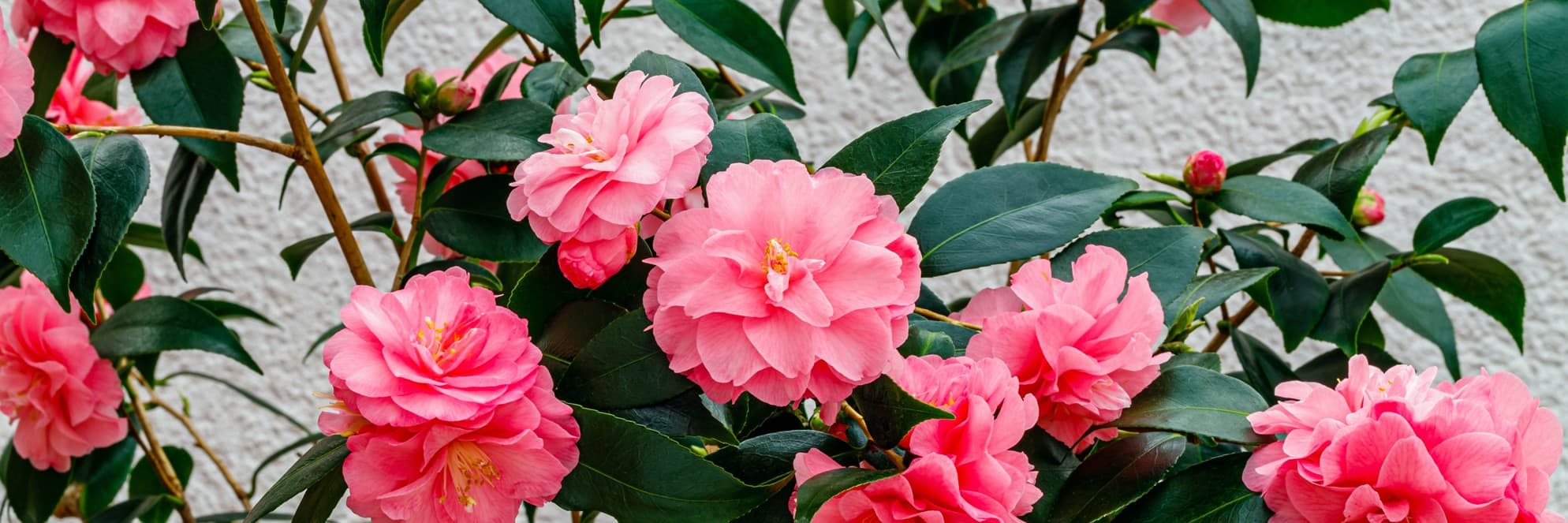
The simple leaves are usually thick, glossy and of a deep green colour.
Many, though not all, Camellia varieties present very well as both the plant and the flower have a neat, manicured, and symmetrical appearance, especially the varieties of upright habit and flowers of Formal Double form.

The flowers are large and showy and single-form flowers have prominent yellow stamens.
Many cultivars, including the most-prized ones, have semi-double or double corollas.
The double forms are divided into a further three sub-forms but the ‘real’ double form is ‘Formal Double’.

Formal double-form flowers do not display stamens.
Their colours include white, off-white, and various shades of pink, rose, red, and fuchsia.
Some varieties are double-coloured, these coming in striped, variegated and dappled styles.

When other plants are dormant or dead, Camellia comes into its own and blooms.
A smartly-chosen mix of Camellia varieties will reward you with colourful flowers from at least October through March.
Habitat & Growing Conditions
In the wild, both C. japonica and C. sasanqua are found at elevations of up to 1,000m in the wooded and forested regions of China, South Korea, and the south of Japan. They grow in acidic soils.

In Japan, C. japonica is adapted to freezing temperatures and snow.
They rejuvenate and flower after the passage of winter.
Aspect
Camellia species do not favour full sun though most species will grow and even thrive in full shade.
Their preference is for part-sun, part-shade exposure where they are sheltered from the mid-day and afternoon sun.
Indeed, they are accustomed to this type of shelter in their native woody and forested habitats where they are also shielded from strong, cold winds.
Hardiness
The vast majority of Camellias are H5 hardy in the United Kingdom – meaning they are able to survive in all but the coldest areas of the British Isles.
Camellia cultivars that are hardy in sub-freezing temperatures are identified by the word ‘Winter’ in their names.

Planting Camellia
Camellias may be planted in pots but at some point these long-lived plants will need to be transplanted to larger containers or into the ground.
Where To Plant
Whilst care should be taken to stake young camellias and to limit exposure to cold easterly winds, mature camellias can withstand windy conditions,” explains Horticultural Consultant Colin Skelly.
“When camellias first arrived in the UK, they were considered glasshouse plants, but we are slowly realising that they are far hardier and tougher than first thought.”
They are best grown in a location of partial shade where they are shielded from the afternoon’s hot sunshine though they will happily thrive in shadier locations too.

Seedlings and growing plants need such sheltering even more than mature plants. Plants should also be protected from stiff, cold winds.
In view of their preferences, Camellias should be planted under the shade of larger plants or trees or close by some structure or a wall.
Optimally these plants should be shielded from the southern sun in the summer and from north winds in winter.
When To Plant
The ideal time to grow Camellia is in spring for a ‘triple play’.
The flowering season is over, the cold winter has departed, and new plants can get established before the return of winter.
References
1. Europe. (n.d.). International Camellia Society. Retrieved March 13, 2023, from https://internationalcamellia.org/en-us/our-organisation/europe
2. Camellia japonica. (n.d.). Kew Royal Botanic Gardens. Retrieved March 13, 2023, from https://powo.science.kew.org/taxon/urn:lsid:ipni.org:names:828524-1



