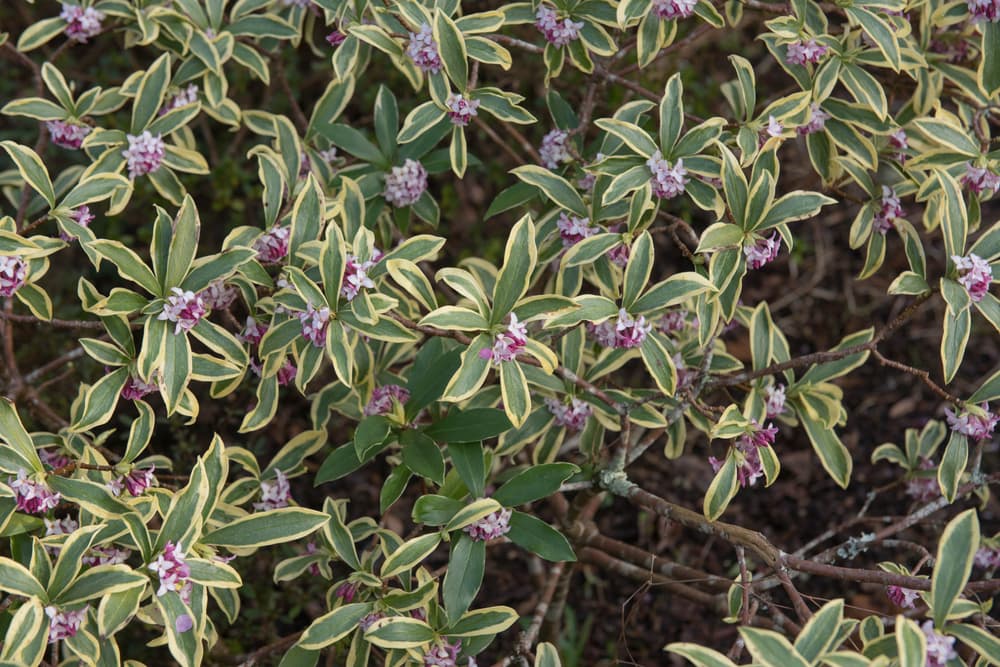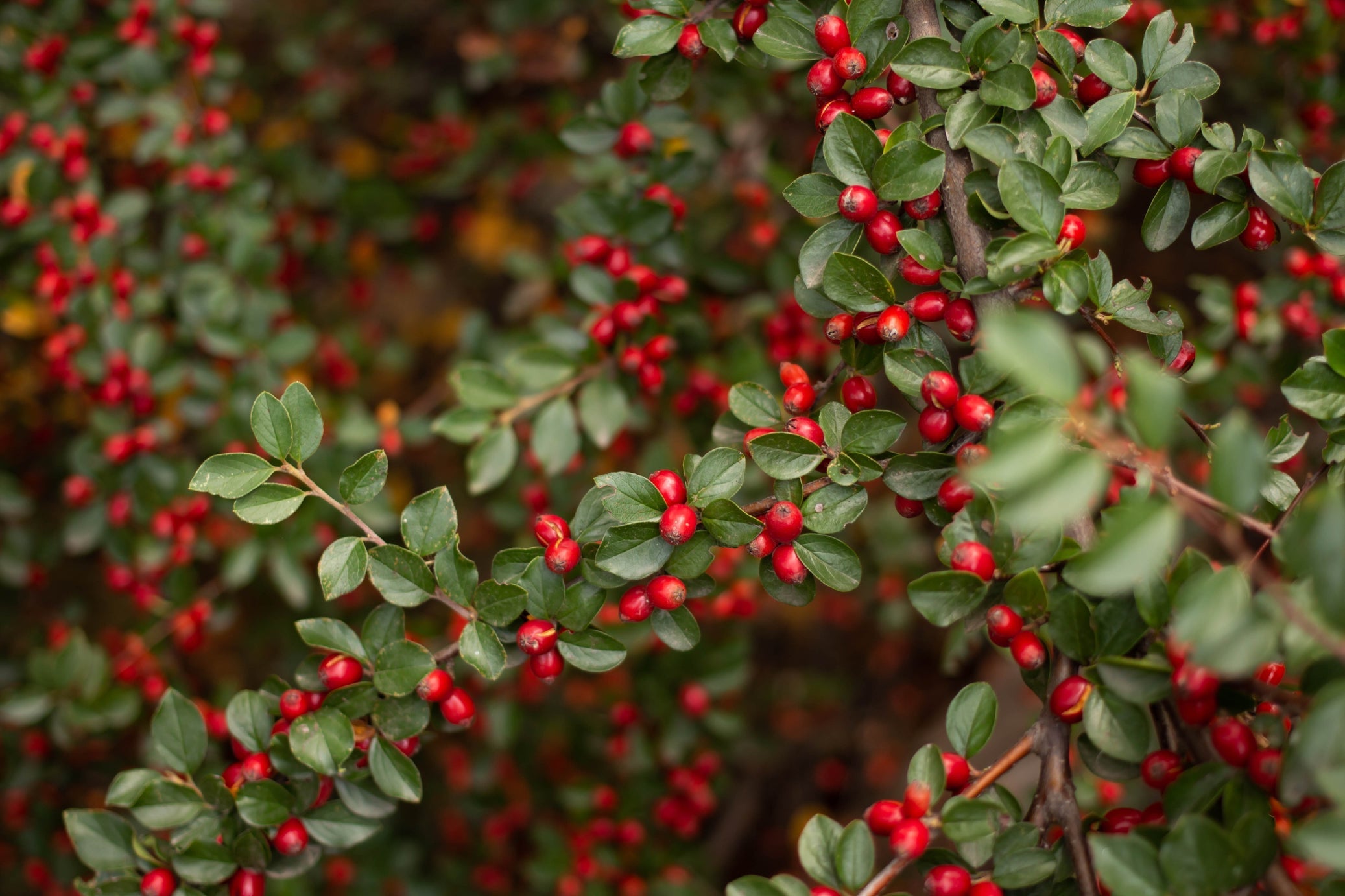
Cotoneasters are a huge range of border and wall shrubs which can work well for year-round interest and wildlife-friendliness in many gardens.
While it should be noted that some cotoneasters, such as C. horizontalis, are considered invasive species in the UK and can pose a threat to rural ecosystems, many cotoneasters can actually be great choices for British gardens.1
Overview
| Botanical Name | Cotoneaster |
| Plant Type | Shrub |
| Native Area | Temperate Asia, Europe & Northern Africa |
| Hardiness Rating | H6 |
| Foliage | Evergreen |
| Flowers | White or pink |
| When To Plant | September |
| When To Prune | March |
Cotoneasters come in a range of shapes and sizes.
Some are large shrubs, or even small trees, while others grow only a short height above the ground and make a great ground cover.
Some are great for garden borders, whilst others are wall shrubs that can be used to cover a wall or fence.
They are native to temperate Asia, Europe and North Africa, with flowers that can range from white through pink, and are followed by vibrant berries in a range of hues.

Many cotoneasters are evergreen, providing visual interest all year round.
A small number of varieties are considered to be problematic, invasive non-native plants.
Invasive species are best avoided by gardeners, as they can be spread to wild ecosystems and have a negative impact on native ecology.
Some invasive species to avoid are:
- C. bullatus
- C. horizontalis
- C. integrifolius
- C. microphyllus
- C. simonsii

Fortunately, there are plenty of other cotoneasters to choose from and these can be hugely beneficial for local wildlife.
“Bees will cover flowering plants in the spring and birds will enjoy the berries right into the winter,” shares Master Horticulturist Roy Nicol.
Common Varieties
If you are looking for a cotoneaster that will be a good border shrub for your garden, here are some good options to consider:
- C. amoenus
- C. frigidus ‘Cornubia’
- C. lacteus
- C. procumbens ‘Queen of Carpets’
- C. rhytidophyllus
- C. ‘Rothschildianus’
- C. salicifolius ‘Avonbank’
- C. salicifolius ‘Pink Champagne’
- C. aff. sternianus
- C. x suecicus ‘Coral Beauty’

If you are looking for a wall shrub, I’d recommend:
- C. conspicuus ‘Decorus’
- C. franchetii
Planting Cotoneaster
Cotoneasters are planted like any other shrub.
- Prepare the soil well and add plenty of organic matter.
- Dig a planting hole large enough to accommodate the root system.
- Make sure that the shrub is planted at the same depth that it was in the pot it came in.
- Firm in the soil around the base of the plant and water it in thoroughly.
- Mulch with organic matter such as garden compost or bark.
Cotoneasters are best planted out in early autumn, when the soil is still warm after the summer, yet reasonably moist.

When planted at this time, the plants have time to develop strong root systems by the onset of winter.
Cotoneaster Plant Care
Cotoneasters are incredibly unfussy and low-maintenance shrubs that can work well for many gardens.
If you choose the right cotoneaster for your space, it really won’t need all that much care at all.
Soil & Fertilising
Cotoneasters require rich soil with plenty of organic matter, which is moist yet free-draining.
They can also cope with more free-draining conditions as long as their nutrient needs are met.

Most soil types will be suitable, and pH levels are not really important.
It is a good idea to mulch around your shrub when planting and to replenish the mulch each spring.
Other than this, additional fertilisation will not typically be required as these plants will more or less look after themselves.
Light, Temperature & Exposure
Cotoneasters can cope with various conditions when it comes to light levels, from full sun through to partial shade, just as long as the shade is not too deep.
Watering
Cotoneaster should be watered well during their first year whilst they become established.

Don’t let the soil dry out during prolonged periods without rain.
After the shrubs become established, they will not usually require additional watering as natural rainfall should be sufficient.
Pruning
How much pruning your cotoneaster will require and how it should be pruned will depend on the variety you are growing.
Cotoneasters can have a range of different growth habits and forms.

Most cotoneasters will benefit from regular pruning to keep them dense and well-formed, though those grown as small trees usually don’t need much pruning at all.
Usually, evergreen types are pruned in early spring and deciduous types a little later, just before spring growth begins.
Cotoneasters are usually relatively tolerant of hard pruning, though flowering and berries may be reduced after a hard cutback.
Companion Planting
Cotoneaster can be combined in beds and borders with many other plants.

Many cotoneasters look great at the back of a border, alongside conifers, rowan trees, holly, Chaenomeles japonica, mahonia and many other shrubs.
Be sure to consider the eventual size of the cotoneaster you have chosen before planting it with other shrubs.
Propagation
Cotoneasters can often propagate themselves through layering, which is when a plant’s stems touch the ground and form new roots.
These rooted sections can easily be removed from the parent plant and transplanted somewhere else in your garden.

Other methods of propagation for cotoneasters include taking softwood cuttings of deciduous types and semi-ripe cuttings of evergreen varieties.
Common Problems
Cotoneasters tend to be mostly trouble-free, though some cultivars can be susceptible to a bacterial disease called fire blight.
If your plant does get fire blight, affected stems should be promptly pruned out and disposed of, ensuring tools are cleaned afterwards.
If allowed to spread the disease will soon kill the plant as no chemical controls are available.
Why Are My Cotoneaster Shrubs Turning Brown?
Remember that some Cotoneasters are deciduous and this may just be a natural part of their life cycle.

However, if the leaves of evergreen cotoneaster are turning brown, this could be due to a lack of water.
Unfortunately, it could also be fire blight, and all affected plants should have affected growth pruned out, or whole plants removed and carefully disposed of to prevent its spread.
References
1. Cotoneaster. (n.d.). The Wildlife Trusts. Retrieved March 14, 2023, from https://www.wildlifetrusts.org/wildlife-explorer/trees-and-shrubs/cotoneaster