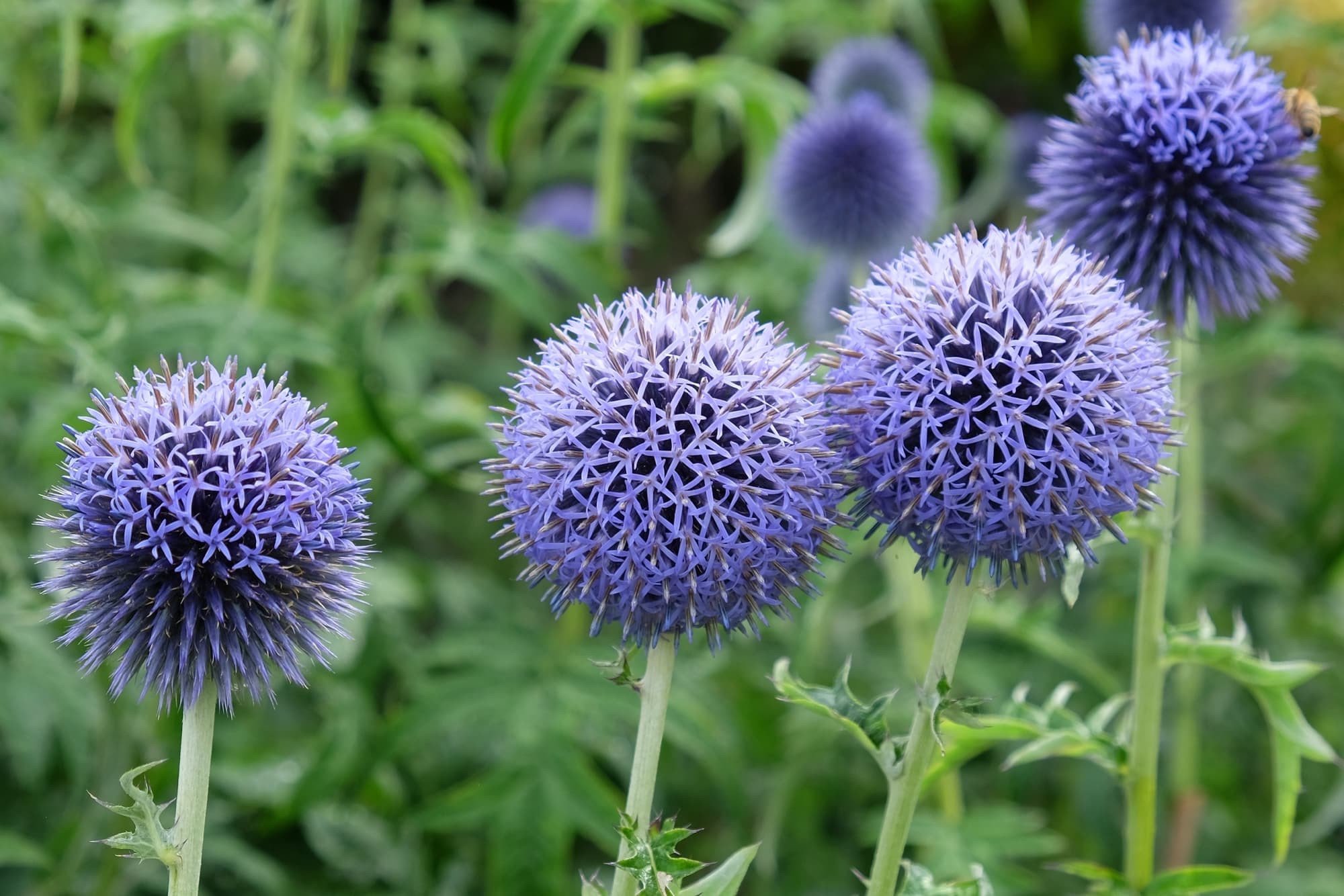
The blue or white spherical flower heads of Echinops can bring a sense of the Mediterranean to a garden.
Also known as ‘Globe Thistles’, these are plants that can fit in alongside many other Mediterranean plants in a sun-kissed part of a garden.
Echinops grown in UK gardens are usually herbaceous perennials that will provide great value in a garden space over a number of years.
Most have flowers held in circular heads with a purplish-blue hue, while some cultivars have white flowers.
Overview
| Botanical Name | Echinops |
| Common Name(s) | Globe Thistle |
| Plant Type | Perennial |
| Native Area | Mediterranean |
| Hardiness Rating | H7 |
| Foliage | Deciduous |
| Flowers | Spherical blue or white flowers |
| When To Plant | May to June |
Echinops largely come from Southeastern Europe, though their native range also spreads into Asia and some are also found in mountains of tropical Africa too.1
Their common name, ‘Globe Thistle’, comes from their spiny foliage, but though they are called globe thistles, they are not closely related to the true thistle species.

The name Echinops comes from the Greek for a hedgehog.2
These plants are prized in gardens for their flowers and their stature.
They pair well with a range of other common plants in cottage gardens, gravel gardens for low-water areas, wildlife gardens perfect for pollinators and plenty of other flower beds and borders.

They are a good choice for loose, organic, prairie planting alongside other herbaceous perennials and ornamental grasses, but also work well in much more formal and orderly planting schemes.
How To Grow Echinops
Echinops is relatively easy to grow as long as you pay attention to its basic needs.
When positioned and cared for correctly, this plant can certainly make for a great choice for a low-maintenance space.
As perennials, they should remain in place and grow back each year over multiple years and these plants can also self-seed readily in a location where they are happy to grow.
Sowing
Echinops seeds should be sown in March or April.
They can be sown indoors in pots or seed trays or in a well-prepared seedbed outside.

You can also directly sow the seeds where they are to grow if the conditions are suitable in your garden.
Some gardeners also sow in the autumn, but in my opinion, sowing in spring in the UK generally gives better results.
If sowing indoors, transplant the Echinops to the garden after the last frosts where you live.
Planting
Above all else, when choosing a location in which to grow Echinops, remember that, though hardy, it comes from southern Europe and likes Mediterranean conditions.
That means planting it in full sun or light shade will get the best results.
There are not really particularly hard and fast rules when it comes to spacing Echinops, though generally seedlings are placed around 30cm apart.
This may vary a little depending on which variety or variety of Echinops you have chosen to grow.
Soil Requirements
Echinops need moist but free-draining or free-draining soil and will do best in moderately poor soil which drains very freely.

Make sure that you dig a generous planting hole for the plants you wish to place in your garden and where the soil is not as free draining, add grit to ensure that waterlogged conditions do not arise.
Planting For Pollinators
Grow Echinops in your garden and you will soon discover that they are surrounded by bees, butterflies and other pollinators throughout their flowering period.
“Echinops are a great plant for pollinators,” states Master Horticulturist Colin Skelly.
“Regardless of the cultivar, they are always covered in a range of pollinating insects, persisting into early autumn in most parts of the UK.”
These flowers are not native, but they do attract and provide pollen and nectar for a wide range of our native insect life.
While it is always a great idea to include a high proportion of native flowers in your garden for the bees and other wildlife, mixing in some non-natives (including Echinops) is not a bad idea and can simply add to the biodiversity within the garden.
Echinops Care
Once established, Echinops growing in a location that provides the right growing conditions generally will not require a great deal of care.
However, there are some key elements to consider.
Watering
One important element of care is watering.
Echinops should be watered in well and watered during prolonged dry spells, especially as they become established.

Once established, however, these are fairly drought-tolerant plants.
In fact, they can cope much better with dry conditions than they can with overly wet situations, so take care not to overwater your plants.
Cutting Back
Another of the jobs to do when growing Echinops is to cut them back after the first blooms have faded.
This is not only to tidy up the garden but also can sometimes encourage a further flush of blooms to develop.
If the plant clumps become too congested, you can lift and divide them to propagate new plants and give the existing plant a new lease of life.
Common Problems
One of the most common problems when growing Echinops, which are generally trouble-free and not prone to many pests or diseases, is an aphid infestation.
Aphids should be welcomed in an organic garden along with their predators who will keep their numbers in check and the ecosystem in balance.

In a healthy, organic and biodiverse garden, aphids will rarely get out of control and won’t typically pose a major threat to your Echinops or to other plantings.
In terms of environmental problems, poor drainage is perhaps the thing that most commonly derails successful Echinops growing.
Making sure that there is adequate drainage in the ground or in containers is one of the most important things when growing these plants.
Container Growing
You can grow Echinops in pots and they can be good candidates for a container garden.
Smaller, shorter cultivars might generally be considered better choices for pots but any cultivar should be fine either on their own or with other plants that similarly like sunny and free-draining conditions.
When choosing a container, make sure that it is sturdy enough to stand up and not tip over when growing taller cultivars.
A terracotta or clay pot can be ideal because it will not retain water as much as a plastic one.

Make sure it allows water to drain out freely at the base so that waterlogging cannot occur.
Fill your chosen container with a suitable peat-free growing medium with added grit or sand to improve drainage.
A soil-based option is best for perennials that will remain in their pots over multiple years.
Note that in pots, as in the garden, Echinops that are taller may require staking or some support, especially if they are grown in a somewhat windy location.
Common Varieties
Some common varieties of globe thistle to consider growing in your garden are:
E. bannaticus

E. exaltatus

E. ritro

E. sphaerocephalus

References
1. Echinops ritro. (2021, August 4). Cambridge Botanic Garden. Retrieved July 5, 2023, from https://www.botanic.cam.ac.uk/the-garden/plant-list/echinops-ritro/
2. All About Echinops. (2022, July 28). Retrieved July 5, 2023, from https://www.americanmeadows.com/perennials/unique-perennials/all-about-echinops