Rudbeckia, commonly known as ‘Black Eyed Susan’ is a plant you have probably seen before, although you may not have known it by name.
Its familiarity is down to the fact that this lovely sunshine yellow bright flower is commonly found growing wild in fields and meadows throughout the UK and USA.
It is a native species of North America and, you possibly won’t be surprised to hear, a fully-paid up member of the sunflower family.1
“Rudbeckia tops the list of my favourite plants for its abundant, long-lasting and hugely reliable flowers, which open like small sunflowers in a domed mass,” says Matt Collins, a Garden Writer.
“Provided it gets a good dose of sunshine, it’s just the most rewarding and unfussy of plants, with long-stemmed blooms that also make fantastic cut flowers.”

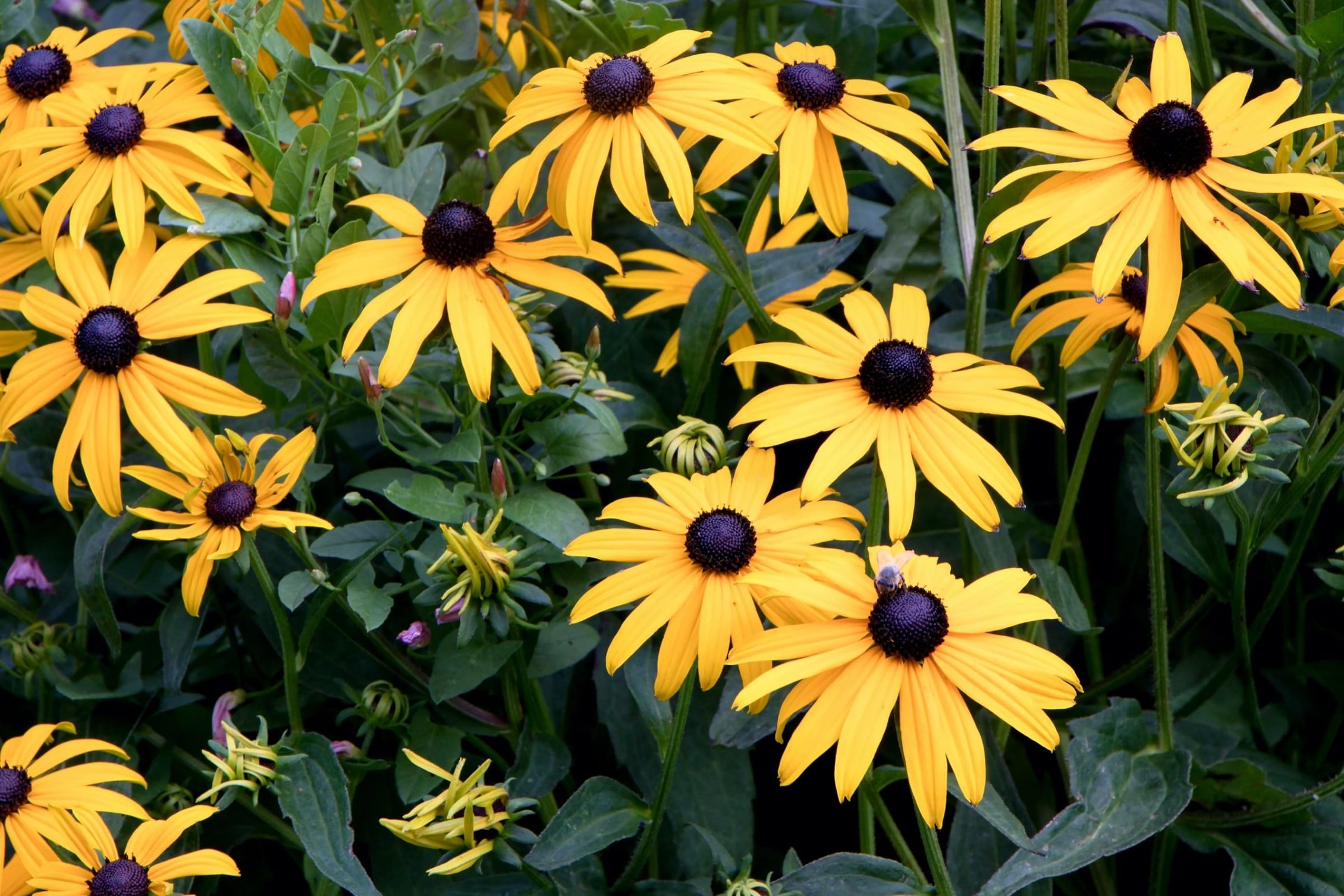
This pretty daisy-like bloom with its yellow petals and dark inner circle (hence the name) is actually a pretty powerful plant.
So powerful, in fact, that it will tend to eventually outgrow most other plants in its wake.
Butterflies and bees use it for nectar – other garden animals including birds also feed on the seed heads.
This is another reason why the plant is so prevalent – the birds and insects spread them as they fly back to their nest (with the seeds as food).
“It’s a plant that a lot of people don’t love, but the Rudbeckia genus is one of my favourite species of plant,” shares Lee Burkhill, the Garden Ninja.
“It flowers in late summer with typical daisy flowers that are bright and light up a garden. People love it or hate it because its colours are so intense.
“It will pretty much tolerate every soil, so for new gardeners, it is great.”
Overview
| Botanical Name | Rudbeckia |
| Common Name(s) | Black Eyed Susan, Coneflower |
| Plant Type | Perennial Flower / Annual Flower |
| Native Area | North America |
| Hardiness Rating | Mostly H4-H6 |
| Foliage | Herbaceous, simple or pinnately divided leaves |
| Flowers | Daisy-like flowers, yellow for perennial types, other colours for annuals and biennials |
| Flowering Months | June, July, August, September |
Rudbeckia isn’t just grown wild, of course; you will also find it in gardens up and down the country where it is often used for creating colourful and attractive borders.

In addition, its cheerfully bright blooms are also a favourite of many high-street florists.
“I love to photograph Rudbeckias, which often have contrasting velvety textures that make you want to touch them,” shares award-winning Garden Photographer Molly Hollman.
With both summer annual and perennial varieties, Rudbeckia comes in a number of different types and beautiful jewel-like colours.
You will certainly find blooms appearing in shades associated with an Indian Summer, such as gold, orange, rust and yellow.

New hybrid versions are equally as colourful and arresting with their shades of emerald green and bright pink.
In essence, Rudbeckia is a very pretty flower which is colourful, easy to grow and low-maintenance.
The plant self-propagates so even if you leave it be, chances are it would still bloom prolifically in your garden.

As a result, it is loved by the majority of gardeners, both amateurs and experienced types on both sides of the Atlantic.
“Perennial Rudebckias are a mainstay of herbaceous borders and are particularly popular in prairie style and matrix planting with grasses,” shares Colin Skelly, a Horticultural Consultant.
“They are well suited to naturalistic planting, and the range of sizes and colours makes them popular for other styles of planting too.
“Rudbeckia is prone to slugs and snails when a young plant, but is more robust when established.”
Plant Care
Although Rudbeckia is capable of withstanding drought conditions, the flowers will grow better if they are watered when necessary.
In other words, it is really not a good idea to let them dry out – not, that is, if you want to see them flourishing and brightening up your borders.

Dividing older plants doesn’t just ensure you have healthier blooms, but that there isn’t too much spreading through self-seeding.
Habitat & Growing Conditions
Rudbeckia should always be planted in the sunniest spot in your garden.
Or, if that’s not available then in a spot that has some shade, but also access to the sun at times.

The soil is important too; preferably moist but not susceptible to becoming waterlogged following periods of intense rain.
Heavier soil can be used, provided you surround the plant’s roots with plenty of good compost.
Container Growing
Make sure your container pot is at least 45cm wide and 30cm deep.
It should also have plenty of decent-sized drainage holes at the bottom.
This will ensure that the soil will remain moist but not waterlogged (as this would kill-off the plant).

Any type of decent multipurpose compost is fine.
Feed after two weeks then every three to four weeks after this.
Incidentally, one of the best varieties of Rudbeckia to grow in containers is ‘Toto’, the dwarf version, since it doesn’t need as much room as the others.
How To Grow Rudbeckia
Start growing the seeds in a greenhouse or at least indoors, during the months of February, March and April.

Expect to wait up to three weeks for them to germinate.
Then, as they grow either thin them out to around 30cm space in between or put them into pots.
Finally, move them into their final positions when the root balls are strong and large enough to transfer.

If you’ve tried both methods of growing (directly planting into the soil and transplanting), then you have probably noticed that directly sown seeds will often not flower until their second year, while transplanted rootballs will bloom within the first 12 months.
References
1. Rudbeckia. (n.d.). Kew Royal Botanic Gardens. Retrieved March 23, 2023, from https://powo.science.kew.org/taxon/urn:lsid:ipni.org:names:329766-2