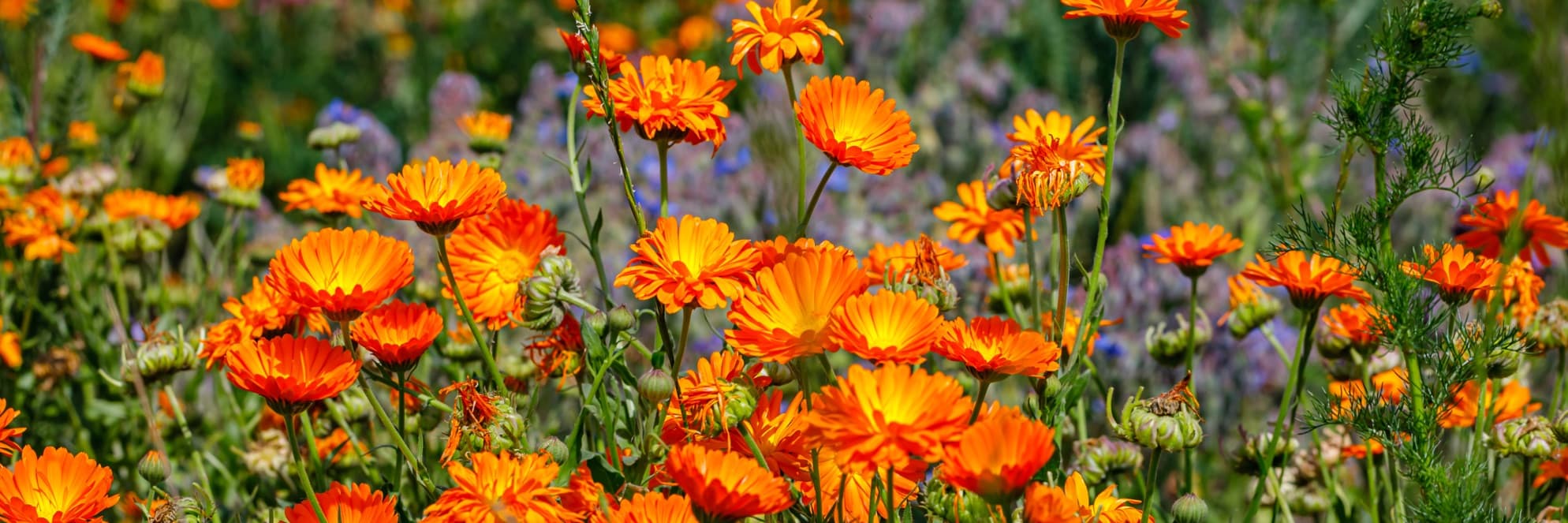
In single through double forms and in tones from softest yellow to deepest orange, calendula is genuinely pretty.
The Calendula genus is a member of the very large Aster family and it probably shows in the disk-shaped daisy-like flowerheads.
Indeed, Calendula arvensis flowers simply look like a yellow daisy!

The most well-known Calendula species and the one from which almost all cultivars descend is C. officinalis, popularly known as ‘Pot Marigold.’
All told there are only 15 to 20 species in this small genus.1
Overview
| Botanical Name | Calendula officinalis |
| Common Name(s) | Pot Marigold, Common Marigold |
| Plant Type | Annual / Biennial |
| Native Area | Western & Central Europe, South Asia, Northern Africa |
| Hardiness Rating | H5 |
| Foliage | Bushy, deciduous, simple alternate leaves |
| When To Sow | March, April |
| Plant Out | After last frost |
‘Pot Marigold’ is not to be confused with what one may call the ‘Marigolds Proper’ which bear fully double semi-dome-shaped golden flowers and which are members of a different genus, Tagetes.
Calendula species are herbaceous deciduous plants and a given species may be an annual, biennial or short-lived perennial, depending on the climate it is grown in.
C. officinalis and its cultivars are biennials or short-lived perennials but are usually treated as annuals in the UK and other temperate regions.

The Calendula flower – like those of other members of the Aster family – is actually an inflorescence or a composite flowerhead made up of innumerable tiny flowers.
It has two parts, the capitulum, which is the central disk, comprising numerous disk florets, and the ‘petals’ which are actually individual ray florets.
The colours are sunny and golden, verging from a light bright yellow to deep rich orange.
Some varieties produce bi-coloured or graduated flowers, and a few varieties produce flowers with pink or reddish edging.
A few new varieties produce creamy and pinkish flowers.
Habitat & Growing Conditions
The Calendula genus is native to Western and Central Europe, South Asia, and Northern Africa.2
The ‘original’ native range of C. officinalis species is restricted only to Spain and the Western Mediterranean region; in stark contrast, the range of countries it has been introduced to spans nearly the whole world including even some sub-tropical and tropical regions.3

It was naturalised in the British Isles no later than the 10th century when it was primarily grown in cottage gardens for use in pot cooking.4
It grows in the wild near inhabited areas in sheltered locations.
Why Grow Pot Marigolds?
The ‘Pot Marigold’ flower has an aroma rather than a scent or a fragrance per see.
The aroma is less like what one expects from a flower and somewhat like the resin or sap that may ooze from tree bark with a note of spice.
Conversely, from a visual standpoint the ‘Pot Marigold’ bloom verily epitomises flowers – if a child is asked to draw a flower, they will end up drawing something that closely resembles a Pot Marigold!

Having sung the plant’s praises, it would be remiss not to mention a few other qualities.
So, to round up, C. officinalis and its cultivars are valued for their long flowering seasons – some varieties bloom all through summer and past autumn.
They number among the more pest-resistant and disease-free plants, being affected by no more than a couple of problems.

They are hardy to H5, and you can grow them as biennials most anywhere in the United Kingdom.
“Typically however they are grown as ‘half-hardy annuals’, started from seed in the early spring and dug up after the first hard frosts,” adds Roy Nicol, a Master Horticulturist.
Finally, these plants really do – to use a well-worn gardener’s phrase – thrive on neglect.
Where To Grow Calendula
C. officinalis and its cultivars are not the most beautiful of ornamentals but they are innocently and charmingly pretty in their own right and are ideally suited to cottage gardens and country gardens.
The flowers’ open, sunny presentation make them excellent choices for potted plants situated on the patio or the balcony.

Commonly considered a very fine bordering plant, consider that C. officinalis varieties range in heights from 25-50cm and bear single through fully double flowers in pale yellow through vibrant, rich orange.
As a result, one or another appropriate variety will be well-nigh perfect as edging, border, or centrepiece!
If you can manage the two plants’ somewhat differing water needs, pair them with bluebells to set up marvellous complements in floral forms and colours, while mixing and matching heights.

Perhaps above all, C. officinalis is recognised as a first-rate companion plant in the herb and vegetable garden.
It draws some pests away from veggies which they’d otherwise destroy and entirely repels other pests including harmful nematodes.
Tomatoes, cucumbers, beans and asparagus are among the vegetables that greatly benefit from having Pot Marigolds as companions.

Calendula Care
There is nearly nothing to cultivating Pot Marigold and other Calendulas.
Soil Requirements
Calendulas in general can and do grow in poor soil, not that you should plant them in such soil; at the same time, very rich and fertile soil or heavy soil does not suit them either.
A light soil composed of sand and loam with 30-40% organic compost mixed in will suit these plants perfectly.

The soil must drain very well and should not stay at all waterlogged.
They may be planted outdoors or in containers and traditional clay pots though these should have sufficient drainage holes.
The best soil pH for C. officinalis varieties is in the Slightly Acidic to Neutral range, that is 6.1 to 7.3, not that it is necessary as this unfussy plant will grow even in Strongly Acidic through Slightly Alkaline soils.
Preferred Aspect

The ideal conditions are full sun in the morning, moderate temperatures, and filtered or dappled afternoon sun or shade if the summers are very warm.
The plants require sun to grow and bloom but the flowers need protection from hot sun to maintain freshness.
So much for ideal – this trooper of a plant will grace your garden even if conditions are nowhere close to ideal.
Watering

Seedlings and growing plants require very regular watering; they should be watered in moderation every other day.
Mature plants’ water needs are low to moderate in fair weather.
Increase the amount and frequency of watering in hot weather as most varieties tend to wilt in the heat, and keeping the soil moist helps to deter the fungal infection powdery mildew.
C. officinalis (and its varieties) happily self-seeds but does not spread too much nor is it considered invasive.
Feeding

As long as plants are rooted in open soil that has been amended with organic matter, they need no fertilising.
Maturing plants growing in poor soil or in containers may be fertilised in early summer with a balanced fertiliser diluted to a strength that is less than recommended bearing in mind that these plants do not respond well to overly rich growing conditions.
Winter Care
If your plants are outdoors and you wish to treat them as biennials or (short-lived perennials), if you live in a coldish region then before the onset of winter put a layer of mulch of 6-8cm around the roots.
If you anticipate a frost, protect the plants with horticultural fleece.

Pruning
As Pot Marigold and full-size cultivars grow and mature, you may pinch off the growing stem to limit height and trigger bushier growth.
Otherwise plants may develop a gangly form and be prone to legginess in warm weather.
Common Problems
The species and the varieties are fairly pest-resistant and disease-free plants in the main.
Indeed, in the vegetable garden they function as ‘decoy plants’ and will end up drawing aphids to themselves.
Apart from aphids, they may succumb to powdery mildew, as Roy explains further:
“This fungal infection thrives where plants are dry at the roots and was particularly evident on C. officinalis plants during the drought of summer 2022.”
References
1. Calendula | Description, Uses, & Facts. (2009, February 5). Encyclopedia Britannica. Retrieved March 13, 2023, from https://www.britannica.com/plant/calendula
2. Fiorentino, M., Gravina, C. F., Piccolella, S., Pecoraro, M., Formato, M., Stinca, A., Pacifico, S., & Esposito, A. (2022). Calendula arvensis: A Systematic Plant Analysis of the Polar Extracts from Its Organs. Foods, 11(3), 247. https://doi.org/10.3390/foods11030247
3. Calendula officinalis. (n.d.). Kew Royal Botanic Gardens. Retrieved March 13, 2023, from https://powo.science.kew.org/taxon/urn:lsid:ipni.org:names:187894-1
4. ASE’s Medieval Garden. (2021, December 16). UCL. Retrieved March 13, 2023, from https://www.ucl.ac.uk/archaeology-south-east/news/2021/dec/ases-medieval-garden-4-flowers