

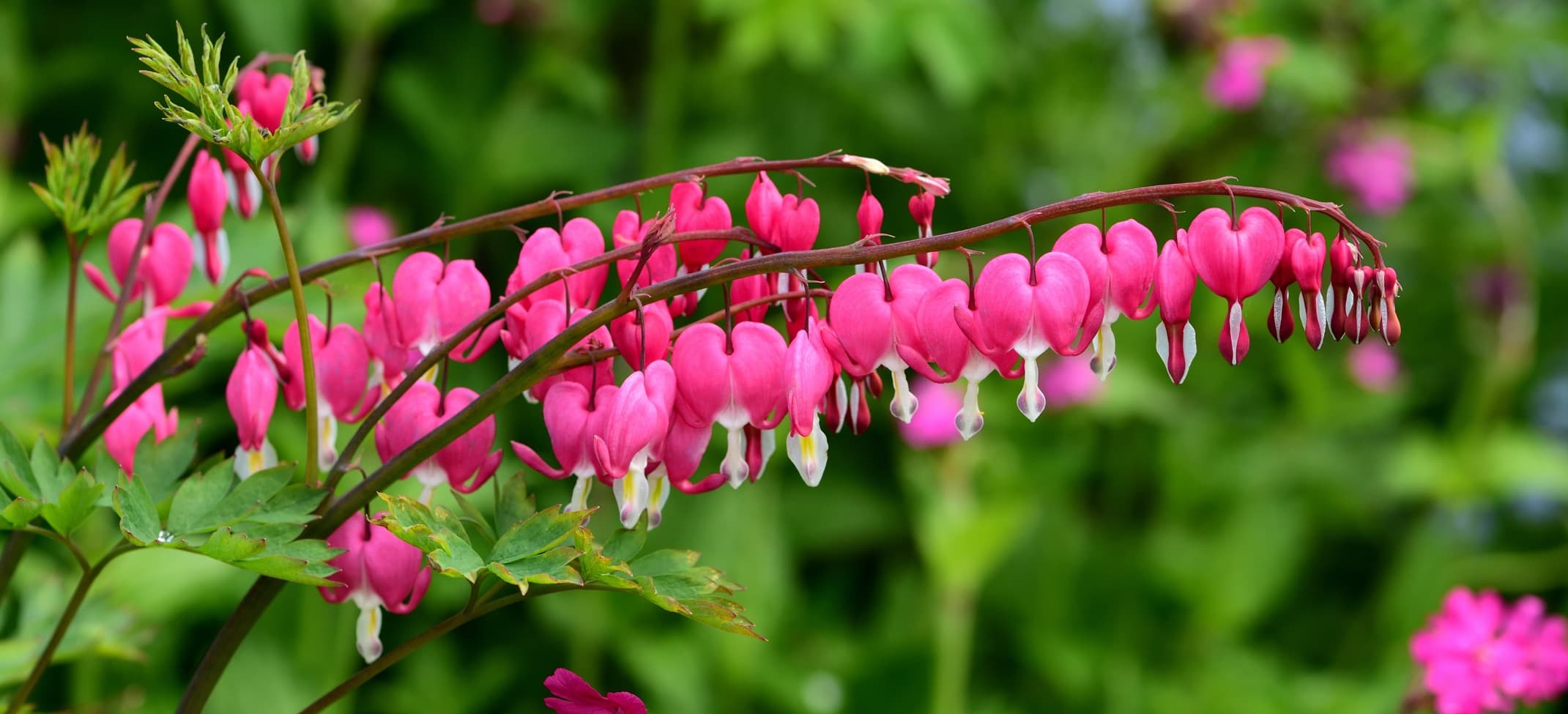
‘Bleeding Heart’ is a popular garden plant in the UK, named for its heart-shaped flowers which hang from long arching stems, often in colours of pink, red and white.
This well-known, deciduous garden perennial is known botanically as ‘Lamprocapnos’ and originates from North-East China and Korea.1
Overview
| Botanical Name | Lamprocapnos spectabilis (formerly Dicentra spectabilis) |
| Common Name(s) | Bleeding Heart |
| Plant Type | Perennial |
| Native Area | East Asia |
| Hardiness Rating | H5 |
| Foliage | Deciduous |
| Flowers | Heart-shaped flowers – commonly pink or red |
| When To Plant | March, April, May, June |
| Flowering Months | April, May, June |
Informally, ‘Bleeding Heart’ is the name given to a herbaceous perennial, Lamprocapnos spectabilis, formerly known as Dicentra spectabilis, as well as a number of other species in the Dicentra genus.2
In this article, we will focus on the most common ‘bleeding heart’ grown in gardens: L. spectabilis.
If you are already familiar with this plant then you will not find it difficult to see how it got its common name.
Each of the flowers is shaped like a heart, with a single, dangling, pearl-like petal beneath.

Though this plant is still often sold and referenced under its old name, this is now categorised as the only species within the Lamprocapnos genus.
The first specimens of this plant were introduced from Asia to the British Isles by Scottish botanist and plant hunter Robert Fortune in the 1840s.3
Since then, the plant has become a popular plant for temperate climate gardens.
Why Grow Bleeding Heart?

Bleeding heart is most commonly grown for its ornamental appeal.
The dangling hearts hanging from the stems are delicate and attractive, brightening up a partially shaded spot in a garden, bringing interest to woodland fringes or charming in more sunny borders.
The plant is in bloom between April and June.
Commonly Grown Varieties
The typical L. spectabilis is fuchsia pink and white, though there are other cultivars.

‘Valentine’ has red and white flowers – and an all-white variety called ‘Alba’ is also available.
Both of these, along with the species type, have received an RHS Award of Garden Merit.

Another cultivar, ‘Gold Type’ or ‘Gold Heart’ has yellow leaves.
Planting
Bleeding heart can be planted in a sunny spot when sufficient moisture is available. However, it will generally do best in dappled or partial shade.
It has a hardiness rating of H6 and will cope with a range of soil types and conditions.

The most important thing this plant requires is a moist, fertile soil, with plenty of organic matter.
A moist but well-drained, or even poorly drained soil can allow it to thrive.
It can cope with other conditions but does best in soils with a neutral or somewhat alkaline pH.
A sheltered spot is typically best.

Bleeding heart is usually planted between March and June.
Care should be taken when planting because the roots are brittle and these are plants that do not like disturbance.
When planting, and developing a scheme for a certain part of your garden, it may be helpful to know that Lamprocapnos typically grows to around 60cm high, and has a spread of 45cm.
If you only have a small garden, you may also be interested to learn that this plant can also be grown in a container as long as its environmental needs are met.
Companion Planting

Bleeding heart works very well in an informal or cottage-garden style space.
“Lamprocapnos spectabilis is a bit of an all-rounder that can be used in different areas of the garden and with different styles to create different effects,” says Horticultural Consultant Colin Skelly.
“I like to use in woodland borders in dappled shade, following on from early flowering perennials and bulbs.
“I tend to use L. ‘Alba’ because it really catches the eye in a shady position.”
Some other plants which work well alongside them include:
Lamprocapnos can also work well as under-planting for roses and other shrubs in a romantic cottage garden scheme.
Of course, since they can do well in dappled shade, they can also work well around deciduous trees in a woodland garden.
Bleeding Heart Plant Care

Bleeding heart is a relatively low-maintenance perennial plant which will not require a lot of ongoing care.
However, there are certain considerations to bear in mind:
Watering

When L. spectabilis is grown in dappled or partial shade, in suitably moist or damp soil, it should only need to be watered during prolonged dry spells.
However, it is important to pay attention to soil moisture – especially if you are growing this plant in a sunnier spot, or in a container.
If you are growing bleeding heart in a container, it is important to water regularly.
Feeding

Your bleeding heart will do best if grown in fertile soil, rich in humus.
An organic mulch each spring should provide all the slow-release fertility required throughout the year.
Since this is naturally a woodland plant, a mulch of leaf litter/leaf mould is ideal.
References
1. Lamprocapnos spectabilis. (n.d.). Kew Royal Botanic Gardens. Retrieved March 20, 2023, from https://powo.science.kew.org/taxon/urn:lsid:ipni.org:names:995841-1
2. The Editors of Encyclopaedia Britannica. (1999b, May 27). Bleeding heart | plant. Encyclopedia Britannica. Retrieved March 20, 2023, from https://www.britannica.com/plant/bleeding-heart
3. The Editors of Encyclopaedia Britannica. (2008, August 14). Robert Fortune | Scottish botanist and traveler. Encyclopedia Britannica. Retrieved March 20, 2023, from https://www.britannica.com/biography/Robert-Fortune



