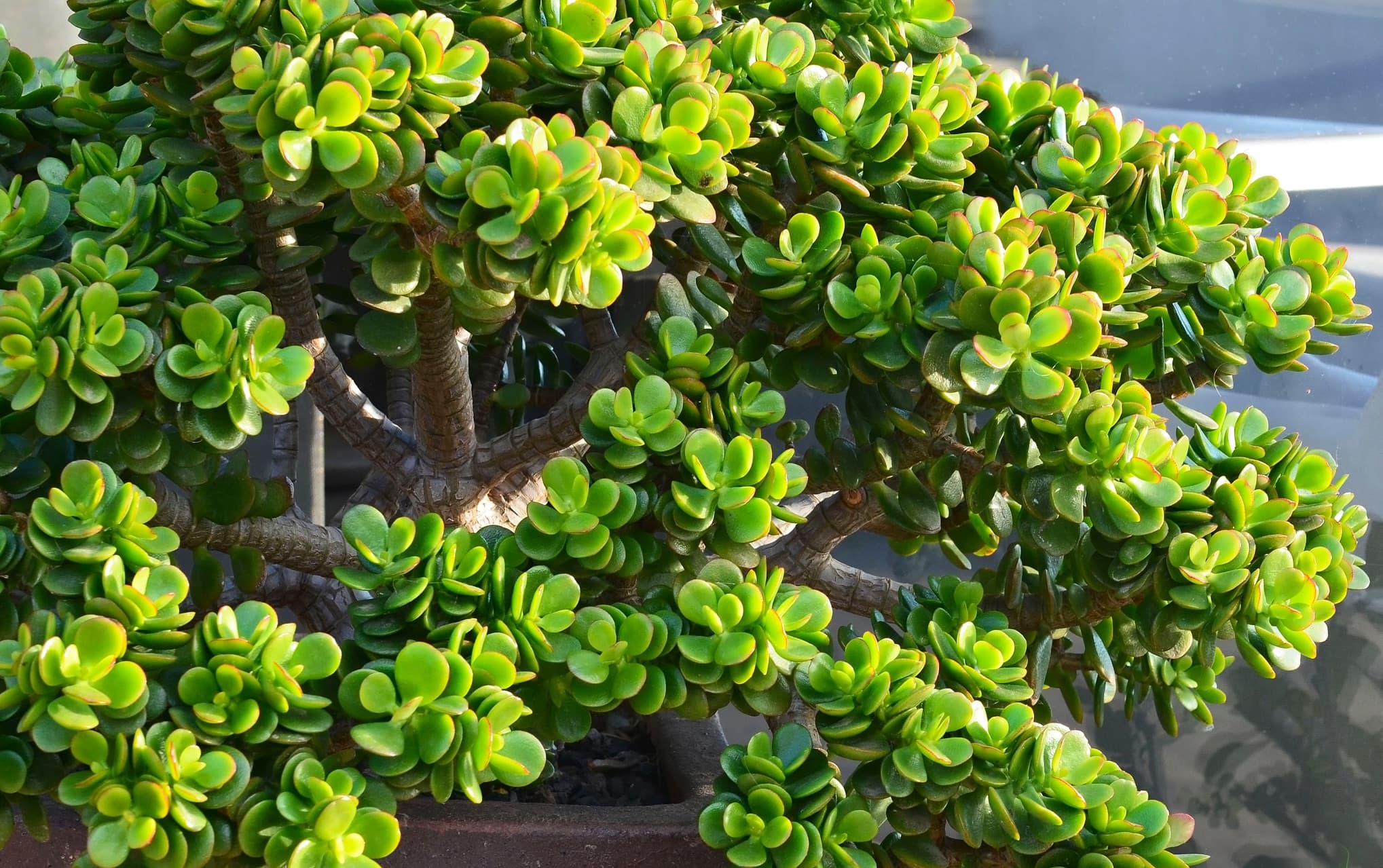
Crassula is native to the South-Eastern part of South Africa and Mozambique, being especially abundant in the Eastern Cape.
It was first studied and described in 1768 by British botanists and has been cultivated in Europe and the United States since the 1800s.1
Crassula ovata is only one species of the approximately 200 in the rich and diverse Crassula genus of succulents.2

This species has between 20-30 cultivars, some of which are quite well-known.
“Crassula species and cultivars make fantastic, eye-catching houseplants for a bright spot,” says Colin Skelly, a Horticultural Consultant.
“They are also good as outdoor potted plants in the summer months where the high light levels will produce attractive red colouration of the leaves.”
Most are differentiated by the colours, forms, or shapes of their leaves.
“My favourite succulent to grow is the Curly Jade Plant (C. arborescens), as this plant shows all the attributes of a perfect succulent” argues Ralph Behrmann from Clouds Hill Succulents.
“Its leaves are beautiful light green with blue undertones and develop a red ending in strong sunlight. It is a fast grower for succulents”.

Here are a few such well-known varieties along with a few less well-known but interesting ones:
1) ‘Gollum’
Also Known As: ‘Monstruosa’
A curiosity that has leaves that are elongated and shaped like narrow tubes, often with red-tinted tips.
2) ‘ET’s Fingers’

Another curiosity that has leaves that are elongated and resemble stubby tubes and have a concavity at the tip which is often tinged with red.
The names ‘Gollum’ and ‘E.T.’s Fingers’ are sometimes used interchangeably but these are subtly different cultivars.
3) Tricolour

So named for its variegated leaves on which shades of cream, yellow, and green run together and intermingle.
4) ‘Hummel’s Sunset’

This cultivar is distinguished by the rich yellow swaths and shadings on its leaves and yellow and red edging.
5) ‘Sunset Magic’

An eye-catching cultivar whose perfectly ovate and flat leaves are different shades of light green with a thick red bordering that enters into the lamina and intermingles with green.
6) ‘Minova Magic’
This varietal has unusually-shaped leaves: instead of ovate they are spade-like or spatulate and are a dark, deep shade of green.
7) ‘Crasmada’
Patented in 2015, this variety is distinguished by large, dark green leaves that have an upward curl and an incurved margin.3
8) ‘Blue Surprise’
Well, it is not actually blue but the leaves are a striking shade of green, call it slate grey-green with a bluish tinge.
Moreover, they are curly and curvy, making this a very distinct cultivar.
9) ‘Undulata’

Also Known As: Jitters; Ripple; Wavy Jade
A highly distinct variety, the leaves of this cultivar are emerald green edged with red, they are thinner than normal and sharply wavy with a somewhat crinkly appearance reminding one of lettuce.
10) Dwarf Jade Plant

Also Known As: Dwarf Green
Similar to the mother species except that, as the name implies, it is a dwarf variety; it attains a maximum height of only 90cm.
11) ‘Crosby’s Dwarf’

Also Known As: Crosby’s Compact
As the name suggests, it is both a dwarf and compact, reaching a height of only 90 centimetres.
With adequate sunlight, its red-edged leaves become more red, including fully red, than almost all other varieties.
12) ‘Minima’

Similar to the mother species except that this dwarf variety is the smallest and most compact, reaching a maximum height of only 75cm and a width of only 50cm.
References
1. Crassula ovata. (n.d.). Kew Royal Botanic Gardens. Retrieved March 14, 2023, from https://powo.science.kew.org/taxon/urn:lsid:ipni.org:names:273350-1
2. Crassula Archives. (n.d.). Surreal Succulents. Retrieved March 14, 2023, from https://surrealsucculents.co.uk/product-category/crassula/
3. Crassula plant named ‘Crasmada.’ (2014, November 27). Google Patents. Retrieved March 14, 2023, from https://patents.google.com/patent/USPP28426