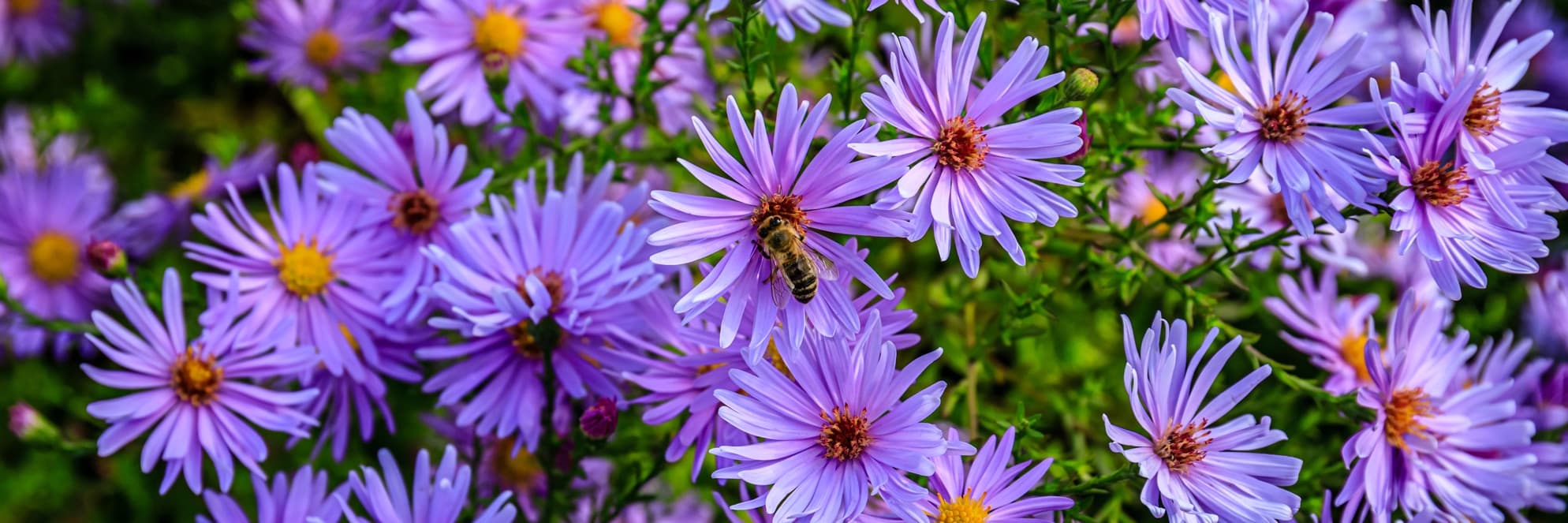
Asters, also known as ‘Michaelmas Daisies’, are popular herbaceous flowering perennials that look wonderful in many UK gardens.
Whether you are trying to create a traditional cottage garden feel or more modern prairie-style planting, Asters can be a go-to choice.
They look lovely – and can be great for the bees, butterflies and other beneficial insects that visit your garden.
And of course, what is good for the wildlife in your garden is good for you as a gardener too – since the rich biodiversity makes it easier for you to grow your own food and derive other yields from your organic garden.
Overview
| Botanical Name | Aster |
| Common Name(s) | Michaelmas Daisies |
| Plant Type | Perennial / Annual Flower |
| Native Area | Eurasia |
| Hardiness Rating | H6-H7 |
| Foliage | Deciduous |
| Flowers | Star-shaped flowers in different colours |
| Flowering Months | August, September, October |
| When To Pinch Out Tops | July |
| When To Deadhead | September, October |
The genus Aster once included over 500 different species of perennial flowering plant from Eurasia and North America.1
However, research during the 1990s led to North American species being reclassified into different genera – such as, for example, Eurybia and Symphyotrichum.2
Nonetheless, these North American species are usually still referred to as Asters.
In this article, we will include and run through these species too – since the care and growing tips for these plants are often the same or very similar to the (roughly 180) Eurasian species in this genus.

The term ‘Aster’ comes from the ancient Greek for ‘star’ – the name refers to the shape of the flower head.3
The genus Aster is part of the large Asteraceae plant family, also known as the ‘daisy’ or ‘sunflower’ family.4
This is a huge plant family with over 32,000 different species, many of which are common garden flowers.5

There is actually only one native Aster in the UK – the Aster tripolium, or sea aster.6
Another species formerly known as Aster linosyris is now known as Galatella linosyris.
However, many Asters from Europe and North America, and hybrids derived from them, can be grown easily and successfully in UK gardens.
Why Grow Asters?
Asters take their common name – Michaelmas Daisies – from the fact that they mostly bloom in late summer or early autumn.
They can be excellent choices where you want to make sure you have flowers in bloom in your garden over as much of the year as possible.
They take over where summer flowering blooms leave off – and can bridge the gap between the summer and autumn seasons in your garden.

Asters can grow in all UK hardiness zones and can be useful for attracting wildlife to your garden.
They can be beneficial for pollinators, and are important food plants for the larvae of a number of common butterflies and moths.
Another benefit of growing Asters, of course, is that these perennials will return to bloom in your garden year after year.
And like many other perennial plants, they will require very little care, so could be a great choice for a relatively low-maintenance garden scheme.
Growing Options

There are a great many different Asters that you might consider choosing for your garden.
Some great options for UK gardeners include:
- A. alpinus
- A. amellus
- A. x frikartii (A. amellus x A. thomsonii)
- A. herveyi (Eurybia x herveyi)
- A. tongolensis (e.g. ‘Beggarten’)
- Symphyotrichum laeve (e.g. ‘Calliope’)
- S. novae-angliae (e.g. ‘Harrington’s Pink’)
- S. novi-belgii (e.g. ‘Dasthree’, ‘Island Series’, ‘Samoa’, ‘Algar’s Pride’)
- S, ‘Ochtendgloren’ (pilosum var pringlei hybrid)
“Callistephus chinensis, the China aster, is a fantastic plant that is often overlooked as it is an annual,” shares Dan Ori, Master Horticulturist.
“However, it can be sown directly to the soil in spring each year.
“There are many varieties available including the Duchess series, which has flowers that are Chrysanthemum-like and come in single, semi-double, and double forms.
“They range from 20cm to 70cm in height, giving you lots of options for pots and borders and he taller varieties work exceptionally well as cut flowers.”
When choosing Asters for your garden, the size and hues of the blooms are one thing to consider, but you should also think about the typical height of the plants.

Since this will determine whether they will work best towards the back, in the middle, or near the front of a bed or border on in a container – some Asters are much taller than others.
See a full breakdown of Aster varieties in this post.
How To Grow Asters

Asters look great in herbaceous perennial borders, especially alongside other perennial flowering plants and meadow grasses.
They are right at home in a prairie planting scheme – the flowers are cheery and colourful, and a number of varieties also make excellent cut flowers.
They can be great for a traditional cottage garden, but many varieties can also work well in a more contemporary scheme.

These perennial flowers will thrive in almost any soil type, ideally one that is moist but well-drained to well-drained.
They will usually do best in areas of full sun though many varieties can also cope with partial or dappled shade.
Many varieties are also excellent for growing in containers.
Remember to place Asters in a location which suits their appearance and form – and note their eventual height when deciding where to place them.

Avoid placing taller Asters in a location that is too exposed, where they may be subject to wind damage.
A border of Asters and tall perennial grasses can also have wider applications.
For example, it can be used to ‘borrow’ landscape from beyond the edges of a rural garden – tying in the garden with farm fields beyond.

A border of perennial flowers and grasses might also screen another part of the garden from view, or partially obscure a view without entirely blocking it.
Planting
Aster seedlings or cuttings should be planted out, typically, between March and May.
This is also the time when you should plant out Asters as potted plants that you have purchased for your garden.

Asters should typically be placed with a spacing of around 40cm between plants.
Companion Planting
Asters are versatile perennials that will work well alongside many other herbaceous perennials in a bed or garden border.

Asters look fantastic alongside other herbaceous perennials for summer and autumn including:
- Achillea millefolium
- Caryopteris
- Chrysanthemums
- Echinacea
- Helenium
- Phlox
- Rudbeckia
- Salvias
- Veronicastrums
And alongside a wide range of ornamental grasses such as:
- Stipa
- Molinia
- and Calamagrostis, for example.
Aster Plant Care
Caring for Asters does not require a lot of work.

In fact, when placed in the right locations, Asters will require very little care and be a great choice for a low-maintenance garden.
Watering
Keep the soil well-watered, but do not let Asters sit with wet feet.
Watering problems are the most common reason for one of the main issues that Aster growers can encounter – mildews.
These flowering plants can be rather prone to mildew problems; over-watering is one of the most common causes.

Typically, in normal UK conditions, watering in addition to natural rainfall will not be required (unless they are grown in containers).
In drought conditions, or when growing in containers, a thorough soaking every two weeks should be sufficient to see them through hot and dry periods.
Mildew Issues
Consistent watering, but a well-draining medium or soil, and good air-flow around the plants can help to reduce the likelihood that this problem will occur.

Avoid overcrowding your plants – and do not water too much.
If you experience a lot of problems with mildew in your particular garden, then it could be a good idea to look for more mildew-resistant cultivars or varieties.
Feeding
Asters typically do not require particularly high levels of nutrients; fertilisers will not typically be required.
Usually, it will be enough to simply mulch around the plants with a good quality organic mulch, which will act as a slow-release fertiliser over time.
When growing in pots, however, or to improve very poor soil, you may wish to add blood fish and bone or another organic fertiliser a couple of times during the flowering period.
Deadheading & Cutting Back
Deadheading the plants and getting rid of spent flowers can also help to reduce the incidence of any problems of this type.
Deadheading will also keep them looking good for longer and will encourage them to produce more flowers.

To get as many flowers as possible from your Asters, you should pinch out top shoots at midsummer, then deadhead as you go.
I like to cut back my Asters hard after flowering finishes in autumn.
Division
Asters should also be divided every four years or so.
This will help the plants to retain their vigour, and prevent clumps from becoming overly congested.

For the health of the existing plant, I find it best to divide mature Asters in the spring, just as new growth begins.
References
1. The BRAHMS Project, University of Oxford, Department of Plant Sciences. (n.d.). Aster species. Oxford University Plants. Retrieved March 9, 2023, from https://herbaria.plants.ox.ac.uk/bol/plants400/Profiles/AB/Aster
2. Why Do Plant Names Change? (2014, July). RHS the Garden. Retrieved March 9, 2023, from https://www.rhs.org.uk/about-the-rhs/publications/the-garden/the-garden-back-issues/2014-issues/july/plant-name-changes.pdf
3. Definition of aster. (n.d.). In www.dictionary.com. https://www.dictionary.com/browse/aster
4. Petruzzello, M. (2015, October 9). List of plants in the family Asteraceae. Encyclopedia Britannica. Retrieved March 9, 2023, from https://www.britannica.com/topic/list-of-plants-in-the-family-Asteraceae-2040400
5. Asteraceae. (n.d.). Global Biodiversity Information Facility. Retrieved March 9, 2023, from https://www.gbif.org/species/113579929
6. Aster (Sea) / Sea Aster. (n.d.). Wild Flower Finder. Retrieved March 9, 2023, from https://wildflowerfinder.org.uk/Flowers/A/Aster(Sea)/Aster(Sea).htm