Trumpet pitchers are carnivorous plants commonly grown as a novelty far beyond their native range, including here in the British Isles.
These plants are often grown as houseplants indoors in our climate, though there are Sarracenia plants hardy enough to be grown outdoors in a bog garden or a pot.
Therefore, they might be grown in a sheltered outdoor location as well as inside your home.
Even when they are grown indoors, these plants are often placed outdoors for a period in the summer.
“My absolute favourite carnivorous plant to grow is the North American Pitcher Plant, Sarracenia,” shares Peter Walker, Owner of Wack’s Wicked Plants.
“They come in so many shapes and sizes, from small and stocky, compact, to beautiful upright pitchers more than 4ft tall.
“They come in any colour you can imagine, with brilliant markings, and are hardy plants that are so easy to grow.”
Overview
| Botanical Name | Sarracenia |
| Common Name(s) | Trumpet Pitcher |
| Plant Type | Carnivorous |
| Native Area | Canada and the US |
| Hardiness Rating | H2-H6 |
| Foliage | Varies |
| Flowers | Purple & five-petalled |
| When To Plant | May to June outdoors, anytime inside |
According to Kew Botanic Gardens, there are 11 different accepted species of trumpet pitcher within the Sarracenia genus.1
All are carnivorous plants which are native to areas of the eastern coast of the United States and southeastern Canada.2
Only one, Sarracenia purpurea, arises in cold-temperate climate areas.

Sarracenias are herbaceous perennials which grow from a rhizome below the ground.
They have many pitcher-shaped leaves that radiate out from the base, with traps at the top of the tubes, known as phyllodes.
S. purpurea, unlike most other trumpet pitchers, typically has plenty of rainwater collected in the base.
Popular Varieties
Sarracenia purpurea is the most common trumpet pitcher to grow inside homes in the UK.

This is called the common pitcher plant, which grows around 30cm tall.
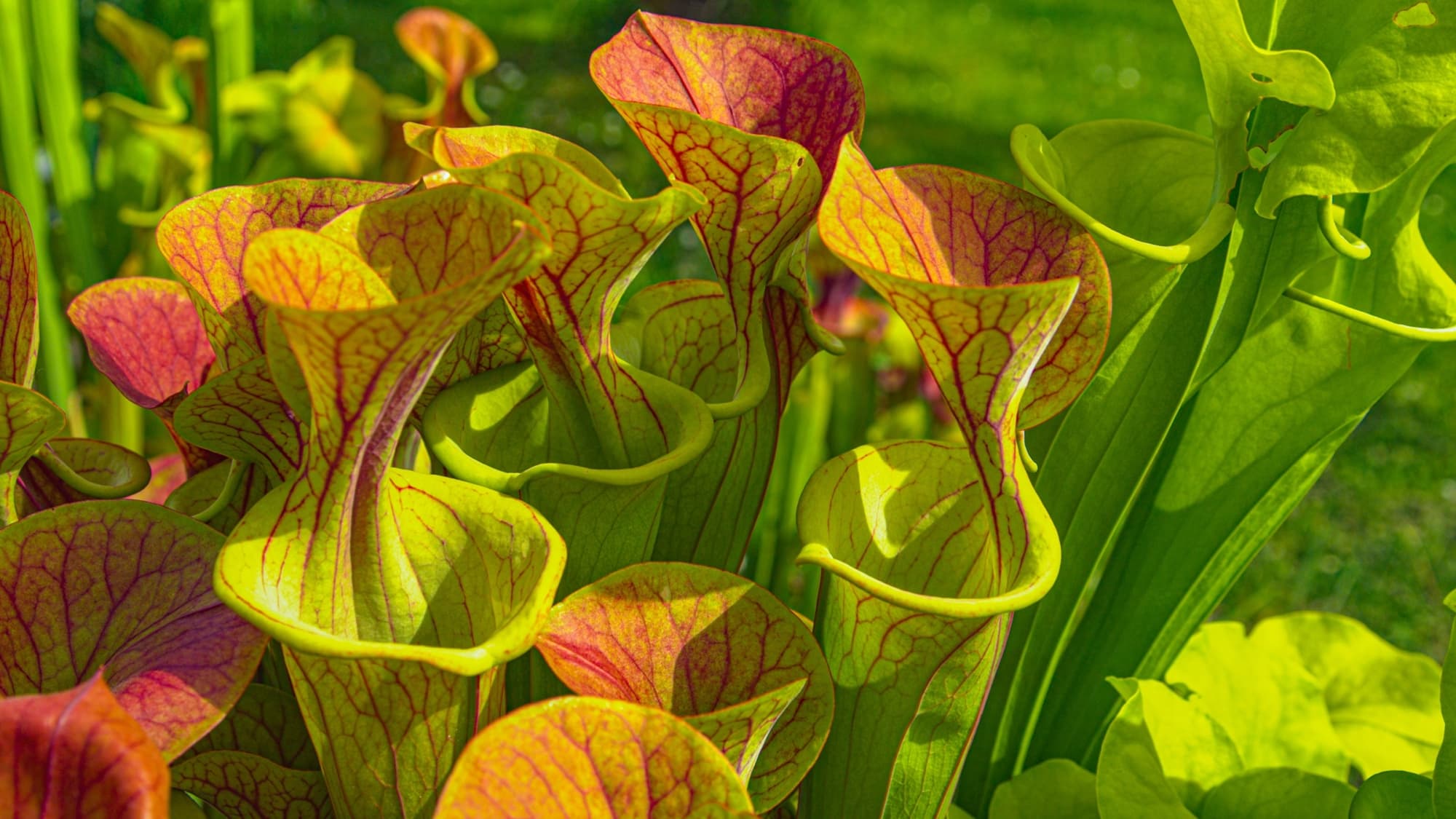
The green pitchers are flushed and veined with a deep purplish red, and there is a large lip at the top of each pitcher and an upright lid that is frilled around the edge.
Five-petalled flowers bloom well above the pitchers in the spring – these are purple and around 5cm across.
While this Sarracenia is the most commonly available, other species within this genus are also sometimes grown and there are also numerous hybrids grown in cultivation by carnivorous plant enthusiasts.
For example, hybrids of S. purpurea and S. leucophylla are becoming more commonly available.

Sarracenia plants which have an RHS Award of Garden Merit to consider growing in the UK are:
- S. ‘Anna Carlisle’
- S. ‘Colin Clayton’
- S. ‘Dixie Lace’
- S. ‘Jenny Helen’
- S. ‘Juthatip Soper’
- S. ‘Vogel’
- S. x catesbaei ‘Birmingham Midnight’
- S. x mitchelliana ‘Victoria Morley’
- S. x moorei ‘Brooks’ Hybrid’
How To Grow Trumpet Pitchers
Trumpet pitchers are considered to be relatively easy to grow as long as their basic needs are met.
Growing From Seed
Trumpet pitchers can be, and often are, grown from seed.
Sarracenia hybrids are fertile and will hybridise further, which means that many carnivorous plant enthusiasts are drawn to collecting and sowing seeds in order to breed new cultivars with interesting variations.
To collect seed from Sarracenia, hand pollination is generally required, as natural pollinators will not be able to pollinate the plants when they are growing indoors so far from their native range.
Once pollination has taken place, seeds should develop and be produced in great numbers.

To mimic the period of cold the seeds need to germinate in the wild, the seeds should be placed in a fridge and kept moist for 2-6 weeks, depending on which species is being grown.
The seeds can then be placed on the surface of a suitable peat-free growing medium.
The growing medium should be acidic, moist and low in nutrients to mimic the plant’s natural environment.
The seeds should germinate in a warm, bright spot and will mature over the next 4-5 years.
Preferred Environment
In the wild, these plants grow in bogs and wetlands in acidic and largely infertile soil.

Providing them with their preferred environment means mimicking the conditions that they would naturally have in the wild when growing them in cultivation.
While many trumpet pitcher plants are tender and grown indoors, S. purpurea is H6 hardy and can potentially be grown outside in a suitable location.
Soil Requirements
Sarracenia needs an acidic soil or potting mix that is low in nutrients. It can be moist but well-drained or even poorly drained.
Sarracenia Care Guidelines
Caring for Sarracenias is largely a question of making sure that their environmental needs are met.

Once their basic positioning is sorted, they are generally easy to care for and do not require huge amounts of care.
Sunlight
These plants can grow in full sun or partial shade, but will generally do best with some protection from the sun during the hottest part of the year, which can also help keep the soil moist.
If grown indoors or under cover, they require a bright location out of direct sunlight.
Watering
Sarracenia plants generally need to be watered regularly to keep the growing medium consistently moist throughout the year.

The medium should be kept moist to wet at all times.
Ideally, these plants should be watered with rainwater or distilled, filtered water.
“Sit them in full sun in a deep saucer filled with rainwater and keep the saucer topped up all growing season,” advises Peter.
“They will crisp off in winter when we cut them down and reduce the watering.”
Pruning
Sarracenia do not require any pruning.
Feeding
Sarracenia plants can benefit from feeding while young (if grown from seed) with a balanced organic fertiliser.
This speeds up their early growth and lessens the time to maturity.

However, once mature they should not need additional feeding and will feed themselves on insect life.
“An added benefit is that they keep insects off you in your house or even when you are just sitting outside,” adds Peter.
Make sure that if you’re growing them indoors where there are no insects around, you place the plant outside for a few weeks in summer should allow it to catch enough insects to survive.
Repotting
You won’t have to repot Sarracenia regularly at all if you are growing in a container.
You may think about repotting every 3 years or so, but less for space or nutrients and more to avoid the build-up of any minerals in the growing medium.
Overwintering
Where you keep Sarracenia over the winter months will very much depend on the species or hybrid cultivar you are growing.

Sarracenia purpurea might remain outdoors for winter in a sheltered spot, but most will be moved indoors or undercover to a cool, frost-free place where they can have their period of winter dormancy before growth resumes in the spring.
“Most Sarracenias require a winter dormancy where they are kept damp and are not stood in water,” says Peter.
“The main winter issue is normally rotting due to overwatering.”
Propagating
If you do not have the patience to grow Sarracenia from seed, then you might consider dividing the rhizome of a mature plant in order to obtain new plants from an existing one.
The best time to lift and divide Sarracenia is in early spring.
Common Problems
Environmental issues are the most likely to cause problems with a pitcher plant.
For example, crispy pitchers might be caused by underwatering or by excessive hot and bright sun.
If no pitchers develop in spring, lack of light could be the issue.

A lack of light might also cause markings on the pitchers to fade and become less vibrant.
These are just a few examples of the most common problems that are encountered when growing these plants.
Pests like scale insects, aphids, mealybugs and moth caterpillars may sometimes also become an issue.
References
1. Sarracenia Tourn. ex L. (n.d.). Kew Botanic Gardens. Retrieved May 16, 2023, from https://powo.science.kew.org/taxon/urn:lsid:ipni.org:names:30020496-2#children
2. Sarracenia. (n.d.). North Carolina Extension Gardener Plant Toolbox. Retrieved May 4, 2023, from https://plants.ces.ncsu.edu/plants/sarracenia/