Growing

Sowing Canna Lily - Scarify Twice As Many Seeds As You Would Like To See Germinated
IN THIS GUIDE 1) Scarify The Seeds 2) Put Seeds In Water 3) Monitor For Germination 4) Prepare The Pots 5) Sow The Seeds 6) Site The Pots 7) Watering 8) Transplanting The Plants Aftercare Cannas, frequently called ‘Canna Lilies’, are tropical plants with brilliant green foliage that can only be described as profuse and plush. Though seekers of rich green shapely foliage would be enamoured of Cannas, so too would those who prize large flowers – which have curved and curling petals and are frequently found in vibrant shades of the warm spectrum from yellow through red, and are often bi-coloured. Cannas are almost always sold as rhizomes or potted plants. Seeds will be hard to come by because these plants do not grow true from seed, for which reason, plants grown from seeds have unpredictable flowers that are sometimes even more striking. However, if you have collected seeds from your garden Cannas or obtained them from a friend, you can certainly grow new plants from seed. “Cannas are good to sow because they are easy, look exotic and you usually get a flower in the first year,” shares Exotic Plant Expert Will Purdom. Canna seeds are smooth, black and round, as if shiny peppercorns. I grew Cannas from seed earlier this year and I must say it does have a couple of drawbacks: First, the plants will only flower in their second or third year. Second, the seeds are ‘armoured’ so they have to be prepped in some way – scarified, soaked, or even boiled before they can be sown. But you can do it – we spell out a straightforward process for growing Cannas from seed: Scarify seeds and drop them in water. When the seeds germinate, sow them in small pots. Place the pots indoors in a warm and sunny spot. Water the little plants regularly. After six to seven weeks, transplant the young plants. This process is explained in more depth below – Canna seeds should be prepped about eight weeks before the last expected frost. Prepping is necessary, otherwise seeds will not germinate. Difficulty Medium Equipment Required Container (bowl, pot, tumbler, etc.), small carpentry file or Swiss Knife file, hand spade or trowel, watering can When To Sow About seven weeks before the last expected frost – mid-February in most UK regions When To Plant Out After the last frost and when the soil has warmed up – April in most UK regions 1) Scarify The Seeds Using a carpenter’s hand file or a Swiss Knife file, scarify the seeds by filing their hard coats (the testa) on one side until the underlying white part (endosperm or embryo, depending on which side you are filing from) is clearly visible. I didn’t actually have much luck using the sandpaper method so I had to place the seeds in a glass of boiling water (yes, they are that tough!). Scarify about twice as many seeds as you would like to see germinated – about half of mine were too tough, even for boiling water! 2) Put Seeds In Water Drop the scarified seeds into a container of warm water and leave them there for about 48 hours. 3) Monitor For Germination From 48 hours onward, keep checking the seeds to see which ones have germinated. You know a seed has germinated if you see a tiny whitish thing (the cotyledon) emerging from the top. 4) Prepare The Pots Put potting soil with compost or any rich and fertile soil in one- or two-litre pots. Pots must have drainage holes; water so as to make the soil moist throughout. 5) Sow The Seeds Sow germinated seeds such that the emerging white cotyledon and just a bit of the seed is above the soil, and water moderately. Discard seeds that have not germinated after five days of soaking. 6) Site The Pots Site the pots in a room where they will get full sun and where the temperature is 18-23°C. 7) Watering Water every two days or so with the aim of keeping the soil moist. 8) Transplanting The Plants After six to seven weeks the young plants can be transplanted to their final location. This could be an appropriately-sized (i.e. big) container or an outdoor bed after the last frost and when the soil has warmed up to 10°C (or more). The frequency of watering should gradually be reduced but when you do water, be sure to give these plants an ample quantity. Aftercare Be aware that you can keep Cannas outdoors year-round only in the coastal and warmer regions of the UK. In other regions you will have to dig up the rhizomes and overwinter them indoors; otherwise plant Cannas in containers so that they can be brought into the house.
Learn more
Always Follow These General Rules When Cutting Back Canna Lilies
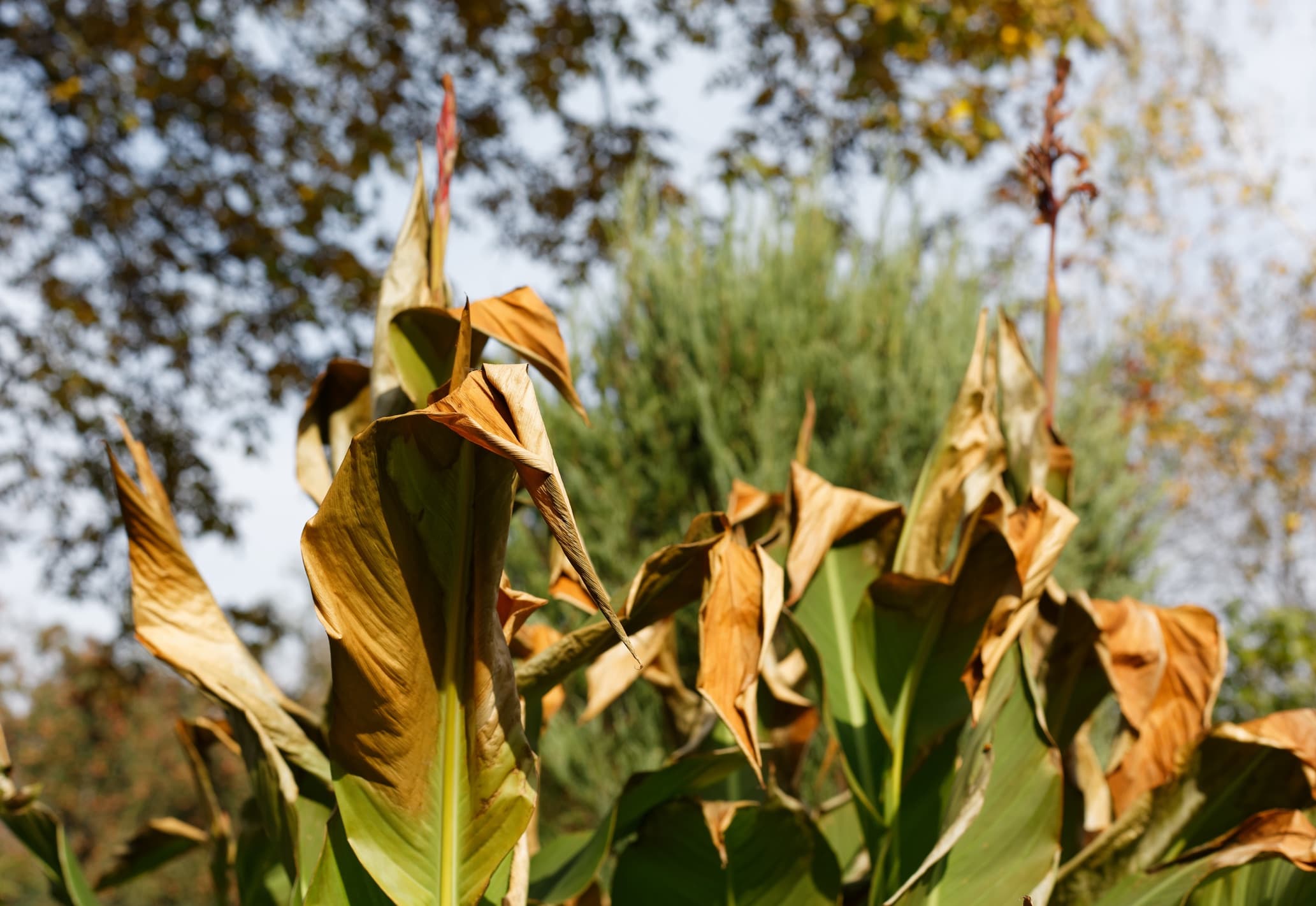
IN THIS GUIDE When To Cut Back Canna Lilies 1) Check Plant Condition 2) Save Any Seed Pods 3) Carefully Cut Sections 4) Cut Your Canna Right Back Canna lilies originally hail from the warm climate of Mexico, and are now found worldwide. These plants like light and water in summer and dryness over winter: so make sure to bring them in when the weather gets cold. Pruning canna lilies brings a couple of benefits: Firstly it removes unsightly dead or dying foliage from the plant; and secondly, it gives space for healthy new foliage to grow in its place. Pruning is also a great way to reset the plant each year to facilitate stronger growth in the following season. It’s easy to prune canna lilies. Here are the general rules, and we’ll go into more detail on the pruning process below: Outdoor plants in cold climates will die back in winter so you can prune aggressively and they’ll regrow next year Indoor plants benefit from pruning throughout the year Cut dead leaves where they meet the stem, rather than cutting the stem You can trim entire leaves or sections of leaves, depending on the condition When pruning spent flowers you should go down to the node When To Cut Back Canna Lilies You can prune canna lilies throughout the year when they need a little spruce up. You should also prune them back hard as winter is setting in. Difficulty Easy Equipment Required Scissors or secateurs (shears) When To Prune Typically late Autumn 1) Check Plant Condition When pruning canna lilies you’re looking for unhealthy leaves or leaf sections. Brown, wilted areas of healthy leaves can be pruned off without damaging the remainder, giving your plant an overall healthier appearance. You can also remove entire leaves if the whole thing is looking worse for wear. If all foliage is brown, you may be better off resetting the plant for the next season (see step four). If your canna lily is in bloom, you can prune back flowers that are on their way out to promote new growth in their place. In this first step, just give your plant a visual once-over to figure out what needs doing. 2) Save Any Seed Pods If a canna lily has finished blooming and created seed pods, you can save and replant these for future growth. On canna lilies that look worse for wear – the whole plant may be brown – grab the seed pods and set them aside. Now, if you’re pruning during the year to spruce up your plant a little bit, read step three. If winter is coming and you’re pruning harder, jump to step four. 3) Carefully Cut Sections Once you’ve identified the areas that need attention and have saved the seed pods, you can begin pruning. For leaves it’s simple: just use scissors or shears to remove the desired area. Cut carefully and don’t remove the entire leaf. For flowers, cut the entire stem down to the node where it meets the main stem. 4) Cut Your Canna Right Back Canna lilies can take aggressive pruning, and doing this in winter resets your plant and stands it in good stead to grow back strong next year. Watering and fertilising your canna lily (use a high nitrogen fertiliser) when you prune it back hard helps to encourage healthy growth.
Learn more
Congested Canna Rhizomes Can Lead To Poor Flowering - Divide Them With This Guide
IN THIS GUIDE 1) Sterilise Implements 2) Cut Back The Plant 3) Loosen & Remove Soil 4) Dig Down Deeper 5) Lift The Rhizome 6) Break / Cut The Rhizome 7) Disinfect The Rhizomes Bringing a touch of the tropics to your cloudy garden in Old Blighty, tall Cannas are brilliant plants to position at the rear of the bed to serve as a spectacular backdrop. Their large wavy leaves are usually bright green but quite often occur in variegated forms or in russet tones. This foliage, pretty in and of itself, frames erect flower stalks. The bilaterally-symmetric flowers are quite unique in their shapes and forms. It is probably fitting that the flowers of an exotic plant frequently can seem rather like the ruffled wings of some small exotic bird! Cannas grow from rhizomes – these rhizomes multiply by growing child rhizomes that are attached to the parent rhizomes. Over time, the rhizomes – particularly the parent rhizome – will suffer from congestion and the growing plants will become undesirably dense while probably also not blooming as well as they used to. Difficulty Medium Equipment Required Gardening gloves, secateurs or hedge shears, gardening fork, gardening trowel or hand spade, sharp knife, sterilising liquid, sulphur powder (optional) When To Divide October You can avoid these problems, give the rhizomes breathing room, space out the plants, and get new ones in the bargain by lifting and dividing them in autumn. Doing so every four years would be just about right. You can lift and divide Cannas by following these steps: Sterilise all cutting implements. Shear down the plants. Gently loosen the soil and carefully dig into it. Carefully lift out the rhizome. Break or cut the rhizome appropriately and correctly. This process is explained in more depth below. Canna rhizomes should be lifted and divided in mid-autumn or after their leaves have withered and they are entering dormancy. 1) Sterilise Implements Sterilise your secateurs or hedge shears and a sharp knife. You may use a rubbing alcohol solution, bleach solution or hand sanitiser. Put on your gardening gloves. 2) Cut Back The Plant Using the secateurs or hedge shears cut all foliage and stalks from the Canna down to 4-6cm from the soil. The next step is best accomplished when the soil is not wet and is dryish. 3) Loosen & Remove Soil Use a gardening fork and gardening trowel or hand spade to gently loosen and remove the soil. Using the stems and stalks as a guide as to the location of the rhizome, start about 30 centimetres away from it, and ‘excavate’. Be careful not to strike the rhizome or the roots. Consider using softish plastic gardening tools, rather than traditional metal ones, for this activity. 4) Dig Down Deeper When the rhizome is exposed, loosen and dig into the soil a little deeper and a little closer around the rhizome – it will need to be removed with its roots intact. At this point take special care not to injure the roots. 5) Lift The Rhizome As soon as you are able to do so, using your (gloved) hands push into the soil, gently wiggle the rhizome and work it loose, and lift it up with its roots intact. Gently clean the soil off it – do not rub it harshly. 6) Break / Cut The Rhizome Break the rhizome cleanly if you are able, or cut it with the sharp knife you’ve sterilised, at the junctures where the children are growing from the parent. Break or cut such that each divided piece has at least one eye and preferably two, and (only) some roots. 7) Disinfect The Rhizomes Pre-emptively disinfect the rhizomes to ward off any diseases. Sprinkle a touch of sulphur powder, or brush the bleach solution with your (ungloved) fingers, on the freshly-broken or -cut surfaces of the rhizome. Now the divided Canna rhizomes are all set for re-planting or storage as the case may be.
Learn more
Here Are 20 Arum Lily Varieties Ranging In Colour From Dark Purple To White
IN THIS GUIDE 1) Z. aethiopica 2) Z. ‘Crowborough’ 3) Z. ‘Crystal Clear’ 4) Z. ‘Mint Julep’ 5) Z. ‘Golden Chalice’ 6) Z. ‘Flamingo’ 7) Z. ‘Crystal Blush’ 8) Z. ‘Eyeliner’ 9) Z. ‘Captain Palermo’ 10) Z. ‘Cantor’ 11) Z. ‘Captain Chelsea’ 12) Z. ‘Captain Romance’ 13) Z. ‘Captain Safari’ 14) Z. ‘Mozart’ 15) Z. ‘Bingo’ 16) Z. ‘Fire Glow’ 17) Z. ‘Odessa’ 18) Z. ‘Picasso’ 19) Z. ‘Green Goddess’ 20) Z. ‘White Giant’ Arum Lily is a herbaceous perennial though it may be deciduous, semi-evergreen, or evergreen depending on a given region’s climate. It is evergreen in sub-tropical climates when it gets year-round water and is deciduous in temperate regions, but which have relatively mild winters that it can weather. These rhizomatous plants lack a central stem as the stalks and petioles emerge directly from the rhizomes. The leaves are sagittate or arrowhead-shaped and are typically 35-40cm long, glossy and of a rich green hue. Some cultivars’ foliage is flecked or liberally speckled with white. This exotic plant is not only a stylish, unusually chic one, when planted in optimal conditions it will turn out to be very low maintenance. “Arum Lily’s make great plants for pots, working well in modernist settings,” says Master Horticulturist Colin Skelly. “They will need a large pot to retain the moisture and nutrients necessary to keep them in good condition during the summer months. “This does mean that there will be a greater number of cultivars to choose from as pots can be protected from frosts during the winter months more easily than those in the ground.” The flower not only looks lovely in a vase indoors, it is also long-lasting as a cut flower. Arum Lily and its various cultivars reach heights of 60cm to about one metre. Their spreads are typically within a narrow range of 40-50cm. In the Northern Hemisphere, they flower from June through July but sometimes start as early as May. The different cultivars vary in the colours of their ‘flowers’ but some also have flecked or speckled leaves, and a few top out at 60cm while some can grow taller. We present a top twenty list below: 1) Z. aethiopica HARDINESS RATING: H4 AKA: ‘Arum Lily’ The ‘mother species’. The spathe is pure white and the spadix is a cheery yellow. 2) Z. ‘Crowborough’ HARDINESS RATING: H4 RHS AWARD OF GARDEN MERIT Has ‘flowers’ that are the same colours as the species but the spathes are just a bit smaller, are wavy, somewhat furled, and display a pleasingly irregular appearance. 3) Z. ‘Crystal Clear’ HARDINESS RATING: H4 Is not infrequently entirely pure white. Pure white spathes encircle spadices that may be creamy yellow, off-white, or white. 4) Z. ‘Mint Julep’ HARDINESS RATING: H1C Have yellow spadices with spathes in shades of creamy white to a rich cream. 5) Z. ‘Golden Chalice’ HARDINESS RATING: H4 Have spadices and spathes in matching colour, this being a bright, buttery yellow. The leaves are heavily speckled. 6) Z. ‘Flamingo’ HARDINESS RATING: H4 One of the most delicate varieties, ‘Flamingo’ has rich and warm yellow spadices encircled by spathes that range from pink-suffused white to pale pastel pink. 7) Z. ‘Crystal Blush’ HARDINESS RATING: H1C Has a yellow spadix which is smaller and less prominent than most. The spathe is a delightful blush pink for the most part but can be gradated from pinkish-white through candy pink. 8) Z. ‘Eyeliner’ HARDINESS RATING: H1C Has a dark, brownish-yellow spadix and a spathe of a rich crimson-maroon verging on black with orange edging. 9) Z. ‘Captain Palermo’ HARDINESS RATING: H1C Is perhaps the winner in the Captain Series of Arum Lilies and must be considered a top contender for the best Arum Lily variety. It has the customary yellow spadix encircled by a spathe that ranges from a delicious rich purple to a smoky blackish maroon-violet, making it unquestionably a superlative choice for an accent plant. It has white-speckled leaves. 10) Z. ‘Cantor’ HARDINESS RATING: H1C Gives heavy competition to ‘Captain Palermo’ as a top pick for best specimen Arum Lily. It has a purple spadix encircled by a spathe that is gradated from purple near the lips down to near-black at the base and into the throat, or it may be a riveting violet hue. It has liberally and heavily speckled leaves. 11) Z. ‘Captain Chelsea’ HARDINESS RATING: H1C Has a yellow spadix with a multicoloured spathe. On the outside it is flushed with light maroon on a yellow ground while on the inside it has a thick border of bright yellow and is maroon in the throat, with a progressively darker hue. 12) Z. ‘Captain Romance’ HARDINESS RATING: H1C Features a deep yellow to yellowish-orange spadix encircled with a candy pink spathe that is flushed greenish-yellow near the base. 13) Z. ‘Captain Safari’ HARDINESS RATING: H1C Has a yellow spadix and a spathe that is predominantly rose pink but flushed with yellow and deeper pink. 14) Z. ‘Mozart’ HARDINESS RATING: H4 Has an unusual orange spadix; also unusual is the spathe. It is multicoloured and gradated, wearing flushes of colour in yellow, pink, and peach; these colours may occur anywhere on the spathe. The leaves have some white flecks. 15) Z. ‘Bingo’ HARDINESS RATING: H1C RHS AWARD OF GARDEN MERIT Have yellow spadices wrapped around by spathes of a rich purple-pink gradating to yellowish-cream at the base. Leaves are liberally speckled with white. 16) Z. ‘Fire Glow’ HARDINESS RATING: H4 RHS AWARD OF GARDEN MERIT Have orangeish spadices encircled by spathes in a gorgeous hue of vermilion-to-red, flushed along the sides and in the throat with bright yellow. Leaves are speckled with white. 17) Z. ‘Odessa’ HARDINESS RATING: H1C Flowers have very short spadices that are barely visible. The spathe is an amazing hue of near black maroon-violet. The striking flower makes this cultivar an outstanding choice for a specimen plant. On top of that, the leaves have small white flecks. 18) Z. ‘Picasso’ HARDINESS RATING: H1C RHS AWARD OF GARDEN MERIT Has yellow spadices encircled in a bi-coloured spathe that have broad white borders and are light purple with the hue getting progressively deeper nearer the base and deeper in the throat. 19) Z. ‘Green Goddess’ HARDINESS RATING: H4 RHS AWARD OF GARDEN MERIT A very popular cultivar but a green ‘flower’ may not be to everyone’s taste. While the spadix is the default yellow, the spathes – which are bracts, of course – are green with white throats. 20) Z. ‘White Giant’ HARDINESS RATING: H4 As the name indicates, this variety is an outlier. It attains a height of 2m and the foliage too is different as the leaves are liberally speckled with white. White spathes encircle yellow spadices.
Learn more
17 Distinct Freesia Varieties - 'Select By The Nose As Well As The Eye' Says Dan Ori
IN THIS GUIDE 1) B. stricta 2) Freesia 3) F. alba 4) F. laxa 5) F. laxa var. alba 6) F. lactea 7) F. ‘White River’ 8) F. ‘Belleville’ 9) F. ‘Elan’ 10) F. ‘Blue Moon’ 11) F. ‘Fragrant Sunburst’ 12) F. ‘Golden Yellow’ 13) Tritonia crocata 14) Tritonia laxifolia 15) F. ‘Oberon’ 16) F. ‘Red Lion’ 17) F. ‘Red River’ References The native range of the Freesia genus spreads from Uganda and Kenya in East-Central Africa southward through South Africa. German Botanist Christian Friedrich Ecklon first described this genus back in 1866 – he named the genus after his fellow botanist and good friend Friedrich Freese.1 The genus has only 16 species of which the two from which the most popular cultivars descend – F. refracta and F. leichtlinii are South African natives.2 “In my opinion, Freesia varieties should be selected by the nose as well as the eye,” says Dan Ori, a Horticultural Consultant. “I recommend visiting some Victorian gardens to try and spot some, as often though it is a matter of buying or swapping a few and seeing what you think before you commit to buying multiple bags of corms.” In nature their flowers are in white and in yellows, while those of F. laxa are in hues of pink to rose red. Freesia horticulture has resulted in quite a number of hues in the yellow through red range. Apart from these, crosses with and cultivars of related flowers from the Babiana genus within the same family, the Iris family, mean that Freesias include a handful of cultivars in blue and purple tones for a full spectrum of colours. Freesias generally attain a height of 20-30cm. Freesias, except F. laxa, have very attractive foliage of a rich green shade varying from a bright tone to a dark one. The narrow leaves are strap-shaped or lance-shaped and grow in fans. F. laxa varieties have wide-open star-shaped flowers – each flower has six tepals. 1) B. stricta This bears cup-shaped flowers. 2) Freesia Produces zygomorphic inflorescences of six to eight blooms, trumpet-shaped or funnel-shaped, all pointing in the same upward-and-outward direction courtesy of the obliging flower stalks that gracefully arc and flex. Blooms occur in white and in various light and pastel hues in – unlike many flowers – both the cool and warm colour spectra. 3) F. alba One of the very first species to reach Europe and score an instant hit. It is perhaps the one that is most renowned for being strongly perfumed; it has a rich, heady fragrance with a touch of spice. The flowers are funnel-shaped and are white but sometimes off-white or cream, and have a golden yellow throat and yellow accents. 4) F. laxa Hailing from Kenya, is different from the other established species in both foliage and flower. The leaves are deep green and are sword-shaped. The open star-shaped flowers are salmon pink to rose red, with the lower (three) tepals displaying darker-hued accents. RHS Award of Garden Merit. 5) F. laxa var. alba AKA: ‘White Flowering Grass’ A variety of F. laxa and is not to be confused with F. alba. The leaves are suggestive of grass, being both extremely narrow and of a light, bright green hue. The flowers are unusually open and are salver-shaped, and are pure white. RHS Award of Garden Merit. 6) F. lactea AKA: ‘Milky-White Freesia’ Has very narrow linear leaves and produces flowers of an opaque white tone – milky white. The funnel-shaped blooms are among the most fragrant and also among the biggest at 5-6cm. 7) F. ‘White River’ Has very narrow leaves and produces funnel-shaped flowers that are pure white. For a cultivar, the strong, wonderful fragrance of the blooms is quite remarkable. 8) F. ‘Belleville’ A favourite in bouquets and is a big seller for florists. It produces perfectly-formed trumpet-shaped double flowers. They are pure white, sometimes set off by a creamy-yellow throat. 9) F. ‘Elan’ Produces fairly large, flared flowers measuring 5-6cm. These are of a pastel purple hue with a creamy white throat. 10) F. ‘Blue Moon’ Produces narrow trumpet-shaped flowers that are of an exquisite pastel lilac-lavender tone. 11) F. ‘Fragrant Sunburst’ Produces perfect trumpet-shaped flowers that are relatively large at about 6cm. They also have a strong but pleasing fragrance – they are a light or pastel shade of yellow. 12) F. ‘Golden Yellow’ ‘Golden Yellow’ Produces narrow trumpet-shaped flowers that are quite striking, being of an exceptionally bright, sunny yellow. 13) Tritonia crocata AKA: ‘Flame Freesia’ Native to South Africa. As one of the ‘False Freesias’ it produces cup-shaped flowers that are on the small side. They are orange to vermilion and have yellow accents on the lower (three) tepals. RHS Award of Garden Merit. 14) Tritonia laxifolia Another ‘Flame Freesia’ but this one hails from further north as it grows in Tanzania. The leaves are narrow and of a sparkling light green hue. The flowers are trumpet-shaped, are highly scented, and are of a dusky, sunset orange hue. 15) F. ‘Oberon’ A bicoloured stunner. The flower is golden-yellow at the centre and orange to vermilion at the outside; however, the balance of colours varies from plant to plant. In some you will notice a small yellow centre with the majority of the flower in a near-red colour; on others you will get the majority of the flower in golden-yellow with a thick orange border. 16) F. ‘Red Lion’ Produces funnel-shaped flowers that are genuine eye-pullers as they are a hard, deep red through and through. 17) F. ‘Red River’ Another stunning bi-coloured variety. It produces flared, funnel-shaped flowers – they are bright red to lipstick red with prominent golden-yellow throats with the yellow colour sometimes radiating or gradating outward. References 1. Freesia. (n.d.-b). Mindat. Retrieved March 16, 2023, from https://www.mindat.org/taxon-2747044.html 2. Freesia. (n.d.-c). Kew Royal Botanic Gardens. Retrieved March 16, 2023, from https://powo.science.kew.org/taxon/urn:lsid:ipni.org:names:331198-2
Learn more
11 Interesting Cultivars Of Platycodon Grandiflorus (The 'Balloon Flower')
IN THIS GUIDE 1) P. grandiflorus 2) P. grandiflorus ‘Astra Double Blue’ 3) P. grandiflorus ‘Fuji Blue’ 4) P. grandiflorus ‘Mariesii’ 5) P. grandiflorus ‘Apoyama’ 6) P. grandiflorus ‘Misato Purple’ 7) P. grandiflorus ‘Astra Pink’ 8) P. grandiflorus ‘Mother Of Pearl’ 9) P. grandiflorus ‘Fairy Snow’ 10) P. grandiflorus ‘Hakone White’ 11) P. grandiflorus ‘Komachi’ References Here is a very odd fact – The Balloon Flower, ie. Platycodon grandiflorus, is the one and only member of Genus Platycodon.1 Yet the Botanical family to which this genus belongs, Family Campanulaceae, contains 94 genera (according to Kew Botanic Gardens) which include a few thousand species!2 Abundant in eastern China and other East Asian regions, this plant is also known as the Chinese Bellflower. The locus of divergence is reckoned to be ‘Asia’ – rather a large landmass; however, the rational inference is that the locus was East Asia, the site of Platycodon’s long-known ubiquity and cultural value. The majority of Platycodon floriculture has taken place in Japan, Korea, and China – it arrived in Europe through Austria. “Thanks to this breeding, there are cultivars of this one species that are suitable for borders, containers and rockeries,” says Colin Skelly, a Horticultural Consultant. “Although some cultivars have made their way into UK gardens, there are some here that deserve a wider audience (and I’ll be looking out for them for my own garden).” Platycodon has been cultivated in Europe to a relatively limited extent. A diverse selection of cultivars are presented underneath: 1) P. grandiflorus The sole species, grows from 60cm up to 1m with a spread of only 30-40cm. It has bluish-green foliage and the flowers are a rich purple with obvious veining, and are 5-6cm across. This plant has received the RHS Award of Garden Merit. 2) P. grandiflorus ‘Astra Double Blue’ Bears double flowers of a lavender hue that are about 7cm in width. The petals have a pleasing alternating or staggered arrangement such that the inner petals do not overlap the outer ones. The plant grows to only about 25cm. 3) P. grandiflorus ‘Fuji Blue’ Even by Platycodon’s robust standards, this variety is especially resistant to pests and diseases. Its bluish-purple flowers are about 6cm across. The translucent petals display pronounced delicate venation. This compact cultivar has a height and spread of 40-50cm. 4) P. grandiflorus ‘Mariesii’ A cultivar that has caught on in the United Kingdom yet is virtually unknown in the United States. It is compact at 40-50cm in height and has a similar spread. The 5cm flowers are light purple with a bluish flush. Recipient of the RHS Award of Garden Merit. 5) P. grandiflorus ‘Apoyama’ Yet another cultivar that has caught on in the UK. The flowers are about 5cm wide and are a light lavender shade. The petals display a filigree of veins. This is a dwarf cultivar that grows to only 20-25cm. Another RHS Award of Garden Merit award recipient. 6) P. grandiflorus ‘Misato Purple’ Not particularly floriferous but it bears true violet flowers that are large at nearly 9cm across. They exhibit dark, delicate venation. This is a compact variety that attains a height and spread of about 50cm. 7) P. grandiflorus ‘Astra Pink’ Stands out among its purple-hued siblings due to its pale pink tone. This is a relatively floriferous variety and the blooms are also good-sized at about 7cm. It is a dwarf cultivar that grows to about 20cm with a similar spread. 8) P. grandiflorus ‘Mother Of Pearl’ Also bears 7cm flowers which are also pink but of a more upbeat candy pink shade. They are rose-red at the centre. This is a tall variety that attains heights from 75-85cm. 9) P. grandiflorus ‘Fairy Snow’ Another cultivar that stands out because this one is white. It displays delicate bluish radial veining and the flowers are only about 4cm across. It too is a dwarf variety that grows to about 20cm with a similar spread. It has a relatively long blooming season. 10) P. grandiflorus ‘Hakone White’ May be said to stand out twice as much because it bears pure white double flowers. What’s more, the flower is large at 7-8cm. This tall cultivar grows from 75cm to 1m. Unlike other cultivars, it is not cold-hardy. 11) P. grandiflorus ‘Komachi’ Could potentially be known as the real ‘Balloon Flower’ – this amusing cultivar only bears purplish ‘balloons’. Call them buds or call them flowers, they never open and stay in that puffed-up state. This cultivar grows from 80cm to 1m. Other notable cultivars include ‘Hakone Blue’, ‘Baby Blue’, ‘Zwerg’ and ’Shell Pink’ (not to be confused with ‘Perlmutterschale’). References 1. Platycodon A.DC. (n.d.). Kew Botanic Gardens. Retrieved July 31, 2023, from https://powo.science.kew.org/taxon/urn:lsid:ipni.org:names:5791-1 2. Campanulaceae juss. (n.d.). Kew Botanic Gardens. Retrieved July 31, 2023, from https://powo.science.kew.org/taxon/urn:lsid:ipni.org:names:30000171-2
Learn more
11 Ornate Gypsophila Varieties Including Florist’s Gyp - 'This Genus Has Much To Offer'
IN THIS GUIDE 1) G. paniculata 2) G. elegans 3) G. repens 4) G. cerastioides 5) G. ‘Rosenschleier’ 6) G. paniculata ‘Viette’s Dwarf’ 7) G. paniculata ‘Bristol Fairy’ 8) G. paniculata ‘Perfekta’ 9) G. paniculata ‘Compacta Plena’ 10) G. paniculata ‘Flamingo’ 11) G. muralis ‘Gypsy’ References Gypsophila is a member of the Caryophyllaceae Family.1 Although the genus is native to nearly the length and breadth of the Eurasian Continent, the majority of species are found in the Caucasus and Irano-Turanian region.2 Northern Iran and Kurdistan are considered to be the loci of Gypsophila speciation and diversification. Baby’s Breath varieties have bushy habits and are usually mound-forming or clump-forming but there are also creeping and mat-forming varieties. Heights and spreads depend upon the particular variety, but they range from 20cm to a full metre in both height and width. Flower size is also somewhat variable. All species and varieties’ plants have a taproot, which gradually becomes thick and fleshy and can extend to over 3m after the plant is established. Underneath we run through some of my favourite Genus Gypsophila’s Baby’s Breath varieties: 1) G. paniculata AKA: Common Baby’s Breath Has a bushy habit and forms mounds of 60-90cm in height and spread. It produces masses of pure white flowers throughout summer and into autumn. The flowers are tiny, measuring only 2-5mm across. This species reproduces by seed and it flowers in its third year. A tough species that needs no care, it repels deer and attracts butterflies, which are characteristics inherited by its cultivars. The majority of commercial Baby’s Breath varieties descend from G. paniculata. 2) G. elegans AKA: Showy Baby’s Breath An annual and is known as ‘Showy Baby’s Breath’ because its white flowers, often with radial purple streaks or in pink hues, are over twice as big as those of G. paniculata with a diameter of up to 1.5cm. Plants grow from 25-50cm in both height and spread. ‘Covent Garden’ is an attractive and popular cultivar. Though its flowering season is relatively short, lasting for only part of the summer, this variety produces figurative clouds of gorgeous white blooms that are comparatively big. 3) G. repens AKA: Creeping Baby’s Breath A mat-forming creeper that is ideal for groundcover and is wonderfully effective in rock gardens. “Everyone knows the florist’s ‘Gyp’, but this genus has much more to offer,” shares Master Horticulturist Colin Skelly. “I love G. repens for its ability to form mats of foliage and flower. “I have tended to use it in gravel gaps between paving stones but it would be equally good in the front of a border or in a rock garden.” It reaches a height of only 12-15cm but spreads to about 60cm. The tiny flowers bring a couple of bonuses; first, at up to one centimetre they are bigger than ‘standard’ and, second, sometimes they have a pink to lilac tone. G. repens ’Rosa Schoenheit’ is a noteworthy German cultivar with large, open, pink blooms. 4) G. cerastioides AKA: ‘Mouse-Eared Gypsophila’; ‘Chickweed Baby’s Breath’ A semi-evergreen dwarf that is native to the Himalayan regions in and around Nepal. It grows to only 5cm and spreads to 15cm, and has a ‘creeping habit’, to coin a phrase, and forms tight clumps. Of particular interest are the lovely flowers that are relatively large and have distinct pink-purple radial streaks. It blooms throughout summer. 5) G. ‘Rosenschleier’ AKA: G. ‘Rosy Veil’ A semi-evergreen that grows up to 30cm tall and 45cm wide, and has a mounding habit. Both panicles and flowers are bigger than those of G. paniculata with the double-form flowers being 1cm wide. Another point of difference is that it is one of the Baby’s Breath varieties whose flowers have a pinkish tone, fading to white. It is the only Gypsophila variety to have received the RHS’s Award of Garden Merit.3 6) G. paniculata ‘Viette’s Dwarf’ Very similar to ‘Rosy Veil’ it too is about 35cm tall and equally wide with a mounding shape, and it also bears panicles of double flowers that have a pinkish hue and fade to white as they mature. 7) G. paniculata ‘Bristol Fairy’ A Gypsophila giant; this tall and broad deciduous variety reaches 1-1.2m and can attain a spread of nearly 1m. It has a tidy, bushy habit with sparse foliage. Its flowers are also big for Baby’s Breath at 1.2cm in width. The plant puts out these double-form, pure-white blooms for most of the summer. 8) G. paniculata ‘Perfekta’ Very similar to ‘Bristol Fairy’ in size and habit. The differences are that it is more robust and blooms later than ‘Bristol Fairy’; also, its flowers are somewhat larger. It is a florist’s favourite variety that is being supplanted by G. paniculata ‘Mirabella’ which is more resistant to pests and bears snowy white flowers. 9) G. paniculata ‘Compacta Plena’ Has a bushy, mounding habit and grows to about 40cm. Its foliage is also on the sparse side. Flowers are in double form, pure white, and 6-7mm wide. It is quite a profuse bloomer and puts out flowers for much of the summer. 10) G. paniculata ‘Flamingo’ An unusual and special variety because of its flowers. They are big at 1cm, are double form, and are a proper pink. It is a semi-evergreen with a clump-forming bushy habit that reaches 70-80cm in height and spread. 11) G. muralis ‘Gypsy’ A lesser-known but standout variety for reasons similar to Flamingo’s characteristics. It is an annual and has a low, mounding form as the plant reaches only 20-25cm in height but attains a spread of up to twice as much. It blooms profusely and the flowers stand out, being in both semi-double and double form, and a natural and solid tone of pink. Baby’s Breath is a commercial staple and because it is used as a filler rather than as a floral centrepiece, the floral industry constantly cultivates this plant, not for form, shape, and such, but to maximise bloom density and blooming duration and to minimise cost, besides introducing other desirable characteristics, such as pest resistance and colouration. ‘Millionstar’ (pictured above) and ‘Xlence‘ are very good examples of such trade cultivars. References 1. Gypsophila. (n.d.-b). Global Plants: JSTOR. Retrieved March 16, 2023, from https://plants.jstor.org/stable/10.5555/al.ap.flora.fna005000312 2. Gypsophila. (n.d.-c). Kew Royal Botanic Gardens. Retrieved March 16, 2023, from https://powo.science.kew.org/taxon/urn:lsid:ipni.org:names:6285-1 3. AGM Plants. (2021, July). Royal Horticultural Society. Retrieved March 16, 2023, from https://www.rhs.org.uk/plants/pdfs/agm-lists/agm-ornamentals.pdf
Learn more
Lobelia Is An Astonishingly Diverse Genus - Here Are 14 Hand-Picked Varieties
IN THIS GUIDE 1) L. x speciosa 2) L. cardinalis 3) L. erinus 4) L. ‘Laguna Compact Blue With Eye’ 5) L. erinus ‘Crystal Palace’ 6) L. ‘Laguna White’ 7) L. × speciosa ‘Monet Moment’ 8) L. × speciosa ‘Hadspen Purple’ 9) L. cardinalis ‘Black Truffle’ 10) L. siphilitica 11) L. tupa 12) L. laxiflora 13) L. dortmanna 14) L. urens References Lobelia is an astonishingly diverse genus of herbaceous flowering plants, with between 420-440 species and many more cultivars.1 These include annuals, biennials, tender perennials, and hardy perennials, and their habits are just as diverse and include upright, bushy, clump-forming and trailing. As for the flowers, they occur in solitary form, in panicles, or in racemes. It is hardly possible to do justice in one article to the varieties of a genus that is both as large and as varied as lobelia. Below we list a few essential species and outline some popular cultivars: 1) L. x speciosa COMMON NAME(S): Lobelia × speciosa HARDINESS RATING: H5 FOLIAGE: Bronze, red and green FLOWERS: Blue, pink, purple and red FLOWERING SEASON(S): Summer / Autumn A popular group of lobelia varieties commonly grown in the UK is a group of hybrids derived from L. cardinalis and L. siphilitica. L. x speciosa are perennial plants but are also often grown as annuals in UK gardens, as most are only borderline hardy and will only typically make it through the winter in milder regions. These are often grown as summer bedding plants and are also commonly grown in containers. 2) L. cardinalis COMMON NAME(S): Cardinal flower HARDINESS RATING: H3 FOLIAGE: Green FLOWERS: Purple and red FLOWERING SEASON(S): Summer / Autumn The cardinal flower is a species that is both very hardy and also heat tolerant. It is a very tall species with an upright habit and bears big flowers on spikes that are a deep, intense reddy-purple hue, producing blooms well into autumn. Though not native to the UK, and usually fairly short-lived, it can be planted anywhere where soil remains reliably moist or boggy all year round. “Give your garden an exotic feel by planting Lobelia cardinalis ‘Queen Victoria’,” says Master Horticulturist Dan Ori. “I love the black-purple leaves crowned with vibrant red flowers. For a totally tropical look, plant L. ‘Queen Victoria’ with red, green and purple varieties of Canna and Imperata ‘Red Baron’ (Japanese blood grass).” 3) L. erinus COMMON NAME(S): Trailing lobelia HARDINESS RATING: H2 FOLIAGE: Green FLOWERS: Blue and purple FLOWERING SEASON(S): Spring / Summer / Autumn Probably the best-known and most planted Lobelia for UK gardeners is the trailing lobelia – L. erinus. This flowering plant grown as a summer annual in UK gardens is native to southern Africa. In the wild, the flowers are blue to violet, but many different cultivars have developed with flowers in many different hues, often with white eyes at the centre. These plants are popular with gardeners for use as bed edging, for the front of borders, and, especially, for use in hanging baskets and pots. They are typically relatively compact plants, with bushy or trailing habits of growth. 4) L. ‘Laguna Compact Blue With Eye’ COMMON NAME(S): Lobelia HARDINESS RATING: H2 FOLIAGE: Green FLOWERS: Blue FLOWERING SEASON(S): Summer / Autumn This variety grows to 25-30cm with a similar spread. It has a semi-upright, bushy habit and is very floriferous, flowering from summer to mid-autumn. It bears lilac-blue flowers with a prominent white eye and is ideally suited for borders and also for containers. 5) L. erinus ‘Crystal Palace’ COMMON NAME(S): Trailing lobelia ‘Crystal Palace’ HARDINESS RATING: H2 FOLIAGE: Bronze and green FLOWERS: Blue and purple FLOWERING SEASON(S): Summer / Autumn ‘Crystal Palace’ is a dwarf variety that reaches only 10cm in height and has a bushy habit. This popular variety is a tender annual. Both the foliage and flowers are striking, as the leaves are of a deep bronze green shade and the blooms are of a deep, intense hue of blue, crossing over into purple. This variety has received the RHS Award of Garden Merit. 6) L. ‘Laguna White’ COMMON NAME(S): Lobelia HARDINESS RATING: H2 FOLIAGE: Green FLOWERS: White FLOWERING SEASON(S): Spring / Summer / Autumn ‘Laguna White’ is a classic cascading lobelia variety that you may see tumbling out of a basket. It has a trailing habit and attains a height of 25-30cm with a spread twice as big. Unusually for lobelias, this one is heat tolerant, at least more so than most. It produces masses of pure white flowers. 7) L. × speciosa ‘Monet Moment’ COMMON NAME(S): Lobelia ‘Monet Moment’ HARDINESS RATING: H5 FOLIAGE: Green FLOWERS: Pink FLOWERING SEASON(S): Summer / Autumn ‘Monet Moment’ is a tall variety at 80cm and has a clump-forming, upright habit. It has a relatively short flowering season that starts in late summer. This somewhat under-rated variety has a robust yet beautiful appearance as spikes hold up spires of brilliant magenta-pink blooms. 8) L. × speciosa ‘Hadspen Purple’ COMMON NAME(S): Lobelia ‘Hadspen Purple’ HARDINESS RATING: H5 FOLIAGE: Green and purple FLOWERS: Purple FLOWERING SEASON(S): Summer / Autumn ‘Hadspen Purple’ grows to 50-60cm and has an upright habit and its attributes combine to make it very suitable for different garden needs. The alternate leaves are of a rich green shade and look particularly neat on this variety. The spikes bear racemes of brilliant purple-to-violet flowers. It is one of the most popular varieties and is easy to find. 9) L. cardinalis ‘Black Truffle’ COMMON NAME(S): Lobelia ‘Black Truffle’ HARDINESS RATING: H3 FOLIAGE: Bronze and brown FLOWERS: Red FLOWERING SEASON(S): Summer / Autumn This variety inherits its flowers and habit from the parent species but the foliage provides a fresh twist. As leaves sprout and form they are nearly black, maturing into a deep, rich chocolate-maroon shade with the lamina exhibiting a distinct sheen. 10) L. siphilitica COMMON NAME(S): Blue cardinal flower HARDINESS RATING: H5 FOLIAGE: Green FLOWERS: Purple and blue FLOWERING SEASON(S): Summer / Autumn Sometimes known as the blue cardinal flower, this is another perennial lobelia that blooms with blue or purple flowers between August and October and tends to last for a few years. This variety also thrives in moist or damp conditions. 11) L. tupa COMMON NAME(S): Devil’s tabacco HARDINESS RATING: H4 FOLIAGE: Green, grey and silver FLOWERS: Red FLOWERING SEASON(S): Summer / Autumn While the options above are the most common options for UK gardeners, there are many other Lobelia varieties to consider. One interesting option, for example, is L. tupa, also known as ‘Devil’s tobacco’. This is an evergreen perennial and has an H4 hardiness rating. It grows up to 2m in height and has narrow, hairy green leaves and terminal racemes of tubular, red flowers that are 6cm long. Grow this in full sun, in a sheltered spot. Unlike most lobelias, it also does best in well-drained soil. 12) L. laxiflora COMMON NAME(S): Sierra Madre lobelia / Mexican lobelia HARDINESS RATING: H3 FOLIAGE: Green FLOWERS: Yellow and red FLOWERING SEASON(S): Spring / Summer Though known to reach heights of 3m, L. laxiflora commonly grows to around 1.5m or so. The flowers are red and yellow in colour and have a hardiness rating of H3. 13) L. dortmanna COMMON NAME(S): Water lobelia HARDINESS RATING: H5 FOLIAGE: Green FLOWERS: White FLOWERING SEASON(S): Summer / Autumn This lobelia is different to the others on this list because it is not a lobelia that you might grow in your beds, borders or containers, but rather one that might be grown in a garden pond or on its boggy fringes in clay soil. It naturally grows in or on the fringes of lakes and tarns with acid water and is native to cool temperate regions of northern Europe, including portions of the British Isles, and northern North America, especially in peaty and mountainous areas in Europe.2 It is an aquatic herbaceous perennial plant with white flowers held on an erect raceme held above the surface of the water. The plant is said to have the unusual ability to remove carbon dioxide from the rooting zone rather than from the atmosphere.3 14) L. urens COMMON NAME(S): Acrid lobelia / health lobelia HARDINESS RATING: H5 FOLIAGE: Green FLOWERS: Blue and purple FLOWERING SEASON(S): Spring / Summer Heath lobelia is rare in Britain but is found in isolated lowland areas of the South and South West of England. It is a plant of grassy health and rough pastures and typically thrives on relatively infertile and acidic soils. This perennial grows around 60cm tall, and has blue-purple flowers in late summer and early autumn. The plant needs bare soil patches for seeds to germinate and will do best where the soil is relatively moist. If you live in the south or south-west and want to establish an area of native meadows then this could be a good flower to consider for your meadow or grazing grassland mix. References 1. Foster, A. (n.d.). Lobelia species. Oxford University Plants. Retrieved March 21, 2023, from https://herbaria.plants.ox.ac.uk/bol/plants400/Profiles/kl/Lobelia 2. Lobelia dortmanna – Water Lobelia. (n.d.). First Nature. Retrieved March 21, 2023, from https://www.first-nature.com/flowers/lobelia-dortmanna.php 3. Lobelia dortmanna: Water Lobelia. (n.d.). NBN Atlas. Retrieved March 21, 2023, from https://species.nbnatlas.org/species/NBNSYS0000004299
Learn more
Diascia ‘Twinspur’ Growing Guide - A Rock Garden Or Potted Plant Favourite
IN THIS GUIDE Overview Planting Ongoing Care Pruning References Diascia or ’Twinspur’ is a pretty little wildflower from South Africa with very appealing features that other, better known, small flowering plants would find hard to match. Diascias are half-hardy annuals or semi-evergreens, usually of a spreading type, that bear oodles of tiny highly distinctive flowers. Each flower has two prominent spurs sticking out from the rear and as gentle little charmers, diascias are suitable for numerous garden purposes. This small plant is of the no-care, sow-and-grow type. It needs no special soil or maintenance and is remarkably pest-resistant and disease-free. Almost all its varieties form a neat, even mat, but are not invasive, and can be used for many different garden purposes. It is for such convincing reasons that diascia’s popularity is on a sharp rise in the UK. Overview Botanical Name Diascia spp. Common Name(s) Twinspur Plant Type Perennial / Annual Native Area South Africa Hardiness Rating H3/H4 Foliage Semi-Evergreen Flowers Small cup or bell-shaped flowers that ranges in colour from peachy tones to orange, white and pink When To Plant March – June When To Prune March – April Diascia is a member of the family Scrophulariaceae.1 This botanical family includes genera whose flowers are bilaterally symmetrical, like pansies, rather than radially symmetrical or asymmetrical. These plants are of three kinds of habit: mat-forming, bushy, and upright. The trailing, mat-forming types are the most common and these are the types that generally come to mind when one talks about diascia. These grow to only 15-25cm in height, but with twice the spread. In contrast, the bushy and upright forms reach heights of 0.5-1m. Diascias are herbaceous plants that are annuals or semi-evergreen perennials depending on your location in the United Kingdom. Whatever the habit or the size, the bilaterally-symmetrical flowers are typically only about 2cm wide and they are cup-shaped or bell-shaped. The leaves are small and ovate, though the shade of green varies somewhat between the varieties, ranging from a bright mid-green to a rich dark green. The flowers are white, and in various tones of pink and orange, particularly coral and apricot shades, through to near red. Planting The mat-forming types of diascias will make very attractive groundcover or edging plants, whilst the upright and bushy types will make pleasing and gentle companion plants for taller plants, and their flowers’ typically soft and pastel shades will set off plants with brightly coloured blooms. All types of diascias will make great choices for borders because of their soothingly colourful floriferousness. Any of the varieties that are on the small side are very well suited for rock gardens because of their diminutiveness and colourations, and also because of their spreading habit. Finally, it is as container plants that diascias are experiencing a sharp rise in popularity. With a cascade or cloud of a profusion of tiny blooms in soft shades look delightful streaming off a hanging basket or patio pot, it’s easy to see why. Ongoing Care Soil Requirements The best type of soil for diascia is moderately fertile, light soil amended with organic material. A free-draining loam amended with organic compost is ideal. The soil should retain moisture but not stay waterlogged – it must drain well. The best to accomplish this would be to incorporate plenty of organic matter such as compost in the planting hole and to mulch with more compost. Sunlight In most areas of the United Kingdom, diascias will do best in full sun, but if you’re in a milder region and you run into a sweltering summer, twinspur will be in a bit of a bother and will certainly stop flowering. Container Growing All varieties can be grown from seed and propagated from softwood cuttings while upright varieties can also be propagated by division. However, the easiest and most common route for growing diascias is to obtain them as potted plants, which are widely available in numerous varieties. If your preferred variety is not hardy enough to survive winter outdoors, the advantage to growing it in a container is that you can simply overwinter this small plant indoors in a sunny and warm spot, provided it is a perennial variety and not annual. Propagating To propagate from cuttings, take a softwood stem cutting of about 8cm. Keep a pair of young leaves and remove the rest. Trim the stem to just below a node. Dampen the bottom of the cutting and dip in rooting hormone, or in honey followed by cinnamon. Insert the cutting 2.5cm into potting compost and then water sufficiently to keep the compost damp. Seeds may be started indoors before spring and this is the choice alternative if you intend to grow potted plants. They may also be sown directly outdoors after there is no threat of frost and temperatures stay above 10°C. Seeds should be sown onto seed-sowing compost, very lightly covered with vermiculite or compost and kept in a light place between 15-20°C out of direct sunlight. Sow seeds for mat-forming varieties 20-30cm apart, otherwise thin seedlings after they emerge. Soil should be kept consistently moist and the seeds should sprout in about a fortnight. Watering & Feeding Diascias should be watered regularly but in moderation. Keep the soil consistently moist but allow the top few centimetres to dry out every few days before watering again. Diascias perform better when they are fed. Either a regular balanced fertiliser applied once a month throughout the season or a slow-release balanced fertiliser applied in spring will suit these plants very well. Be wary of applying fertiliser at the recommended strength for diascias; it will not hurt if the dilution is about 20% greater than what is recommended. Pruning No matter which kinds of diascias you grow, pinching the leaders of growing plants will result in bushier growth. Doing so may especially benefit some of the newer upright varieties. When plants are beginning to look leggy or otherwise when blooming tapers off in the dog days of summer, cut back the plants by about a 30-50% of their current growth. Doing so will trigger fresh growth and renewed blooming, particularly when you move into the end of summer and the weather starts to cool down. If you are lucky enough to live in a region where you can grow diascias as outdoor perennials, you may divide the plants when they look hemmed-in or congested 2-3 years after they were planted. Such division is best done in early spring. Common Problems One of the major plusses of these plants is that they are not susceptible to any worrying pests or diseases. All you need to watch out for are snails and slugs which love to chew up diascia foliage. “If this is an issue, organic solutions such as a mat of sheep wool on the soil surface or copper tape around the lips of containers can help to keep troublesome molluscs at bay,” says Master Horticulturist Roy Nicol. References 1. Diascia fetcaniensis. (2019, August 9). Cambridge Botanic Garden. Retrieved March 15, 2023, from https://www.botanic.cam.ac.uk/the-garden/plant-list/diascia-fetcaniensis/
Learn more