Growing


Here's 10 Vivid Blue Flowering Shrubs Grown By Colin Skelly
IN THIS GUIDE 1) African Lily 2) Bluebeard ‘Heavenly Blue’ 3) Buddleja ‘Blue Chip’ 4) Blue Flowering Lilac 5) Rose Of Sharon ‘Blue Chiffon’ 6) California Lilac 7) Chinese Wisteria 8) Clematis ‘Dutch Sky’ 9) Hydrangea ‘Nikko Blue’ 10) Russian Sage Shrubs and bushes are essential for adding body and depth to your garden, while choosing ones with blue blossoms brings a splash of colour to boot. What is it about blue flowers that make them such a striking sight? Perhaps it’s their relative rarity in comparison to white, yellow, red and purple blossoms; maybe it’s the cool tranquillity they lend to their surroundings. Whatever the reason, blue blooms are quite something to behold and when adorning a bush or shrub, they can bring even more variety to your existing display. Even though blue flowers are less commonplace than some other colours, there are still plenty of shrubs and bushes bearing their picturesque petals to choose from. Here are ten of our favourite blue flowering specimens to provide some inspiration the next time you’re planning a makeover or tweaking the colour scheme of your garden arrangements. 1) African Lily BOTANICAL NAME: AGAPANTHUS HARDINESS RATING: H3-H5 FLOWERING MONTHS: JUNE – SEPTEMBER Despite originally hailing from South Africa, the African Lily (sometimes known as Lily of the Nile) has been bred to thrive in climes less kindly than its native land. Today, the genus positively thrives in Britain, producing clusters of bell-shaped flowers on towering stems that can surpass 1.2m. They bloom all summer long and add a striking blue focal point to any bed or border. Thankfully, Agapanthus come in three different categories, according to their size: small plants, reaching a maximum of 60cm; medium-sized specimens, which can grow to around 90cm; or the larger varieties mentioned above, which exceed one metre. As such, you can choose whichever species fits best for the location in which you wish to plant it. As for growing them, African Lilies perform best when drenched in sunshine, so plant them in a south-facing spot of the garden. They’ll do well in any fertile soil that drains freely, though more vulnerable strains (A. africanus) may need transplanting indoors during the colder months. 2) Bluebeard ‘Heavenly Blue’ BOTANICAL NAME: Caryopteris x clandonensis HARDINESS RATING: H4 FLOWERING MONTHS: AUGUST – SEPTEMBER ‘Heavenly Blue’ is a deciduous shrub that will treat you to a spectacular display of dark blue flowers each August and September. The blooms are stacked intermittently on spindly stems, atop a mass of pale green leaves with pointed tips and aromatic foliage. Come winter, the plant will lose all of its finery and wither back into itself, before springing forth with new shoots the next year. Best of all, Bluebeard is an absolute magnet for bees, butterflies and other pollinating insects. That makes it an invaluable tool for injecting a dollop of biodiversity into your garden and ensuring it is full of life, colour and activity. It makes a particularly pleasing addition to a mixed border or in amongst a collection of other shrubs. The cultivar generally does well in most climates, being a fully hardy shrub that’ll stand up to even the most dramatic drops in the mercury. If you do expect temperatures to plummet regularly below -5°C, accommodate it by planting against a south-facing wall or fence, and prune and mulch each spring to ensure best results. 3) Buddleja ‘Blue Chip’ BOTANICAL NAME: Buddleja davidii HARDINESS RATING: H5 FLOWERING MONTHS: JULY – OCTOBER Speaking of butterflies, Buddlejas aren’t known colloquially as butterfly bushes for nothing. This particular cultivar, smaller and more compact than its more sprawling cousins, makes for a perfect border plant or can even be cultivated as a low hedge, giving off an intoxicating fragrance and drawing in countless fluttering wings to please both the sight and the smell. Aside from the wonders that it will work for the diversity of your garden’s ecosystem, ‘Blue Chip’ will also, as the name suggests, bring striking azure tones to your garden. The delicately bobbing stems will be awash with thousands of blue flowerheads throughout the whole summer long, making it highly useful as a cut flower, too. A miniature deciduous shrub, ‘Blue Chip’ isn’t likely to surpass 30cm in height, but could double that in width. It loves the full warmth of the sun’s rays and will do well in almost all soil types, while it’s also resistant to drought, pests and disease. Remove spent flowerheads to maximise blossoms and minimise self-seeding, but avoid pruning until the spring. 4) Blue Flowering Lilac BOTANICAL NAME: Syringa vulgaris ‘Nadezhda’ HARDINESS RATING: H4 FLOWERING MONTHS: MAY – AUGUST This Russian hybrid is a particularly striking type of lilac that can be grown as either a deciduous shrub or small tree. Its heart-shaped flowers deliver up stems studded with pinky-purple buds, which unfurl themselves in late spring and early summer to reveal double flowerheads that are stunning for both the eyes and the nostrils. Indeed, the deep blue lilac bloom is so heavily perfumed that you can even take cuttings to place around the home, and your household will be filled with a wonderful fragrance for days at a time. Depending upon the specific cultivar you choose, this blue flowering lilac can reach a maximum height of up to 4m in tree form, though it will obviously remain shorter as a shrub. The species isn’t a fan of acidic soil, but other than that, it’s a very low-maintenance, high-reward choice for a low hedge, mixed flower bed or even indoor display. It’ll do well facing any aspect, but if planting in a spot that’s particularly susceptible to full sun, remember to mulch it occasionally to retain some moisture for the roots. 5) Rose Of Sharon ‘Blue Chiffon’ BOTANICAL NAME: Hibiscus syriacus HARDINESS RATING: H5 FLOWERING MONTHS: JULY – SEPTEMBER Otherwise known as Blue Chiffon, this eye-catching hibiscus is a medium-sized deciduous shrub with palmately lobed leaves, its points spreading out from the stem liked fingers on a hand. Every year, the foliage serves as background to beautiful pale-blue blooms with layer upon layer of papery petals, the outermost bearing a purplish stain at their centre. Indeed, it’s the layering of those petals which give the Blue Rose its alternative moniker; the flower itself resembles a pile of ruffled chiffon. It’s a reliable shrub that has been awarded the RHS Award of Garden Merit, meaning you know you’re getting a quality plant when you settle upon it as part of your floral garden display. Growing up to a maximum of 2m in height, the hibiscus serves equally well as a standalone plant or as a low hedge as it does in tandem with other shrubs around it. It loves the sun but prefers shelter from the wind, while it requires little maintenance other than trimming back to keep it from encroaching on surrounding species. 6) California Lilac BOTANICAL NAME: CEANOTHUS HARDINESS RATING: H4 FLOWERING MONTHS: JUNE – OCTOBER Ceanothus are arguably the most impressive and instantly recognisable of all blue-flowering shrubs, coming in both deciduous and evergreen varieties. Indeed, there are so many different strains available that you can even select whether you’d prefer a spring, summer or late-blooming addition to your garden, offering maximum flexibility in your options. Whichever variety you choose, you’re guaranteed to enjoy a sea of colour when the shrub is in full bloom, with its dense foliage carpeted in blossoms of its characteristic blue (although pink and white flowering alternatives are available). They look particularly impressive when trained against a south-facing fence or wall, but can also serve as low hedges or border plants. This species can be prone to flowering profusely one year, then producing nothing the next. To avoid that problem, remove the blooms after they have lost their vibrancy but before the seeds begin to form. You can also instigate more growth by clipping back those stems which have already flowered more than once. 7) Chinese Wisteria BOTANICAL NAME: Wisteria sinensis HARDINESS RATING: H6 FLOWERING MONTHS: MAY – JUNE Unlike all of the other plants mentioned on this list, Chinese wisteria won’t necessarily be confined to your garden. As a prolific climbing shrub, wisteria can completely transform the exterior of your home, trailing up around doors and windows and adding a spectacular aesthetic to your building’s façade. It is characterised by blue, purple or pink drooping blooms each year. When choosing a wisteria specimen to introduce into your garden, ensure that you get one that has been bred by grafting rather than from seed, since the latter variety can take decades to produce flowers. Grafted wisteria is immediately discernible by the bulbous growth at the base of its stem, while all varieties of this breathtaking climber demand plenty of sunshine. For best results, position the plant against a sturdy wall and fix wires in place across it to train the new growth. You can plant the wisteria in a pot, but it’ll do much better in the earth itself, while a fully mature specimen can swell to the size of a small tree trunk, so ensure the surface that you plan to train it against is stable and can support its weight as it grows. Prune twice a year, in January and July, to ensure that the wisteria follows the path you have laid out for it. 8) Clematis ‘Dutch Sky’ BOTANICAL NAME: Clematis viticella HARDINESS RATING: H6 FLOWERING MONTHS: MAY – SEPTEMBER Clematis is another climbing shrub, and though it might not produce as jaw-dropping results as wisteria, its faint blue flowers which subtly slide into a darker hue at the tips are a pleasing sight in themselves. The blooms will occur between June and September and produce plentiful blossoms without fail each year, ensuring the wall, fence or other greenery they adorn enjoys a boost of colour. Despite their name, the sky isn’t the limit for ‘Dutch Sky’ plants – they rarely reach a height in excess of two metres, but their spread can exceed one metre comfortably. Plant them in any type of fertile soil which enjoys good ventilation and ensure they receive at least partial exposure to sun and you’ll have no problems whatsoever with this low-maintenance climbing shrub. They’re also not as structurally demanding as wisteria, meaning they can be trained to climb trees, shrubs and other plants in the vicinity, as Master Horticulturist Colin Skelly shares: “I use Clematis viticella a lot in my gardening, wheter that’s up walls, on trellises, over pergolas, up trees and shrubs or through hedges. “It will put on a large amount of growth quickly in spring and early summer and flower on that year’s growth. “They can be pruned back to 30cm from the ground in winter or to wherever you want the growth to start from the following spring. “You can prune out stems during the growing season if it becomes vigorous.” Another variety to consider is Clematis ‘Fukuzono’, a rare Japanese strain which features incredible bluish-purple flowers at will. When planted alongside ‘Dutch Sky’, this variety will complement the subtle, pastel colours of the former with its own bold palette, creating a stunning display of climbers wherever they appear. 9) Hydrangea ‘Nikko Blue’ BOTANICAL NAME: Hydrangea macrophylla HARDINESS RATING: H5 FLOWERING MONTHS: AUGUST – SEPTEMBER Nikko Blue is remarkable for the rounded globes of its flowerheads, in which individual blossoms group together to create a mophead effect of metallic blue. As such, it’s an excellent cut flower in its own right and will work exceptionally well as a hedge or border plant. In fact, the sharp contrast between its vibrant flowers and lush foliage make it versatile for planting anywhere you wish. Aside from its attractive floral display, another strong selling point of Nikko Blue is its fast-growing properties. In just two or three years, a seedling plant can reach its full height of over 1.5m, providing a convenient screen to create privacy without having to sacrifice on aesthetic impression – or wait forever and a day for the plant to provide adequate cover. Like most hydrangeas, Nikko Blue likes partial sun and moist terrain that enjoys good drainage. It should be protected from the worst ravages of the wind – especially as a younger specimen – but once established, it will require very little in the way of any maintenance whatsoever, except for perhaps the occasional pruning to keep it in shape. You might need to undertake some efforts to keep your hydrangea blue, but we think it’s well worth the spectacle! 10) Russian Sage BOTANICAL NAME: Perovskia atriplicifolia HARDINESS RATING: H5 FLOWERING MONTHS: AUGUST – SEPTEMBER Characterised by dense tangles of thin, grey-green stems dotted with blue or lavender flowerheads, Russian Sage can lend its environment an aura of weightlessness and calm. It will bloom slightly later in the year than some other options and hold its blossoms well into autumn, making it a great choice if you wish to prolong the displays in your garden. It’s beautiful but austere aesthetic means it may work best when planted in a gravel garden or as part of a herbaceous border. Its blooms also attract plenty of bees, butterflies and other pollinators, meaning that it can enhance biodiversity, especially when planted among complementary shrubs which do the same. One of the hardiest plants on this list, Russian Sage is all but impervious to droughts and pests, though it does prefer full sun and may require protection in colder parts of the UK during winter. It can grow to over a metre in height and may require support if cultivated individually; alternatively, you can plant it in batches to provide mutual support. Careful pruning should be conducted once a year in early spring to prevent floppy growth later in the year.
Learn more
These Special Plum Cultivars Can Be Grown For Culinary, Cooking Or Dual-Purpose Use
IN THIS GUIDE Culinary Plums (For Jams, Sauces & Preserves) 1) P. domestica ‘Belle de Louvain’ 2) P. domestica ‘Czar’ 3) P. domestica ‘Marjorie’s Seedling’ 4) P. domestica ‘Purple Pershore’ Desserts Plums (For Eating Right Away) 5) P. domestica ‘Cambridge Gage’ 6) P. domestica ‘Jefferson’ 7) P. domestica ‘Mirabelle de Nancy’ 8) P. domestica ‘Opal’ Dual-Purpose (For Cooking & Eating) 9) P. domestica ‘Avalon’ 10) P. domestica ‘Blue Tit’ 11) P. domestica ‘Oullins Gage’ 12) P. domestica ‘Victoria’ Planting Considerations References While all types of plum trees will perform best in warm and sheltered gardens, the fruit they bear can vary significantly in taste and purpose. Do you like nothing more than taking a bite of a sweet and succulent plum? Or perhaps you prefer to whip them up into a mouth-watering preserve? Whatever your chosen method of consuming plums, there are plenty of varieties out there to suit all palates and preferences. In this guide we share some of the different plum varieties to choose from, how to coax the best performance from them and the practical considerations to take into account. Here is a selection of some of the most popular types of plums that can be grown in the UK, subdivided into cooking, culinary or dual-purpose cultivars: Culinary Plums (For Jams, Sauces & Preserves) 1) P. domestica ‘Belle de Louvain’ NAME: BELLE DE LOUVAIN FRUIT COLOUR: DARK RED HARDINESS RATING: H5 DISEASE RESISTANCE: STRONG SELF-FERTILE: PARTIALLY The dry flesh of the ‘Belle de Louvain’ makes it an excellent choice for crafting pie fillings, since its lack of moisture means the bottom of your pastry won’t turn into a soggy mess. It’s also exquisite when converted into jam, with a rich dark colour that catches the eye. It’s also a hardier variety of plum tree than many on this list, meaning it’s more capable of withstanding colder and windier conditions and will fight off disease more successfully than others.1 It is partially self-fertile and though it may take longer to bear fruit than others, this gives the tree time to strengthen its branches and prove more reliable in the long run. 2) P. domestica ‘Czar’ NAME: CZAR FRUIT COLOUR: BLUE HARDINESS RATING: H6 DISEASE RESISTANCE: AVERAGE SELF-FERTILE: YES ‘Czar’ plum trees produce decent quality fruits on a remarkably reliable basis. The tree will produce dazzling white flowers in the spring, while the fruits themselves – a devastatingly attractive dark blue – will appear in late August onwards. Growing to a very maximum of four metres in height (but normally shorter), the ‘Czar’ is a compact and self-pollinating specimen which is ideal for locations where space is at a premium. Its ability to withstand more inclement conditions and its unfailing ability to yield fruit means it’s best suited for northern locations. 3) P. domestica ‘Marjorie’s Seedling’ NAME: MARJORIE’S SEEDLING FRUIT COLOUR: BLUE HARDINESS RATING: H5 DISEASE RESISTANCE: AVERAGE SELF-FERTILE: YES Another hardier strain that is suitable for colder gardens, ‘Marjorie’s Seedling’ produces heavy, blue fruits which can be harvested from September onwards. However, a fuller, richer taste can be obtained if they are left to ripen on the vine, since the fruit itself will not be damaged by dropping to the ground. As such, it can be left to ripen fully until late October. To achieve the best results, it’s essential to thin out the fruit in late June to ensure that the tree devotes the requisite attention to those remaining on its branches. It is self-fertile and invariably returns a good yield when cropping time arrives. 4) P. domestica ‘Purple Pershore’ NAME: PURPLE PERSHORE FRUIT COLOUR: RED / PURPLE HARDINESS RATING: H5 DISEASE RESISTANCE: STRONG SELF-FERTILE: YES ‘Purple Pershore’ is a favourite culinary plum for its durability, dependability and resistance to disease. It’s one of very few plum cultivars which can fend off silver leaf fungus and the fact that it blossoms later in the year means it normally escapes the most serious effects of spring frost.2 It’s also self-fertile, making it fairly easy to cultivate. On the other hand, ‘Purple Pershore’ can be particularly susceptible to over-cropping; if that occurs, the tree is likely to produce no yields at all the following year. Therefore, it’s a good idea to thin it out in summer before reaping the fruits in mid-August. It’s also quite a large specimen, making it unsuitable for smaller gardens. Desserts Plums (For Eating Right Away) 5) P. domestica ‘Cambridge Gage’ NAME: CAMBRIDGE GAGE FRUIT COLOUR: BLUE HARDINESS RATING: H5 DISEASE RESISTANCE: AVERAGE SELF-FERTILE: PARTIALLY As a greengage, ‘Cambridge Gage’ produces smaller fruit than some other plum cultivars – but what it lacks in size, it makes up for in its delectably sweet taste. With yellow-green flesh that falls easily away from the stone, it’s been a favourite for desserts for centuries. The tree itself is a slightly sensitive creature, doing best in warmer and more sheltered climates. It takes its time to crop and is vulnerable to spring frosts, while it’s self-incompatible, meaning it will require pollination. Even in the best conditions, it produces only a modest yield on a semi-reliable basis – but the fruit itself is well worth the struggle. 6) P. domestica ‘Jefferson’ NAME: JEFFERSON FRUIT COLOUR: YELLOW HARDINESS RATING: H5 DISEASE RESISTANCE: AVERAGE SELF-FERTILE: NO The ‘Jefferson’ cultivar is about as good as it gets for taste and texture. With unparalleled sweetness and juiciness, the robustness of the fruit’s skin is helpful in keeping most of it in your mouth and not on your chin! It produces average-sized fruit of a dull greenish-yellow colour and crops over a ten-day period in mid-to-late August. Its susceptibility to spring frosts makes it unsuitable for northern locations, but anywhere in the Midlands or further south will nurture its needs more adequately. It won’t self-pollinate, so planting it with a partner (‘Czar’, ‘Marjorie’s Seedling’ and ‘Victoria’ are all advisable) returns the best results. 7) P. domestica ‘Mirabelle de Nancy’ NAME: MIRABELLE DE NANCY FRUIT COLOUR: YELLOW HARDINESS RATING: H5 DISEASE RESISTANCE: AVERAGE SELF-FERTILE: YES Hailing from the Lorraine region in France, ‘Mirabelle de Nancy’ trees produce such bountiful crops of cherry-sized yellow plums that they were traditionally harvested by laying a large sheet under the branches, then shaking them for all they are worth.3 The fruit is tasty but drier than many other dessert varieties, meaning it can work as a cooking plum, too. With an early flowering pattern, the ‘Mirabelle de Nancy’ produces its yields in mid-to-late August and requires minimal maintenance due to its self-pollinating capabilities. However, its French heritage means that it doesn’t like colder temperatures and can be decimated by late spring frosts, while its abundant yields also mean that overcropping can be a problem. 8) P. domestica ‘Opal’ NAME: OPAL FRUIT COLOUR: GREEN / RED HARDINESS RATING: H6 DISEASE RESISTANCE: STRONG SELF-FERTILE: YES The ‘Opal’ is a mix between a plum and a gage, meaning it has inherited the best of both worlds. On the one hand, it has the delicious sweetness of the gage family, but with the slightly bigger dimensions of a plum. When ripe in late July and early August, its exterior is a very appetising yellow adorned with swirls of red and purple. Due to the fact that the ‘Opal’ crops earlier in the year than some of its counterparts, it is a little susceptible to spring frost and therefore does best in full sunlight in warmer parts of the country. On the other hand, it is self-fertile, resists disease fairly well and produces generous yields – so much so that overcropping can become a problem on occasion. Dual-Purpose (For Cooking & Eating) 9) P. domestica ‘Avalon’ NAME: AVALON FRUIT COLOUR: PINK / PURPLE / RED HARDINESS RATING: H5 DISEASE RESISTANCE: STRONG SELF-FERTILE: PARTIALLY A relatively novel cultivar, ‘Avalon’ was originally bred to offer a more attractive option than the Victoria variety. If picked when the skin is a pinkish red, it’s ideal for making jams or other preserves. However, it’s possible to leave the fruit on the tree until it turns a darker purplish red, at which point it becomes an excellent choice as a dessert plum. ‘Avalon’ might take a little longer (a year or more) than other cultivars to bear its first fruit, but once it has done so, it’s a fairly reliable option. It’s partially self-fertile, meaning it will benefit from another plum variety in its vicinity, while it does have a tendency to overcrop – which can not only impact upon the quality of this year’s yield, but also endanger the emergence of any fruits whatsoever the following year. Appropriate pruning can prevent such an eventuality. 10) P. domestica ‘Blue Tit’ NAME: BLUE TIT FRUIT COLOUR: DEEP PURPLE HARDINESS RATING: H5 DISEASE RESISTANCE: STRONG SELF-FERTILE: YES An offspring of ‘Old Green Gage’ and ‘Czar’, the ‘Blue Tit’ has inherited the succulent taste of the former and the hardiness of the latter. Its fruit will first appear on the branch as light green, but will darken to a deep purple over time. Pick a week or so before it’s fully ripe in order to use for culinary purposes, or wait until it drops to the ground to eat right away. A good choice for novice gardeners, the ‘Blue Tit’ has strong disease resistance and is self-fertile. Having said that, you can improve the crop yields by introducing a second similar species nearby (Victoria is a particularly apt choice). It handles spring frosts reasonably well and should survive in all but the most intemperate parts of the country. 11) P. domestica ‘Oullins Gage’ NAME: OULLINS GOLDEN GAGE FRUIT COLOUR: GREEN / YELLOW HARDINESS RATING: H5 DISEASE RESISTANCE: AVERAGE SELF-FERTILE: PARTIALLY ‘Oullins Golden Gage’ is one of the most reliable gage varieties going, producing relatively large fruits every summer. It serves the dual purposes of culinary and cooking plums, meaning you can eat it right away or whip up a delicious jam with it. The fruits, ready for picking in mid-August, are a greenish-yellow colour. Due to its late flowering nature, the ‘Oullins Golden Gage’ is suitable for almost all locations in the country, proving fairly frost- and disease-resistant. That includes northern spots which suffer from colder drops in temperature, though it’s advisable to cultivate it in a sheltered location that is protected from the worst of the wind to achieve the best results. It is self-fertile but, once again, will benefit from the presence of a partner cultivar nearby. 12) P. domestica ‘Victoria’ NAME: VICTORIA FRUIT COLOUR: ORANGE / RED HARDINESS RATING: H5 DISEASE RESISTANCE: HIGHLY SUSCEPTIBLE SELF-FERTILE: YES Undoubtedly the most popular variety of plum tree grown in the UK, ‘Victoria’ is one of the oldest species and one of the easiest to grow, to boot. It’s equally suitable for cooking or eating; simply pick the fruit when it is an orangey-red for the former, or wait until it develops into a purplish red to enjoy it via the latter method. ‘Victoria’ is self-fertile and will produce generous yields even without the presence of another plum variety nearby. On the flipside, it is highly susceptible to disease and pests, with bacterial canker, brown rot, plum moth and silver leaf all notable concerns. “I used to have a ‘Victoria’ plum tree that produced delicious but declining numbers of fruit as it slowly succumbed to canker and silver leaf, despite my best efforts to create the conditions for it to thrive,” shares Colin Skelly, a Master Horticulturist. “A couple of years after its removal I planted ‘Czar’ on a dwarfing rootstock and this seems to be healthy so far (fingers crossed).” Its high yields can also lead to overcropping and irreparable damage to the branches, so be sure to thin it out in mid-June. Planting Considerations Plan in advance to achieve the best results There are several things that you should ponder before deciding which type of plum to introduce in your garden. These include (but are not limited to): Purpose – In general, plum trees come in three distinct varieties: dessert plums, which are best suited to eating uncooked; culinary plums, which are ideal for cooking and converting into sauces and jams; and dual-purpose plums, which can fulfil both roles. Your preferred purpose for the plums will dictate the type you should choose, so the varieties below have been divided into those three categories. Siting – All varieties of plum tree invariably perform best in a warm, sheltered location in your garden – and none of them are impervious to spring frosts. With that in mind, it’s advisable to plant the plums in a south-facing or west-facing site in the garden which is not exposed to the elements. On the other hand, you could try to fan train the tree(s) against a wall or fence which receives a lot of sun. Region – As mentioned above, no plum variety in the UK is completely immune to spring frosts. However, there are specific species of the fruit which are regional to each county of the UK and are better equipped to cope with the unique climatic conditions of their geographic location. Bear that in mind when researching the type of plum which might be best suited to your home. Pollination – Some plum trees are self-pollinating, others are partly self-fertile, and others still are self-incompatible cultivars. While the former category is the easiest to grow, all types will benefit from having another tree in the same or an adjacent pollination group planted nearby. For that reason, it’s advisable to plant at least two different plum varieties at once, even though a single tree will normally produce a good yield. Disease resistance – Unfortunately, plum trees are generally more susceptible to disease than certain other types of fruit trees. Bacterial canker and silver leaf are the two most serious ailments which can befall them, though some regional (and some modern) cultivars are more resistant to those blights than others. Armed with that foreknowledge, you should now be better placed to select a plum variety that serves your needs and suits your circumstances best. References 1. Prunus domestica “Belle de Louvain.” (n.d.). Royal Horticultural Society. Retrieved March 23, 2023, from https://www.rhs.org.uk/plants/81932/i-prunus-domestica-i-belle-de-louvain-(c)/details 2. Purple Pershore. (2020, June 26). Suffolk Fruit and Trees – the Fruit Tree Specialists. Retrieved March 23, 2023, from https://realenglishfruit.co.uk/purple-pershore/ 3. Prunus d. “Mirabelle de Nancy.” (n.d.). Majestic Trees. Retrieved March 23, 2023, from https://majestictrees.co.uk/fruit-nut/1608-prunus-d-mirabelle-de-nancy
Learn more
Horticulturists Recommend These Colourful Shrubs For Shaded Areas
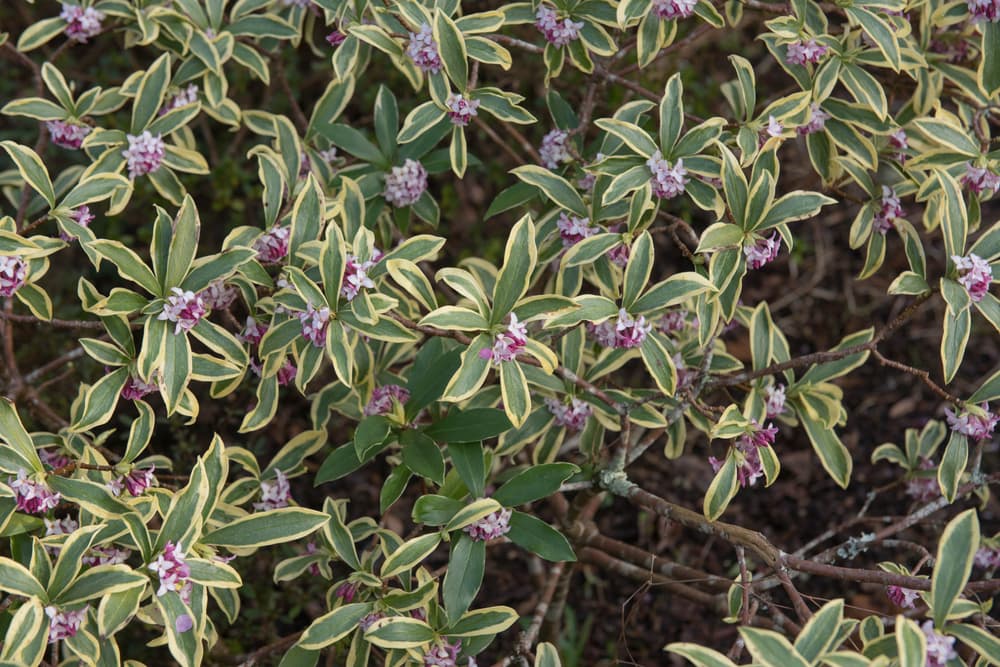
IN THIS GUIDE 1) Azalea 2) Buddleja 3) Camellia 4) Chaenomeles 5) Cornus 6) Daphne 7) Hydrangea 8) Magnolia 9) Pieris 10) Rhododendron 11) Sarcococca 12) Skimmia 13) Viburnum 14) Weigela References Flowering shrubs can bring a splash of much-needed colour to a dark and shaded area of your garden. Shady gardens are an increasingly common phenomenon around the UK, especially in towns and cities. If that sounds familiar, don’t fret. There are many varieties of flowering shrubs that positively thrive in full or partial shade, adding a dollop of lush foliage and a dazzle of bright blooms to a part of your garden which might otherwise suffer from a lacklustre aesthetic. Indeed, the options available to you are so plentiful that you’re simply spoiled for choice, but the following list (in alphabetical order) of our favourite flowering shrubs for shade can give you some inspiration when it comes to planning out a shady display. 1) Azalea COMMON NAME(S): AZALEA HARDINESS RATING: H6 PREFERRED SUNLIGHT: FULL SUN / PART SHADE FLOWERING PERIOD: SPRING RECOMMENDED VARIETIES: ‘ENCORE’, ‘CHERRY DROP’, ‘KIRIM’ Azaleas belong to the Rhododendron family, but generally speaking, the former are a smaller beast than their more expansive counterparts, with finer foliage and slower-growing habits. Azaleas are demanding when it comes to the acidity of the soil, but otherwise they’ll bloom impressively in partial shade. There are two types of azaleas, evergreen and deciduous, both of which are extremely hardy and easy to maintain once established. Simply mulch them each spring in order to give their roots an extra helping hand and marvel at the floral extravaganza they put on for you every year. Some double-blooming varieties, the aptly named Azalea ‘Encore’ is a notable case in point, will even repeat the trick once again in autumn. 2) Buddleja COMMON NAME(S): BUTTERFLY BUSH HARDINESS RATING: H6 PREFERRED SUNLIGHT: FULL SUN / PART SHADE FLOWERING PERIOD: SUMMER / AUTUMN RECOMMENDED VARIETIES: ‘BLACK KNIGHT’, ‘SANTANA’ This hardy shrub grows just about anywhere in the UK, from abandoned wastelands to immaculate country gardens. Although it prefers full sunlight, it’ll do just fine in partial shade and its abundant blooms (which last all season long) add cones of colour to the darker parts of your garden. It’s often colloquially known as a butterfly bush and you can expect to see plenty of these captivating creatures fluttering around it during the warmer months.1 It’s great for other pollinators too, making it ideal for boosting biodiversity in your garden. 3) Camellia COMMON NAME(S): CAMELLIA HARDINESS RATING: H5 PREFERRED SUNLIGHT: FULL / PART SHADE FLOWERING PERIOD: SPRING RECOMMENDED VARIETIES: ‘EXIMIA’, ‘DEBBIE’, ‘LUCINDA’ With glossy evergreen foliage and big, beautiful flowers that bloom in the late winter and early spring, camellias can be the forerunner you need to inject some vibrancy into your home after the colder months. They do best in partially shaded locations that are protected from strong gusts of wind. Although C. japonica is by far the most common variety of camellia in the UK, other strains such as C. x williamsii can be hardier and produce longer-lasting floral displays. Having said that, most camellia varieties are durable enough to look after themselves once established. 4) Chaenomeles COMMON NAME(S): JAPANESE QUINCE HARDINESS RATING: H6 PREFERRED SUNLIGHT: FULL SUN / PART SHADE FLOWERING PERIOD: SPRING RECOMMENDED VARIETIES: ‘WHITICE’, ‘SARGENTII’, ‘NIVALIS’ Otherwise known as Japanese quince, Chaenomeles japonica is an incredibly undemanding shrub to grow. Stick it in the shade, plonk it in substandard soil, train it to climb a fence or wall – the intrepid Chaenomeles is always up to the task. When early spring rolls around, Chaenomeles is a real sight to behold. Its wiry branches become studded with brilliant pockets of bright orange flowers, making it look like the whole bush is aflame. As the year rolls on, the flowers will eventually mature into greenish-yellow quinces, which can then be harvested and converted into an exquisite jelly. What’s not to like? 5) Cornus COMMON NAME(S): DOGWOOD HARDINESS RATING: H7 PREFERRED SUNLIGHT: FULL SUN / PART SHADE FLOWERING PERIOD: SPRING / SUMMER RECOMMENDED VARIETIES: ‘MAS’, ‘CHINA GIRL’, ‘ANNY’S WINTER ORANGE’ There are a wide variety of different Cornus shrubs; some are grown for the bright red brilliance of their winter stems alone, but there are plenty of flowering species to choose from, too. All of the above will do well in partial or even full shade but prefer fertile, well-drained soil that is rich in nutrients, and regular mulching can help with this. C. mas is a particularly popular variety of Cornus, delivering fragile yellow petals on its dense undergrowth. The floral blooms generally appear in late winter, while red fruits (Cornellian cherries) spring forth in late summer. 6) Daphne COMMON NAME(S): DAPHNE HARDINESS RATING: H4 PREFERRED SUNLIGHT: FULL SUN / PART SHADE FLOWERING PERIOD: WINTER / SPRING RECOMMENDED VARIETIES: ‘EXIMIA’, ‘NAKAFU’ In total, there are around 70 different types of Daphne, several of which are grown in the UK. With a variety of sizes, flowering calendars and floral blooms to choose from, you have plenty of options when it comes to tailoring the shrub to your garden’s requirements. Whichever strain you opt for, Daphnes inevitably perform best in partial shade and neutral, well-drained soil that maintains moisture without becoming waterlogged. They also don’t take kindly to being relocated, so choose your spot wisely. Once you do, however, you’ll be blessed with gorgeous blooms that are pleasing on both the eyes and the nostrils. 7) Hydrangea COMMON NAME(S): HYDRANGEA HARDINESS RATING: H5 PREFERRED SUNLIGHT: FULL SUN / PART SHADE FLOWERING PERIOD: SUMMER RECOMMENDED VARIETIES: ‘ANOMALA’, ‘PANICULATA’ There is an abundance of hydrangea species available in the UK, many of which have only been introduced in recent years. Some of those modern strains can offer longer floral blooms, a second flowering spell later in the year or even flowers which change colour as they mature. Whichever species you plump for, you’ll find them incredibly easy to grow, thriving in either full sun, full shade or anything in between, and climbing varieties can easily be trained to scale a wall or fence. “There are a variety of Hydrangeas to consider,” explains Master Horticulturist Colin Skelly. “The most common garden Hydrangea, H. macrophylla, will thrive in full shade and its flowers will light up a shady area from late summer to early winter.” Just be sure to plant them in moist soil, leave the seedheads on the plant over winter to protect the buds below, then prune them come spring and you can’t go wrong. 8) Magnolia COMMON NAME(S): MAGNOLIA HARDINESS RATING: H6 PREFERRED SUNLIGHT: FULL SUN / PART SHADE FLOWERING PERIOD: SPRING RECOMMENDED VARIETIES: ‘RUTH’, ‘HOT LIPS’, ‘MILKY WAY’ Although magnolias will perform best in full sun, they’ll still thrive in partial shade as long as they’re protected from the ravages of the wind. It’s for this reason that they’re often grown alongside walls and fences, in order to provide a shield against the elements and support for their drooping stalks. While they might take a little more coaxing into blossom than some of the other options on this list, they’re well worth the effort. In fact, their delicate and waxy flowers might be among the most eye-catching of all flowering shrubs, so taking the time to ensure magnolias have the conditions they need to come to maturity pays off dividends in the spring and summer. Expect the flowers in early summer, but verdant foliage the whole year round. 9) Pieris COMMON NAME(S): PIERIS HARDINESS RATING: H5 PREFERRED SUNLIGHT: FULL SUN / PART SHADE FLOWERING PERIOD: WINTER / SPRING RECOMMENDED VARIETIES: ‘FOREST FLAME’, ‘BLUSH’, ‘PRELUDE’ Pieris is one of the more ostentatious shade-tolerant shrubs out there. Its foliage will shoot forth new growth of a vivid red in spring, mellowing to subtler tones of pink in the summer, before settling into its customary green later in the year. It can handle semi-shade well and tolerates most soil types, but it flourishes best in acidic terrain. As for its blooms, the foliage of Pieris is complemented beautifully by masses of slender bell-shaped flowers in spring, normally white in colour. 10) Rhododendron COMMON NAME(S): RHODODENDRON HARDINESS RATING: H4 PREFERRED SUNLIGHT: PART SHADE FLOWERING PERIOD: SPRING RECOMMENDED VARIETIES: ‘BLUE PETER’, ‘CYNTHIA’, ‘MARKEETA’S PRIZE’ Rhododendrons are most commonly found in the wild among woodland areas, which means they enjoy the dappled shade that tree canopies provide. Replicating those conditions as closely as you can in your own garden will lead to the best results, although any partially shady spot will serve them well. Avoid full sun or full shade. Rhododendron is a genus encompassing many plants, including the aforementioned azaleas, meaning you should be able to find a variety which suits your desired colour palette.2 Whichever one you opt for, you’re guaranteed a head-turning display of blossoms in the late spring and large, leafy foliage all year round. 11) Sarcococca COMMON NAME(S): SWEET BOX / CHRISTMAS BOX HARDINESS RATING: H5 PREFERRED SUNLIGHT: FULL / PART SHADE FLOWERING PERIOD: WINTER RECOMMENDED VARIETIES: ‘PURPLE STEM’, ‘DRAGON GATE’ This compact, bushy shrub produces leathery green leaves, tiny white flowerheads and chunky blackberries. They thrive in full or partial shade and cope well in all well-drained but still moist types of soil, delivering their fragrant blossoms each winter and their fruit in summer. Sarcococca confusa (otherwise known as ‘Christmas box’ or ‘sweet box’) is an ideal pick for a sheltered corner of the garden, but plenty of other cultivars will do equally as well. S. ruscifolia is an even more space-efficient option if your garden dimensions are on the smaller side, while S. hookeriana has a lovely scent to its flowers. 12) Skimmia COMMON NAME(S): JAPANESE SKIMMIA HARDINESS RATING: H5 PREFERRED SUNLIGHT: PART SHADE FLOWERING PERIOD: SPRING RECOMMENDED VARIETIES: ‘RUBELLA’, ‘FRAGRANS’ Boxy shrubs native to China, Japan and the lower reaches of the Himalayan mountain range, skimmia generally grow to around 1m in height with the same spread, making them an ideal choice for cosier garden environments.3 Plant them at regular intervals and you can even create a bespoke hedge, fit for purpose. They’re most commonly grown for their impressive foliage, though pollinated females will produce red berries and both genders feature attractive clusters of white flowers, budding in late autumn and blossoming in spring. They thrive best in acidic soil, but will fare well in almost all soil types and require little in the way of maintenance throughout the year. 13) Viburnum COMMON NAME(S): VIBURNUM HARDINESS RATING: H5 PREFERRED SUNLIGHT: ANY FLOWERING PERIOD: SPRING RECOMMENDED VARIETIES: ‘DAVIDII’, ‘EVE PRICE’, ‘ESKIMO’ The viburnum family are a very diverse bunch. Choose between deciduous and evergreen varieties, those which flower in spring or summer and those which blossom in the colder months, and berry-bearing strains and sun- or shade-loving species. For providing variety and year-round floral extravagance, a mixture of viburnum never disappoints. For a British native, check out V. opulus, which thrives in all types of sun exposure and isn’t fussy about the soil it inhabits. Meanwhile, those searching for a cultivar that delivers evergreen colour and picturesque florets of miniature flowers should try V. davidii. This latter variety has a whole host of different subspecies, several of which handle partial shade without a problem. 14) Weigela COMMON NAME(S): WEIGELA HARDINESS RATING: H6 PREFERRED SUNLIGHT: ANY FLOWERING PERIOD: SPRING / SUMMER RECOMMENDED VARIETIES: ‘VARIEGATA’, ‘RED PRINCE’, ‘ROSEA’ Hardy, compact and easy to grow, it’s easy to see why weigelas are a popular option for borders, flower beds or standalone containers. The exquisite pinks, reds and whites of their blossoms make them a sight to behold wherever they’re planted and with a number of strains to choose from, you can mix and match to create a multi-coloured floral collage in your garden. Their diminutive dimensions mean they’ll fit snugly into any spot you select for them, while their capacity to do well in partial shade is ideal for anyone who doesn’t enjoy the luxury of an expansive south-facing garden. Some varieties are more tolerant of shade than others, however, so be sure to check the label carefully – W. florida ‘Variegata’ and ‘Foliis Purpureis’ are two cultivars that generally do well in less sunny spots. References 1. Young, M., Bullock, A., & Brookes, A. (2016). Butterflies & Moths: Three members of Butterfly Conservation give their views on the best Buddleja for butterflies. The Buddleja National Collection. Retrieved March 15, 2023, from https://www.buddlejacollection.com/butterflies-moths/ 2. The Editors of Encyclopaedia Britannica. (2023d, February 20). Rhododendron. Encyclopedia Britannica. Retrieved March 15, 2023, from https://www.britannica.com/plant/rhododendron 3. Skimmia japonica (Japanese Skimmia). (n.d.). North Carolina Extension Gardener Plant Toolbox. Retrieved March 15, 2023, from https://plants.ces.ncsu.edu/plants/skimmia-japonica/
Learn more
Who Doesn't Love Yellow Perennials? Here Are 20 That Will Keep Coming Back
IN THIS GUIDE 1) Yarrow 2) Corn Marigold 3) Primrose 4) Chamomile 5) Juniper 6) American Skunk Cabbage 7) Sunflower 8) Sneezeweed 9) Jeannine 10) Hooker Inula 11) Sweet Laura 12) Sauce Hollandaise 13) Daylily 14) Iris 15) Tickseed 16) St John’s Wort 17) Black Eyed Susan 18) Yellow Flowered Hellebore 19) Yellow Corydalis 20) Red Hot Pokers References Yellow perennials can bring the twin advantages of low maintenance with high impact to your garden’s palette. Who doesn’t love yellow flowers? Bringing a splash of sunshine to your garden, these reliable crowd-pleasers can make it feel like summer even when temperatures drop and the nights begin to grow longer. By selecting perennial varieties too, you can reap the benefits of a hardier plant that’ll require little maintenance – while mixing and matching the plants you choose can result in continual blooms from early spring right through until the end of autumn. “I love to use clumps of yellow plants to act like pots of gold, leading the eye through a garden, as perhaps the most visible colour to us and many pollinators,” shares Master Horticulturist Peter Lickorish. If you’re looking for inspiration for which yellow flowering perennials to introduce into your garden, this list of our favourites should give you plenty of food for thought. 1) Yarrow BOTANICAL NAME: Achillea millefolium HARDINESS RATING: H7 FLOWERING SEASON: SUMMER Yarrow blooms in a range of different colours, with yellow, white and pink being the most common varieties. “‘Sassy Summer Lemon’ is a more intense yellow, while ‘Summer Fruits Lemon’ is a creamy yellow,” shares Master Horticulturist Peter Lickorish. They’re immediately identifiable by their tight clusters of tiny flowers, whose flat-topped appearance calls to mind a levelled-off umbrella. They’re hardy plants that love the sun, thriving in well-drained soil and blooming from the end of spring to the beginning of autumn. Their delicate leaves, feathery to the touch, give off a pleasing aroma when crushed. 2) Corn Marigold BOTANICAL NAME: Glebionis segetum HARDINESS RATING: H7 FLOWERING SEASON: SUMMER Although not a true native flower, corn marigold has been fully naturalised across much of northern Europe today.1 It has upright stems growing to a medium height, topped with large, daisy-like discs of brilliant yellow. It grows well in most types of soil, though not alkaline soils, and it enjoys as much sun as you can give it. Its eye-catching yellow blooms occur from late spring to early autumn and are complemented by its bluish-green foliage, which is covered in a fine waxy layer and emanates an attractive odour. The plant is hugely popular among bees and butterflies, making it a great pollinator that encourages garden biodiversity. 3) Primrose BOTANICAL NAME: Primula vulgaris HARDINESS RATING: H7 FLOWERING SEASON: SPRING The pale yellow of the primrose is one of the first signs that spring has sprung, and as such can inject a welcome dose of colour into your garden come March. Its rosette-shaped flowers grow up to 4cm in diameter and will offer a pleasing contrast to the greenery around it, while it flourishes best in soil that receives some shade. If planting in full sun, make sure the soil is always moist and be mindful of aphids and other pesky insects which feed upon it. The name of the flower comes from the Latin prima rosa, meaning first rose of the year.2 It’s no surprise, therefore, that it’s one of the earliest bloomers, although April 19th is officially known as “Primrose day” despite the flowers blooming long before then. The reason? That date is the anniversary of former UK Prime Minister Benjamin Disraeli’s death – and the primrose was his favourite flower.3 4) Chamomile BOTANICAL NAME: Chamaemelum nobile HARDINESS RATING: H7 FLOWERING SEASON: SUMMER This delicate flowering perennial grows up to 25cm in height and features oversized daisy-like heads, with bright yellow disc florets at their centre and white petals It used to grow wild all across the UK, but now is confined mainly to the southwest of England. However, it can be cultivated fairly easily in your garden in well-drained soil receiving full sun, but requires regular pruning to encourage dense growth. The plant gives off a pleasing apple scent when crushed. 5) Juniper BOTANICAL NAME: Juniperus communis HARDINESS RATING: H7 FLOWERING SEASON: SPRING Unlike the other entrants on this list, juniper is an evergreen shrub rather than a flower. However, it does produce small yellow blooms in May and June, which are closely followed by juniper berries. Gin enthusiasts will know all about these, with the name of the spirit actually coming from either the Dutch (genever) or French (genièvre) word for the plant.4 Juniper grows best in well-drained soil, but is hardy enough to flourish either in full sun or partial shade. It also requires little in the way of maintenance, but growers should keep in mind that its berries and flowers are significantly outperformed by its sprawling and spindly foliage – so planting locations should accommodate its prickly nature. 6) American Skunk Cabbage BOTANICAL NAME: Lysichiton americanus HARDINESS RATING: H4 FLOWERING SEASON: SPRING As the name suggests, this plant is not native to the UK, but rather hails from North America. It is considered an invasive species due to the fact that it quickly outgrows its space and outcompetes native rivals, causing significant damage to local flora if left unchecked.5 You can therefore no longer buy this plant in the UK, but the tender calla lily Zantedeschia ellottiana has a similar aesthetic. Despite the unpleasantness of its name, skunk cabbage boasts brilliant yellow flowers up to 30cm in height, bolstered by broad leaves growing up to 90cm. Whilst it adds exquisite elegance to a pond or other water feature (it thrives in fertile and very moist soil) remember to ensure it doesn’t encroach on neighbouring species. Allowing it to spread to the wild is illegal and material must be disposed of carefully.6 7) Sunflower BOTANICAL NAME: Helianthus HARDINESS RATING: H4 FLOWERING SEASON: SUMMER There are a wide variety of different sunflower species to choose from when it comes to bringing some of their tall and slender splendour into your garden. Perennial species such as H. salicifolius return year after year, along with its attention-demanding cousin ‘Lemon Queen’. Other exciting varieties like ‘Solar Chocolate Gold’ are annuals, so do your research beforehand to find the species and cultivar that suits your needs best. Whichever one you plump for, the sunflower invariably performs best in fertile and moist (but well-drained) soil. It also demands plenty of sunshine exposure (as you might guess from its name), while it’s also susceptible to slugs and requires pruning after flowering due to the fact that old stems die away in the winter months. 8) Sneezeweed BOTANICAL NAME: Helenium HARDINESS RATING: H7 FLOWERING SEASON: SUMMER / AUTUMN Again, Helenium (or sneezeweed as it is more colloquially known) comes in a wide range of varieties. One of our particular favourites is ‘El Dorado’ (pictured above), which features upright clumps ending in bright yellow flowers (tinged with red) centred around a brown cone. Blooming from midsummer to early autumn, the flower is the perfect addition to any yellow floral arrangement. Hardy enough to perform well in almost all soil types, Helenium ‘El Dorado’ does prefer decent drainage and requires full sun to properly flourish. In order to prolong its bloom, it’s important to deadhead it periodically, while it should be pruned halfway after it has bloomed and cut back all the way to its base in winter. Alternatively, leave its old stems and last spent flowers to stand upright over the winter and the seed heads have a skeletal elegance, especially when frosted. 9) Jeannine BOTANICAL NAME: Allium moly ‘JEANNINE’ HARDINESS RATING: H6 FLOWERING SEASON: SUMMER This bulbous perennial plant can grow up to 40cm in height and features tight clumps of grey-green leaves, topped with star-shaped flowers of a yellow variety in early summer. It performs best when exposed to full sun and also prefers reasonably fertile soil, but it doesn’t require much in the way of maintenance after planting and can fend off most pests on its own. It’s an ornamental onion plant and although it won’t bear edible produce for humans, it’s a favourite among bees, moths, butterflies and other pollinators, so it’s a good one to have around the garden in order to encourage biodiversity and promote growth. 10) Hooker Inula BOTANICAL NAME: Inula hookeri HARDINESS RATING: H6 FLOWERING SEASON: SUMMER Hooker inula is non-native and can be quite invasive, a little like the Skunk cabbage mentioned above. Originally hailing from the Himalayan mountains, it can propagate quickly and interfere with the development of plants in its vicinity, so be sure to choose your planting site with care when it comes to finding room for it in your garden.7 However, it is also just as eye-catching as the Skunk cabbage, meaning its invasive properties shouldn’t discourage inclusion in your display. With oversized flowers capable of growing up to 8cm in diameter and thin, tapering petals, it’s sure to draw the attention of visitors to your house throughout the summer months when it’s in full bloom. It enjoys partial shade and fertile, well-drained soils, but it’s resilient enough in most situations and works well in borders and beds. 11) Sweet Laura BOTANICAL NAME: Alstroemeria ‘SWEET LAURA’ HARDINESS RATING: H4 FLOWERING SEASON: SUMMER / AUTUMN Also known as the Peruvian lily, Sweet Laura is another striking cultivar of a non-native species that has become increasingly popular in gardens across the UK in recent years. That’s largely due to the brilliance of its flowers, which feature yellow petals flecked with a deep maroon and protruding stamen of the same red hue. It forms compact mounds and blooms from early summer to early autumn. This plant likes moist but well-drained soils and will cope well in most conditions, but does benefit from mulching annually in the first two years after planting. 12) Sauce Hollandaise BOTANICAL NAME: Anthemis tinctoria ‘SAUCE HOLLANDAISE’ HARDINESS RATING: H6 FLOWERING SEASON: SUMMER This knee-high perennial offers everything you might want in a yellow flowering plant for your garden. It’s incredibly easy to cultivate, requires minimal maintenance and produces masses upon masses of daisy-like flowerheads each summer, blooming throughout the warmer months and into autumn. The only real demand it places upon you is adequate soil drainage and full sun exposure. Its sprawling yellow-centred flowers complement a variety of backgrounds, from dense green foliage to spikes of startling colour. It also makes a beautiful cut flower in its own right, while the lovely aromatic scent given off by its foliage will stimulate the nostrils as well as the eyes. All in all, it’s an excellent addition to any garden due to its versatility, hardiness and eye-catching aesthetic appeal. 13) Daylily BOTANICAL NAME: Hemerocallis HARDINESS RATING: H6 FLOWERING SEASON: SUMMER Daylilies come in a variety of different forms, from the pastel yellow of ‘Stella de Oro’ to the pink and yellow ‘Catherine Woodbury’ to the more exotic reds, pinks and purples of other species. Regardless of which one you pick, they will invariably add irrepressible energy to your garden with their trumpet-like blooms and delicate petals. Although individual flowers only last for a single day, a daylily plant will produce plentiful blooms throughout summer, meaning your displays will look fantastic for weeks on end. They are hardy enough to require little care or maintenance, growing in sun or partial shade and being unfussy when it comes to the type of soil. They don’t require pruning, either, though they can be pared back right down to their base after flowering in order to encourage more growth the subsequent year. 14) Iris BOTANICAL NAME: Iris germanica HARDINESS RATING: H7 FLOWERING SEASON: late SPRING / early summer Irises come in a lovely spectrum of different colours – but perhaps none are quite as resplendent as the the fresh yellow of ‘Chickee.’ Its feathery petals communicate an image of fragile beauty, while its alluring odour and pleasing aesthetics are sure to turn the heads of any visitors to your garden during June when the flowers are in full bloom. Irises thrive when grown in full view of the sun and they prefer fertile and well-drained soil with slightly acidic content. After two years or so, they should reach their full height of around 0.5m, while you can encourage continual growth by removing fading foliage in early autumn – then stripping them back completely once all flowers have withered later on in the season. 15) Tickseed BOTANICAL NAME: Coreopsis HARDINESS RATING: H5 FLOWERING SEASON: SPRING / SUMMER 16) St John’s Wort BOTANICAL NAME: HYPERICUM HARDINESS RATING: H5 FLOWERING SEASON: SUMMER 17) Black Eyed Susan BOTANICAL NAME: Rudbeckia fulgida HARDINESS RATING: H6 FLOWERING SEASON: SUMMER / AUTUMN 18) Yellow Flowered Hellebore BOTANICAL NAME: Helleborus orientalis HARDINESS RATING: H7 FLOWERING SEASON: WINTER / SPRING 19) Yellow Corydalis BOTANICAL NAME: Corydalis lutea HARDINESS RATING: H5 FLOWERING SEASON: SPRING / SUMMER 20) Red Hot Pokers BOTANICAL NAME: Kniphofia HARDINESS RATING: H5 FLOWERING SEASON: SUMMER References 1. Corn Marigold (Glebionis segetum). (n.d.). iNaturalist. Retrieved March 27, 2023, from https://www.inaturalist.org/taxa/77281-Glebionis-segetum 2. Primroses – heralds of spring. (2017, March 2). Woodlands.co.uk. Retrieved March 27, 2023, from https://www.woodlands.co.uk/blog/flora-and-fauna/primroses-heralds-of-spring/ 3. ‘Primrose Day‘, Frank Bramley, 1885. (n.d.). The Tate. Retrieved March 27, 2023, from https://www.tate.org.uk/art/artworks/bramley-primrose-day-t03962 4. What is Genever? (n.d.). By The Dutch. Retrieved March 27, 2023, from https://www.bythedutch.com/genever/ 5. American Skunk Cabbage. (n.d.). Scottish Invasive Species Initiative. Retrieved March 27, 2023, from https://www.invasivespecies.scot/american-skunk-cabbage 6. Be Plant Wise. (n.d.). NNSS. Retrieved October 2, 2023, from https://www.nonnativespecies.org/what-can-i-do/be-plant-wise/ 7. Inula hookeri | Hooker inula. (n.d.). Royal Horticultural Society. Retrieved March 27, 2023, from https://www.rhs.org.uk/plants/9172/inula-hookeri/details
Learn more
"There's More Than Just Bluebells" - Choosing 12 Blue Coloured Wildflowers For The Garden
IN THIS GUIDE 1) Bluebell 2) Harebell 3) Cornflower 4) Chicory 5) Field Scabious 6) Common Forget-Me-Not 7) Sweet Violet 8) Viper’s Bugloss 9) Bugle 10) Sea Holly 11) Meadow Clary 12) Spiked Speedwell References Create a mesmerising daydream in blue in your own garden with these twelve blue-coloured wildflowers for the garden. There’s nothing quite like a touch of blue to make the colours in your garden pop and really bring it to life. Whether you want to introduce random pockets of blue into the overall palette, concentrate it in one area or aim for a completely blue theme in your outdoor space, the UK offers plenty of wildflowers to satisfy your needs. “There are a number of blue native wildflowers that make good garden plants and are also suitable for meadows,” says Horticultural Consultant Colin Skelly. “Many have become scarcer due to industrial agricultural practices, so gardens provide a good opportunity to boost their numbers whilst you enjoy them.” Here are a dozen of the prettiest blue-coloured wildflowers out there, guaranteed to spruce up your garden’s colour scheme and bring some joie de vivre to your space. 1) Bluebell BOTANICAL NAME: Hyacinthoides non-scripta PLANT TYPE: DECIDUOUS BULB HARDINESS RATING: H6 UK NATIVE: YES FLOWERING SEASON: SPRING It’s surely the first thought that springs to anyone’s mind when discussing blue wildflowers, so we might as well get it out of the way early on. With its iconic bell shape, delicately curved petals and folkloric connotations, bluebells are a favourite among any flower lover. A perennial bulb, bluebells bloom from April onwards and prefer shade and humidity to thrive. They’re found throughout the UK but concentrated more densely in the woodlands of England, while the British variety should not be confused with its Spanish counterpart.1 The difference between the two is that the flowers on UK bluebells droop to one side, while their Latin cousins stand more upright.2 Bring some fairy magic into your garden with these beauties! 2) Harebell BOTANICAL NAME: Campanula rotundifolia PLANT TYPE: HERBACEOUS PERENNIAL HARDINESS RATING: H7 UK NATIVE: YES FLOWERING SEASON: SUMMER Sometimes referred to as Scotland’s answer to the bluebell, the harebell is not actually related to its more illustrious counterpart. It goes by a variety of other monikers, too, including Witch’s Bell, Cuckoo’s Shoe and Old Man’s Shoe – and the old man being referred to here is none other than the devil himself.3 It’s also connected with true love in some folklore. Whatever name it goes by, the harebell is a deceptively robust little specimen. Its drooping bells and paper-like petals might give it the appearance of a fragile flower, but the harebell is actually a hardy little plant that can survive well as long as it’s given the conditions it requires. It does best on dry grasslands exposed to the elements, such as windswept shorelines or bare hills. 3) Cornflower BOTANICAL NAME: Centaurea cyanus PLANT TYPE: DECIDUOUS ANNUAL HARDINESS RATING: H6 UK NATIVE: YES FLOWERING SEASON: SPRING / SUMMER Blue, blue, electric blue – cornflowers are striking enough to give your garden the gift of sound and vision. In fact, their flowers are so vibrant that they even have a colour named after them! The most expensive sapphires are ‘Cornflower blue’, which is testament to the value placed upon this stunning shade of flower. The species is so named because it is commonly found in croplands across the UK (especially central and southern England), often rising proudly above the arable produce surrounding it. Indeed, the fact that cornflowers can surpass a metre in height means they’re best placed next to a fence or other border, while they thrive best in slightly sandy soils that are not too dense. 4) Chicory BOTANICAL NAME: Cichorium intybus PLANT TYPE: Herbaceous Perennial HARDINESS RATING: H5 UK NATIVE: NO FLOWERING SEASON: SUMMER The pastel blues found on the petals of a chicory plant can be a lovely addition to any garden. Not only will it spruce up a sunny border or add a flash of colour to a sea of foliage, but it’s also a huge draw for pollinating insects. This means that it’s ideal for encouraging biodiversity into your garden and returns the best results when planted in tandem with species like viper’s bugloss (see below). Chicory plants perform well in dry and dusty sites, which is why it’s often seen at the side of busy roads where conditions are arid. To replicate a similar environment at home, plant it in sandy soil or that containing traces of chalk or limestone. It’s a tallish variety, growing to well over half a metre in size, so bear that in mind when choosing a location for it among your other florae. 5) Field Scabious BOTANICAL NAME: Knautia arvensis PLANT TYPE: Clump-Forming Perennial HARDINESS RATING: H7 UK NATIVE: YES FLOWERING SEASON: SUMMER / AUTUMN Another species which is often found at the roadside, Field Scabious are perhaps more lilac or lavender than outright blue. Having said that, they can certainly complement an azure colour scheme and bloom exceptionally well; a single plant can produce up to 50 flowers, while the fact that their blooming period lasts so long makes them attractive to bees and other pollinators. Field Scabious are easily identifiable by their spindly stalks with oversized, pompom-like flowers growing atop of them. 6) Common Forget-Me-Not BOTANICAL NAME: Myosotis arvensis PLANT TYPE: SHORT-LIVED PERENNIAL HARDINESS RATING: H7 UK NATIVE: YES FLOWERING SEASON: SPRING / SUMMER Prolific on arable terrain, the common forget-me-not (sometimes known as field forget-me-not) is actually deemed a weed by farmers who wish to clear their lands.4 Just one look at its small, blue (and sometimes pink) flowers will make you question how something so pretty could ever be thought of as a nuisance, but its name soon reminds that not everyone sees it that way. Indeed, the forget-me-not was christened due to the fact that it was often viewed as a symbol of love, so hopeful suitors would gift them to their beloved to ensure they remained close in their memory. It has incredible longevity and ingenious methods of seed dispersal – when rubbed up against, the small seedpods will cling to clothing, before being dropped in other locations in which they can germinate afresh. This flower will grow easily in cultivated land. 7) Sweet Violet BOTANICAL NAME: Viola odorata PLANT TYPE: Rhizomatous Perennial HARDINESS RATING: H6 UK NATIVE: YES FLOWERING SEASON: WINTER / SPRING Another one that leans more to the purple end of the spectrum, sweet violets can grow in both blue and white varieties, as well. They favour woodland and hedgerows, providing offshoots of bright colour in among the foliage. While they’re found throughout the UK, their distribution is not as widespread in Scotland, Wales and northern England. Sweet violets have a long and interesting history with regard to the romantic connotations that various civilisations and cultures have attached to them. The ancient Greeks, for example, extracted their essence to make perfume, while the Romans did the same to produce wine.5 8) Viper’s Bugloss BOTANICAL NAME: Echium vulgare PLANT TYPE: Deciduous Biennial HARDINESS RATING: H7 UK NATIVE: YES FLOWERING SEASON: SUMMER There’s no mistaking this fearsome but fascinating flower. So named for its serpentine appearance, Viper’s Bugloss is characterised by its tall, thick and hairy stems, vivid blue blooms and coarse petals surrounding a brilliant red stamen which flicks out like a snake’s tongue. Bees, butterflies and other pollinating insects can’t get enough of it. It thrives well in chalky soil and flowers in the summer months, at which time it will bring an unmistakable charm to your backyard. 9) Bugle BOTANICAL NAME: Ajuga reptans PLANT TYPE: EVERGREEN PERENNIAL HARDINESS RATING: H7 UK NATIVE: YES FLOWERING SEASON: SPRING / SUMMER This evergreen perennial plant will continue to grow all year round, but comes to life in the spring. In April, its dense undergrowth of dark green leaves will shoot forth great spikes of blue flowers, complemented with purple highlights, adding colour, texture and variety to any background which it adorns. It’s a low-growing ground cover plant, so bear that in mind when it comes to planting. The bugle is found all over the UK, preferring woodlands, meadows and hedges as its preferred habitats. Damp conditions are what it loves most, so soil that is rich in organic matter should see it prosper. 10) Sea Holly BOTANICAL NAME: Eryngium maritimum PLANT TYPE: Clump-Forming Perennial HARDINESS RATING: H5 UK NATIVE: YES FLOWERING SEASON: SPRING / SUMMER In appearance, Sea Holly resembles something like a combination between its Christmas namesake and Scotland’s national flower, the thistle. In actuality, it’s related to neither! Even more surprisingly, it’s actually an unlikely member of the carrot family.6 It’s immediately identifiable by its tall stems, spiky leaves and bluish-green, pin-cushion-like flowers. In 2002, the sea holly was nominated as the flower for the city of Liverpool, most likely due to its widespread appearance along the Wirral.7 It favours sandy dunes and shorelines, meaning it’ll do best in free-draining soils exposed to lots of sunshine. Bear in mind, though, that those leaves can be quite sharp to the touch, so planting it well away from paths is advisable! 11) Meadow Clary BOTANICAL NAME: Salvia pratensis PLANT TYPE: Herbaceous Perennial HARDINESS RATING: H7 UK NATIVE: NO FLOWERING SEASON: SUMMER Easy on the eye, meadow clary has tall stems with clumped offshoots of brilliant blue flowers. It used to be widespread throughout the British Isles until the middle of the last century, when a change in agricultural practices saw it crowded out by other plants. It is now classified as a near threatened species and is only found in 21 native locations around the UK.8 It’ll fare best in soil with chalk or limestone content that’s open to the sun, while its petals give off a very pleasant aroma when crushed. 12) Spiked Speedwell BOTANICAL NAME: Veronica spicata PLANT TYPE: Clump-Forming Perennial HARDINESS RATING: H4 UK NATIVE: YES FLOWERING SEASON: SUMMER With long stems, jagged leaves and extensive spikes of vivid blue-purple flowers tapering towards their apex, spiked speedwell is an excellent border plant that draws the eye with its vibrancy and size. The flower of the historic Welsh county of Montgomeryshire (or Maldwyn), spiked speedwell is found scattered in isolated pockets throughout England and Wales.9 As for cultivation, it’s a fairly hardy species which can fare well in most soil types, though best results will be witnessed when situated in well-drained terrain. It prefers full sun but can also thrive in south-facing areas of the garden, while it blooms from July to September. References 1. Bluebell (Hyacinthoides non-scripta). (n.d.). Woodland Trust. Retrieved March 13, 2023, from https://www.woodlandtrust.org.uk/trees-woods-and-wildlife/plants/wild-flowers/bluebell/ 2. Titford, K. (2018, March 1). How to tell a native bluebell from the rest. Berkshire, Buckinghamshire & Oxford Wildlife Trust. Retrieved March 13, 2023, from https://www.bbowt.org.uk/blog/kate-titford/how-tell-native-bluebell-rest 3. Harebell. (n.d.). Plantlife. Retrieved March 13, 2023, from https://www.plantlife.org.uk/uk/discover-wild-plants-nature/plant-fungi-species/harebell 4. Distribution and biology of field forget-me-not in the UK. (n.d.). AHDB. Retrieved March 13, 2023, from https://ahdb.org.uk/knowledge-library/distribution-and-biology-of-field-forget-me-not-in-the-uk 5. Sweet violet. (n.d.). Plantlife. Retrieved March 13, 2023, from https://www.plantlife.org.uk/uk/discover-wild-plants-nature/plant-fungi-species/sweet-violet 6. Apiaceae (umbellifers), wildflowers of the Carrot family. (n.d.). First Nature. Retrieved March 13, 2023, from https://www.first-nature.com/flowers/~apiaceae.php 7. Sea Holly (Eryngium maritimum). (2008, September 13). Geograph. Retrieved March 13, 2023, from https://www.geograph.org.uk/photo/909824 8. Conservation of Britain’s biodiversity: Salvia pratensis L. (Lamiaceae), Meadow Clary. (n.d.). Walsonia. Retrieved March 13, 2023, from https://archive.bsbi.org.uk/Wats22p405.pdf 9. Veronica spicata: Spiked Speedwell. (n.d.). NBN Atlas Wales. Retrieved March 13, 2023, from https://wales-species.nbnatlas.org/species/NBNSYS0000004105
Learn more
17 Types Of Thistles With Native, Naturalised And Even Edible Options
IN THIS GUIDE Why Grow Thistles In Your Garden? Native / Naturalised Thistles 1) ‘Scottish Thistle’ (Onopordum acanthium) 2) Spear Thistle (Cirsium vulgare) 3) Melancholy Thistle (C. heterophyllum) 4) Creeping Thistle (C. arvense) 5) Meadow Thistle (C. dissectum) 6) Marsh Thistle (C. palustre) 7) Woolly Thistle (C. eriophorum) 8) Slender Thistle (Carduus tenuiflorus) 9) Musk Thistle (C. nutans) Other ‘Thistles’ & Thistle-Like Plants 10) Carline Thistle (Carlina spp.) 11) Common Knapweed (Centaurea) 12) Blue Sow Thistle (Cicerbita alpina) 13) Globe Thistles (Echinops) 14) Milk Thistle (Silybum marianum) 15) Globe Artichoke (Cynara scolymus) 16) Cardoon (C. cardunculus) 17) Sea Hollies (Eryngium) References Thistles are flowering plants characterised by their sharp prickles – some are common weeds but many can be great additions to UK gardens. Sometimes, the word ‘thistle’ is used to refer only to specific genera – Cirsium, Carduus and Onopordum. And sometimes it is used more broadly to refer to a wider range of prickly flowering plants. However you define the term, thistles can be very useful and attractive plants for your garden. Even those commonly considered to be weeds can be great choices to consider. We will begin by discussing a number of native or naturalised thistles that could be grown in UK gardens. Then we will go on to discuss other plants referred to as thistles or thistle-like plants that you might want to grow in your garden. Why Grow Thistles In Your Garden? The first and most important thing to recognise is that some of the plants listed below can be rather thuggish – they can be invasive plants and can quickly become irritating weeds if you do not take care.1 However, all of the thistles or thistle-like plants on this list are also excellent for wildlife – so it is well worthwhile considering giving them some space in a wildlife-friendly garden. Thistles of different types are important nectar sources for pollinators.2 When we are too zealous in getting rid of thistles or are reluctant to give them space in our gardens, we risk diminishing biodiversity and contributing to the loss of many important pollinator species. The spear thistle ranked in the top ten for nectar production in a survey carried out here in the UK, and this and other thistles are valued by bumblebees, for example, for their high nectar production.3 Thistles are also important for a range of lepidoptera, and are a favourite nectar source for several native butterflies, including the ‘painted lady’.4 Thistle seeds are also an important food source for finches and other seed-eating birds.5 You might be surprised to learn that thistles can also be a human food source. A number of thistles and thistle-like plants have edible uses and can also provide other yields in an abundant and productive garden. Native / Naturalised Thistles 1) ‘Scottish Thistle’ (Onopordum acanthium) Onopordum acanthium While it is likely to be one of the common plants that spring to mind when you think of the thistle, this national emblem of Scotland, chosen by Sir Walter Scott, is not actually a native plant.6 It is believed to have been introduced in Europe pre-16th century and has now naturalised in many areas. Though vigorous and often considered a weed, it can still be a useful plant, in flower from July to September and noted for attracting wildlife. The flower buds can be cooked and eaten, though are a little fiddly, and stems (with rind removed) can be boiled like asparagus or rhubarb. 2) Spear Thistle (Cirsium vulgare) C. vulgare The spear thistle, common thistle or bull thistle is the most likely candidate for the true Scottish thistle. This is also abundant in Scotland and native throughout much of the UK. This also has great benefits for wildlife, and has limited culinary uses. The root can be cooked and is somewhat akin to Jerusalem artichoke – and the flower buds can also be cooked and eaten. The dried flowers can also be used as a rennet substitute in cheese making.7 Though it can be a pernicious weed, eating the weeds can be a great way to deal with them while retaining natural biodiversity in your garden. 3) Melancholy Thistle (C. heterophyllum) C. heterophyllum A plant found in upland pastures in the north of the UK, it is common to see it in hay meadows, open woodlands and along streams and woodland verges. It could be another thistle to include in your garden. Unlike other thistles, it does not have prickles. Its leaves have a dense white felt underneath and it has single purple, thistle-like flowers. 4) Creeping Thistle (C. arvense) C. arvense This is the most common thistle species in the UK and is frequently found on disturbed and cultivated ground.8 It spreads very quickly and is often considered a weed, but like the other thistles mentioned, it has great benefits to wildlife. Its seeds are an important food source for garden and farmland birds. Like other thistles, these too have historically been viewed as a human food source.9 5) Meadow Thistle (C. dissectum) C. dissectum The meadow thistle is an herbaceous perennial that is small and slender, without large spines on its leaves. It is a short thistle, up to around 80cm in height, with single pinky-purple flowers. And is commonly found on damp meadows and grassland. It could find a place in a similar habitat in your garden if you are in Southern England, South Wales or Northern Ireland. 6) Marsh Thistle (C. palustre) C. palustre The marsh thistle or European swamp thistle is a tall thistle that produces a lot of nectar for a wide variety of pollinators.10 It thrives in damp ground such as wet fields, marshes or stream banks. Typically the multiple flowers of this plant are purple though white flowers are sometimes also found. 7) Woolly Thistle (C. eriophorum) C. eriophorum This is one somewhat more scarce species of thistle that is found mainly in Southern England. It prefers chalk or limestone grasslands and will do well in these conditions in a southern garden.11 The woolly flower heads of this type of thistle are unmistakable. The reddish-purple flowers top spiny bracts that are covered in ‘white wool’. 8) Slender Thistle (Carduus tenuiflorus) Carduus tenuiflorus The slender thistle, also known as the seaside thistle, occurs naturally occasionally in the UK, mainly in coastal regions. It occurs very infrequently inland. It is quite tall, and bears small pinking flower heads in compact clusters of 3 or more. This is a thistle for coastal gardens with free-draining soil. A similar and more widespread species is Carduus crispus, the welted thistle, which is found in several areas of the UK, south of Edinburgh. 9) Musk Thistle (C. nutans) C. nutans The musk thistle is found throughout the UK but is most common in England and Wales. It is a common species of chalky soil and so could be a useful garden plant if you have this soil type where you live.12 It is common to see this plant on roadside verges or rough grassland, and it could be a good choice for a wilder, less tended part of your garden. Other ‘Thistles’ & Thistle-Like Plants 10) Carline Thistle (Carlina spp.) Carlina spp. The Carline thistle produces distinctive brown-and-golden flower heads that resemble a seeded thistle. This spiny biennial plant thrives on dry, chalk grassland in England and Wales. They create interest over a long period, the flower heads look like a thistle that has gone to seed, but they are actually in full flower. And the dead heads then persist, often through winter to the following spring. 11) Common Knapweed (Centaurea) Common Knapweed Common knapweed is frequently found on all sorts of grasslands around the UK. It has thistle-like purple flower heads and like the true thistles described above, attracts a wide range of wildlife including many native butterfly species including common blues, marbled whites and meadow browns.13 It can be a great flowering plant to naturalise in your lawn. 12) Blue Sow Thistle (Cicerbita alpina) Cicerbita alpina A rare native of Scotland, the blue sow thistle is a perennial hardy to UK zone 4. It thrives in partial or dappled shade and prefers moist soil, and the limited sites where it grows in Scotland are at the edge of its native range. It is a protected species in the UK – if you live in the Highlands then perhaps you could be involved in conservation efforts by cultivating this flowering thistle-like plant. Even in other areas, it can make a good garden plant. 13) Globe Thistles (Echinops) Echinops Echinops is a genus known commonly as ‘globe thistles’. They have spiny foliage and blue or white flower heads in a spherical shape. Echinops such as the blue globe thistle E. bannaticus can be excellent choices for garden plants. They will do best in a well-drained soil in full sun but will tolerate most soils in full sun, or light shade. Try E. bannaticus ‘Star Frost’, E. bannaticus ‘Taplow Blue’, E. ritro ‘Vietch’s Blue’ or E. ritro ‘Arctic Glow’. These are all great pollinator plants and also beautiful ornamental plants for a garden. 14) Milk Thistle (Silybum marianum) Silybum marianum Milk thistles, also called blessed Mary’s thistles, blessed thistles or lady’s thistles, are robust perennials that form rosettes of large, spiny leaves veined with white, and purple flower heads. Native to the Mediterranean, they can grow in a UK garden in full sun, in poor to medium fertile, well-drained soil that has neutral or mildly alkaline pH. It also potentially has a number of edible uses, though in nitrogen-rich soil it can accumulate nitrates, so care should be taken.14 15) Globe Artichoke (Cynara scolymus) Cynara scolymus If you were intrigued by the edible possibilities of some of the thistles listed above then you will likely be very interested in growing globe artichokes in your garden. Cynara are thistle-like plants that find a place in many edible gardens. C. scolymus is the common edible globe artichoke. The edible portion of the plant is of course the flower bud before the flowers come into bloom. There are a number of edible cultivars that can be grown in the United Kingdom. Artichoke hearts are a delicacy common in Italy and other countries, and the leaves covering the choke are also edible. 16) Cardoon (C. cardunculus) C. cardunculus The ancestor of the globe artichoke, the cardoon or ‘wild artichoke’ is another option to consider. “Solely on ornamental merit, the Cardoon has great presence in the garden,” says Master Horticulturist Colin Skelly. “Even when not in flower, its large silver foliage is a great foil for many other perennials.” The stems of cultivated varieties are also used as food around the Mediterranean, and this is also a source for a rennet substitute used in cheese making. The leaf stalks look like large celery stems. They can be steamed or braised and have an artichoke like flavour with a little bitterness. 17) Sea Hollies (Eryngium) Eryngium Finally, no discussion of growing thistles in the UK would be complete without some discussion of the group of thistle-like plants called Eryngium. These spiny perennials are dramatic and architectural in form and some look superficially like thistles. They can be great garden plants which can be used to great effect in many garden schemes. Eryngium, also called sea hollies, will thrive in a very free-draining soil, sometimes even soils that are lacking in nutrients. They do best in full sun. Avoid planting them in rich soils, or in the shade. Some Eryngium to grow in the UK include: E. giganteum E. bourgatii E. pandanifolium E. x tripartitum E. x oliverianum Like the other thistles and thistle-like plants mentioned above, Eryngiums not only look beautiful but can also help you to create a wildlife-friendly garden. This list is by no means an exhaustive one. But considering the above should help you find a place for thistles and thistle-like plants in your garden. Whether you want a native thistle, or something to add drama to your garden without getting out of control, you should be able to find the right plants to place in the right positions where you live. References 1. Thistle management and control. (n.d.). Suffolk Wildlife Trust. Retrieved March 27, 2023, from https://www.suffolkwildlifetrust.org/thistle-management-and-control 2. Life on a spear thistle. (2020, August 7). Alan Watson Featherstone. Retrieved March 27, 2023, from https://alanwatsonfeatherstone.com/life-on-a-spear-thistle/ 3. Memmott, J. (n.d.). Quantifying nectar resources from the flower to the national scale. Retrieved March 27, 2023, from https://www.agriland.leeds.ac.uk/news/documents/4_JaneMemmottnectarresources.pdf 4. Thistles, foodplant of caterpillars of teh Painted Lady Butterfly in Britain. (n.d.). Butterfly Friendly Wildflowers From Ladyburn Native Plant Nursery. Retrieved March 27, 2023, from https://www.caterpillarfoodplants.com/thistles.html 5. Vanover, L. (2022, December 13). 3 Types of Seeds and Feeders Birds Love Best. Birds and Blooms. Retrieved March 27, 2023, from https://www.birdsandblooms.com/birding/attracting-birds/feeding-birds/three-seed-types-birds-love-best/ 6. Scotch Thistle. (n.d.). National Records of Scotland. Retrieved March 27, 2023, from https://www.nrscotland.gov.uk/research/archivists-garden/index-by-plant-name/scotch-thistle#:~:text=The%20plant%20we%20know%20as,accepted%20as%20a%20national%20emblem. 7. Rylander, S. (2021, June 11). A Brief History of Cheesemaking with Thistle Rennet. The Cheese Professor. Retrieved March 27, 2023, from https://www.cheeseprofessor.com/blog/thistle-rennet-cheesemaking 8. Creeping thistle. (n.d.). The Wildlife Trusts. Retrieved March 27, 2023, from https://www.wildlifetrusts.org/wildlife-explorer/wildflowers/creeping-thistle 9. Cirsium arvense. (n.d.). PFAF Plant Database. Retrieved March 27, 2023, from https://pfaf.org/user/plant.aspx?LatinName=Cirsium+arvense 10. Hicks, D., Ouvrard, P., Baldock, K. C. R., Baude, M., Goddard, M. A., Kunin, W. E., Mitschunas, N., Memmott, J., Morse, H., Nikolitsi, M., Osgathorpe, L. M., Potts, S. G., Robertson, K., Scott, A. M., Sinclair, F., Westbury, D. B., & Stone, G. N. (2016). Food for Pollinators: Quantifying the Nectar and Pollen Resources of Urban Flower Meadows. PLOS ONE, 11(6), e0158117. https://doi.org/10.1371/journal.pone.0158117 11. Woolly thistle. (n.d.). Cumbria Wildlife Trust. Retrieved March 27, 2023, from https://www.cumbriawildlifetrust.org.uk/wildlife-explorer/wildflowers/woolly-thistle 12. Musk thistle. (n.d.). The Wildlife Trusts. Retrieved March 27, 2023, from https://www.wildlifetrusts.org/wildlife-explorer/wildflowers/musk-thistle 13. Common Knapweed or Black Knapweed. (n.d.). Norfolk Wildlife Trust. Retrieved March 27, 2023, from https://www.norfolkwildlifetrust.org.uk/wildlife-in-norfolk/species-explorer/plants/common-knapweed-or-black-knapweed 14. Milk Thistle (Blessed Thistle, Mary Thistle). (n.d.). Tortoise Table Plant Database. Retrieved March 27, 2023, from https://www.thetortoisetable.org.uk/plant-database/viewplants/?plant=447&c=6#.ZCGG2OzML0o
Learn more
Horticulturists Share 10 Ornamental Grass Types For Movement In The Garden
IN THIS GUIDE Choosing Ornamental Grasses 1) Carex 2) Stipa 3) Pennisetum 4) Festuca 5) Molinia 6) Miscanthus 7) Hakonechloa 8) Cortaderia 9) Calamagrostis 10) Deschampsia Where To Use Them Why Grow Ornamental Grasses? References Choosing ornamental grasses for your garden can be a great way to add drama and style. “I love ornamental grasses for the softness and movement they can provide in a garden,” Manoj Maldé, award-winning Garden Designer, says. We offer some things to think about when choosing ornamental grasses in the UK – help you think about why and where you might use them in your garden, while exploring ten of the best ornamental grasses to consider. To help inform this guide we interviewed Hayley Willerton, the Owner of The Alpine and Grass Nursery. “I love their versatility, low maintenance, drought tolerance and amazing range that can suit both a large garden and a small trough,” says Hayley, when asked why she is so passionate about growing grasses. “There’s a grass for everyone.” Choosing Ornamental Grasses “I’ve spent most of my life training myself not to have favourites because I have to adapt to the locations in which I’m growing my plants, so I can’t be biased about which ones I love,” shares Neil Lucas, an ornamental grass specialist. “Having said that, there are always plants that you love.” When choosing ornamental grasses for your garden, you should consider: Whether you want annual or perennial grasses. If evergreen or deciduous species are right for you. Sunlight and shade conditions in the area where the grass is to grow. What type of soil you have, and its characteristics. If you want an ornamental grass to grow in the ground or in containers. “I’m a big fan of grasses,” says TV Presenter and Garden Designer Danny Clarke. “They give you some movement in a garden, which also gives an added touch of sense. “The sound of the grass in the breeze is great.” “In containers, it’s a good idea to choose grasses that will keep their shape, combine well with others and stay evergreen for an all-year-round display,” says Hayley. “Whilst those in the ground will draw water from the soil, those planted in containers will require regular watering, especially in drier times.” “When watering grasses, it is best to do this early in the day so that their leaves get a chance to dry out during the day. Calamagrostis brachytricha “For success when planting grasses into the garden, it is important to consider whether the grasses you choose are cool season grasses, such as Carex testacea and Stipa tenuissima, or warm season grasses, such as Panicum virgatum ‘Shenandoah’ and Calamagrostis brachytricha. “Warm-season grasses are best planted when the average daily temperatures have started to rise, whereas the cool-season types can be planted much earlier.” Neil is also a fan of Panicum grasses, as he shares: “My current favourite plant is Panicum amarum ‘Sea Mist’, which is a Knoll Gardens introduction and I’m really delighted at how it looks in the garden.” So, if you’ve decided ornamental grasses are right for your garden – which should you choose? “Some of my personal favourites are Pennisetum macrourum, Hakonechloa macra and Calamagrostis varia,” says Manoj. Here are ten more genera that could provide the answers you are looking for and help you to find the right plants for the right places: 1) Carex Carex oshimensis Technically a sedge rather than a grass, Carex has flowering stems that are triangular and solid rather than round and hollow in cross-section.1 But this plant is grass-like and often grouped in and categorised with ornamental grasses. The arching leaves of these plants, produced in clumps, can vary dramatically in colour and can have different edging or stripes. Most carex will prefer consistently moist soil in sun or light shade, but there are a few which like wet soil, and others that thrive in acid conditions. Carex elata ‘Aurea’ “Most grasses will not cope with shade or prolonged damp but Carex really expands the range of options for grass-like planting in these conditions,” says RHS Master Horticulturist Colin Skelly. “I like to grow Carex divulsa and C. remota in damp shade because I like the natural feel that they provide and because they are very tolerant of a range of conditions. “There are variegated options of Carex as well and the genera Luzula and Acorus also provide attractive options in similar conditions.” Carex to consider include: C. comans ‘Bronze Leaved’ C. dipsacea ‘Dark Horse’ C. elata ‘Aurea’ (Pictured above) C. oshimensis ‘Evergold’ C. siderosticta ‘Variegata’ 2) Stipa Stipa is a genus of grasses that provides several more great options for UK gardens. These are perennial grasses that have fluffy, feathery or oat-like flowering beds. Some are deciduous, and some are evergreen. They come in various sizes and so can work well in many gardens. Stipa calamagrostis (Rough Feather Grass) Stipa tenuissima (Syn. Nasella tenuissima), Mexican feather grass, is a deciduous ornamental grass forming tufts of thread-like leaves that are around 60cm in height. It has narrow, arched panicles of feather-like flowers in the summer. It will grow well in any medium or light, moderately moist yet well-drained soil in full sun. Other Stipa to consider include: S. gigantea ‘Pixie’ (Golden oats ‘Pixie’) S. gigantea ‘Gold Fontaene’ (Golden Oats ‘Gold Fontaene’) S. calamagrostis (Rough Feather Grass) S. pseudoichu S. ichu (Syn. Jarava ichu) 3) Pennisetum Pennisetum advena Commonly known as ‘fountain grasses’, this is another type of ornamental grass well worth considering in a UK garden. Pennisetum orientale ‘Fairy Tails’ Pennisetum orientale ‘Fairy Tails’ is a perennial, deciduous grass that can grow up to around 1.2m tall. It forms quite upright clumps of greyish-green leaves and forms arching silvery-pinkish flower heads that fade to a soft beige by the time of the first frosts. Pennisetum advena ‘Fireworks’ P. advena ‘Fireworks’ is a more dramatic option, with leaves of deep burgundy red that fade to pink at the edges when grown in full sun. The red flower plumes fade to brown gradually over the autumn months. Other interesting Pennisetum ornamental grasses include: P. villosum (bunny tail-like flowers; great for stroking). P. orientale P. thunbergii ‘Red Buttons’ P. macrourum (African Feather Grass) P. alopecuroides ‘Red Head’ 4) Festuca Festuca ornamental grasses can be either herbaceous or evergreen. They have linear, often strikingly hued leaves and form brownish flower heads in summer. One particularly interesting Festuca is Festuca glauca ‘Blaufuchs’. It has dramatic steely blue needle-like leaves, and forms compact tufts around 20cm in height. It will grow in almost any reasonably well-drained soil in full sun and can be great for rock gardens or containers. Another interesting small Festuca glauca is ‘Golden Toupee’, which has bright yellow leaves in spring which fade to greyish green. Other ornamental grasses within this group include: F. amethystina (Tufted Fescue) F. gigantea (Giant Fescue) F. arundinacea F. caesia F. violacea 5) Molinia If you are looking for a British native ornamental grass then Molinia caerulea (Purple Moor Grass) is a great option to consider. This belongs to a genus with just two herbaceous perennial grasses. It forms clumps of erect leaves up to around 1.2m tall, with tall spikes of purplish flowers which emerge in the summer. Molinia arundinacea ‘Skyracer’ In autumn, the foliage turns a zingy yellow colour. Cultivars of Molinia caerulea include ‘Karl Foerster’, ‘ Skyracer’ (pictured) and ‘Windspiel’. 6) Miscanthus Miscanthus sinensis Miscanthus are common ornamental grasses for UK gardens. They grow well in a range of locations and provide visual appeal over a long period. Compact varietals work very well to break up borders, or even in containers, while larger and grander varietals are best grown as isolated specimen plants so their elegance can be admired from 360 degrees. They will flower best in full sun and dislike having wet feet. M. sinensis ‘Zebrinus’ Miscanthus to consider when looking for ornamental grasses for your garden include: M. sinensis ‘Zebrinus’ (Pictured) M. sinensis ‘Ghana’ M. sinensis ‘Morning Light’ M. sinensis ‘Flamingo’ M. sinensis ‘Kleine Fontane’ 7) Hakonechloa Hakonechloa is a type of perennial, deciduous grass. It forms compact tufts of arching stems. In the late summer and autumn, it has arching flower panicles, which are obvious in some cultivars and insignificant in others. Hakone Grass Hakonechloa macra, also known as Hakone Grass, is known for its tough and eye-catching foliage. Unlike many other grasses, this is a great choice for moist and shady conditions. The foliage can come in a range of hues, sometimes with variegation. Options for those looking for ornamental grasses for a more moist and shady spot include: H. macra ‘Alboaurea’ H. macra ‘All Gold’ H. macra ‘Aureole’ H. macra ‘Naomi’ H. macra ‘Nicholas’ 8) Cortaderia Cortaderia, or Pampas Grasses, are another well-known genus of ornamental grasses well worth considering for many gardens. They are large evergreen grass species which typically form grand, compact tufts of rough-edged leaves and bear grand silvery or pinkish panicles of flowers. Cortaderia selloana Cortaderia selloana is a grand and dramatic plant selection, growing up to 2.5-3m high, and spreading into clumps 1.8m wide or more. Its grand plumes of flowers are 45-90cm long, silvery-white and often tinged with pink or purple. But it will need full sun and a rich, deep, fertile, well-drained soil to perform at its best. If you want something smaller and a bit more manageable, consider C. selloana ‘Pumila’, which forms clumps of leaves around 45cm in height, then sends up silky, cream-coloured plumes on stems 1.2m high in late summer. 9) Calamagrostis Calamagrostis is a genus of grasses that also provides several great options when it comes to ornamental grasses for UK gardens. These are perennial grasses that form tufts of linear leaves, with upright stems which bear dense flowering panicles in summer. Karl Foerster Grass Calamagrostis x acutiflora ‘Karl Foerster’ is one common option to consider. It is a striking grass prized for its plentiful flower stems that stand up well to a height of up to 1.8m without support. 10) Deschampsia Deschampsia grasses are tufted grasses that can be either deciduous or evergreen. They have linear or thread-like leaves and open flowering panicles that form during the summer. Deschampsia cespitosa Deschampsia cespitosa is a deciduous ornamental grass called ‘Tufted Hair Grass’. Interesting cultivars include: D. cespitosa ‘Schottland’ D. cespitosa ‘Goldschlier’ D. cespitosa ‘Tatra Gold’ D. cespitosa ‘Waldschatt’ D. cespitosa ‘Bronzeschleier’ Of course, the options mentioned above are just a small selection of the many ornamental grasses that you could consider for your garden. But these should give you a place to start if you are seeking out some attractive ornamental grass varieties for your beds and borders. Where To Use Them Ornamental grasses can be used in a wide range of different gardens. The good news is that there are so many grasses to choose from that you can find one that is suited to almost every position. There are ornamental grasses that grow best in full sun, and others that can cope with shade. Some thrive in very dry conditions, while others love a water-retentive or even boggy site, perhaps even as a marginal beside a garden pond. You can find dramatic grasses that grow metres tall, and others that are ideal for small gardens or containers that are much more restricted in size. Some grow just 30cm or so high. Taller grasses will do best in a sheltered position, as this will prevent their long flower spikes from becoming damaged by wind. You can use ornamental grasses as individual specimen plants, or in mixed beds or borders. But, arguably, ornamental grasses look at their very best when planted together in drifts of naturalistic, prairie-style planting in a sunny border. They can also be beneficially planted to partially screen off certain areas of a garden from view, or to obscure unsightly views from the garden. Why Grow Ornamental Grasses? Ornamental grasses are great low-maintenance plants. Many can grow even in problematic locations, on even the poorest of soils. They take little work, are bothered by few pests or diseases, and often provide visual interest for most, if not all, of the year.2 They can break up and soften other planting, especially dense floral borders… They can be used to relieve stolid, overly floral and old-fashioned planting and give a garden a natural but more modern appearance and atmosphere. And ornamental grasses can often also bring benefits for local wildlife too – providing them with shelter, and seeds to eat later in the year – especially if they form part of a broader and more varied perennial planting scheme.3 They can work very well in drifts interspersed with perennial prairie wildflowers, for example. References 1. Uyterhoeven, S. (2011, November 11). Sedges and Grasses. Plant Talk. Retrieved March 28, 2023, from https://www.nybg.org/blogs/plant-talk/2011/11/tip-of-the-week/sedges-and-grasses/ 2. Russ, K. (2017, August 27). Ornamental Grasses and Grass-like Plants. Home & Garden Information Center | Clemson University, South Carolina. Retrieved March 28, 2023, from https://hgic.clemson.edu/factsheet/ornamental-grasses-and-grass-like-plants/ 3. Wildlife benefits of uncut grasslands. (n.d.). The Wildlife Trust for Lancashire, Manchester and North Merseyside. Retrieved March 28, 2023, from https://www.lancswt.org.uk/wildlife-benefits-uncut-grasslands
Learn more
Here's 30 Perennial Flowers That Grow Well In Shade According To Horticulturists
IN THIS GUIDE Deep Or Partial Shade? Damp Or Dry Shade? Shady Perennials That Bloom In Spring Shady Perennials That Bloom in Summer Shady Perennials That Bloom In Autumn Shady Perennials That Bloom In Winter Tips When Choosing Perennials For Shade Patterns & Colour Scheme Benefitting Wildlife References In any garden, one key thing essential to success is choosing the right plants for the right places. The best perennial flowers that grow in shade are not the same as those that will grow best in full sun, for example. First of all, you need to think about what type of shade you are looking at. Deep Or Partial Shade? You might be looking for perennial flowers that will do well in deep shade, in a north-facing border for example. Or you might be looking for perennial flowers that will bloom in partial shade, or in the dappled shade below trees and shrubs. The type of shade in the location where the flowers will be planted is important. Damp Or Dry Shade? Another factor is whether you are looking at damp shade, or dry shade, since the moisture content of the soil will also be important in determining which plants are right for you. Of course, other characteristics of the soil will also come into play. You should think about soil type, and whether it is moisture retentive and fertile, or particularly free draining. Soil pH is another important factor to consider. In this article, we will explore how to choose the best perennial flowers for the shady sight in question, then go on to discuss thirty potential options that bloom throughout the different seasons of the year. Shady Perennials That Bloom In Spring Let’s begin then, by looking at some of the excellent options to consider for spring. These perennial flowering plants are all excellent choices for some colour and interest in the springtime months: 1) Aquilegia ALSO KNOWN AS: COLUMBINE SUNLIGHT: PARTIAL OR DAPPLED SHADE SOIL: RICH, MOIST, FREE-DRAINING (NOT TOO WET OR DRY) 2) Bergenia ALSO KNOWN AS: ELEPHANT’S EARS SUNLIGHT: FULL OR PARTIAL SHADE SOIL: MOIST, WELL-DRAINING 3) Brunnera ALSO KNOWN AS: SIBERIAN BUGLOSS SUNLIGHT: FULL OR PART SHADE SOIL: MOIST BUT WELL-DRAINING 4) Daffodils ALSO KNOWN AS: NARCISSUS SUNLIGHT: LIGHT OR DAPPLED SHADE SOIL: WELL-DRAINED 5) Lamium ALSO KNOWN AS: DEAD NETTLES SUNLIGHT: FULL OR PART SHADE SOIL: MOIST, FREE-DRAINING 6) Primroses ALSO KNOWN AS: PRIMULA SUNLIGHT: PARTIAL OR DAPPLED SHADE SOIL: MOIST, WELL-DRAINED 7) Pulmonaria ALSO KNOWN AS: COMMON LUNGWORT SUNLIGHT: PART OR FULL SHADE SOIL: MOIST, WELL-DRAINED SOIL Shady Perennials That Bloom in Summer Next, let’s take a look at some of the best perennial flowers for shade that will bloom during the summer months: 8) Acanthus mollis ALSO KNOWN AS: BEAR’S BREECHES SUNLIGHT: PART OR FULL SHADE SOIL: WELL-DRAINED 9) Alchemilla mollis ALSO KNOWN AS: LADY’S MANTLE SUNLIGHT: FULL OR PART SHADE SOIL: MOIST, FREE-DRAINING 10) Astrantia maxima ALSO KNOWN AS: LARGEST MASTERWORT SUNLIGHT: FULL OR PART SHADE SOIL: MOIST BUT FREE-DRAINING OR POORLY DRAINED AREAS 11) Beesia calthifolia Meneerke bloem, CC BY-SA 3.0, via Wikimedia Commons1 ALSO KNOWN AS: MARIGOLD-LEAVED BEESIA SUNLIGHT: PART SHADE SOIL: GOOD QUALITY, MOIST BUT WELL-DRAINED LOAM 12) Campanula persicifolia ALSO KNOWN AS: PEACH-LEAVED BELLFLOWER SUNLIGHT: PART OR DAPPLED SHADE SOIL: MOIST, WELL-DRAINED (NOT TOO WET OR DRY) 13) Comfrey ALSO KNOWN AS: Symphytum officinale SUNLIGHT: ANY SOIL: MOST CONDITIONS 14) Hostas ALSO KNOWN AS: PLANTAIN LILY SUNLIGHT: FULL OR PART SHADE SOIL: MOIST 15) Hydrangea anomala ALSO KNOWN AS: JAPANESE CLIMBING HYDRANGEA SUNLIGHT: FULL OR PART SHADE SOIL: WELL-DRAINING, NEUTRAL TO ACIDIC 16) Geraniums ALSO KNOWN AS: CRANESBILL SUNLIGHT: PART OR DAPPLED SHADE SOIL: MOIST, FREE-DRAINING 17) Malva ALSO KNOWN AS: COMMON MALLOW SUNLIGHT: PART OR DAPPLED SHADE SOIL: MOIST, FREE-DRAINING 18) Meconopsis baileyi ALSO KNOWN AS: HIMALAYAN BLUE POPPY SUNLIGHT: PART SHADE SOIL: MOIST, FREE-DRAINING, NEUTRAL TO ACIDIC Shady Perennials That Bloom In Autumn As summer fades, there may be fewer blooms in your shade garden. But here are perennial flowers for shade that will provide blooms into the autumn months: 19) Caryopteris x clandonensis ALSO KNOWN AS: BLUE MIST BUSH SUNLIGHT: LIGHT OR DAPPLED SHADE SOIL: ANY 20) Colchicum autumnale ALSO KNOWN AS: AUTUMN CROCUS SUNLIGHT: LIGHT OR DAPPLED SHADE SOIL: WELL-DRAINING 21) Corydalis ALSO KNOWN AS: BLUE CORYDALIS SUNLIGHT: PART SHADE SOIL: MOIST, FREE-DRAINING 22) Saxifraga fortunei ALSO KNOWN AS: FORTUNE SAXIFRAGE SUNLIGHT: FULL OR PART SHADE SOIL: MOIST, WELL-DRAINED 23) Tradescantia ALSO KNOWN AS: SPIDERWORT SUNLIGHT: FULL OR PART SHADE SOIL: MOIST, WELL-DRAINED Shady Perennials That Bloom In Winter Finally, even in winter, there are perennial flowers that will bloom – even in shady spots. Here are some interesting options to consider: 24) Chaenomeles ALSO KNOWN AS: JAPANESE QUINCE / FLOWERING QUINCE SUNLIGHT: PARTIAL OR DAPPLED SHADE SOIL: MOIST, FREE-DRAINING 25) Chionodoxa ALSO KNOWN AS: GLORY OF THE SNOW SUNLIGHT: DAPPLED SHADE (WORKS WELL BENEATH TREES) SOIL: ANY 26) Hellebore ALSO KNOWN AS: LENTEN ROSE SUNLIGHT: PARTIAL OR DAPPLED SHADE SOIL: MOIST, WELL-DRAINED, NEUTRAL TO ALKALINE 27) Mahonia ALSO KNOWN AS: WINTER SUN SUNLIGHT: DAPPLED OR DEEP SHADE SOIL: ANY 28) Snowdrops ALSO KNOWN AS: GALANTHUS SUNLIGHT: PART SHADE SOIL: MOIST 29) Winter aconites ALSO KNOWN AS: ERANTHIS HYEMALIS SUNLIGHT: PARTIAL SHADE SOIL: MOIST, WELL-DRAINED 30) Witch hazel ALSO KNOWN AS: HAMAMELIS SUNLIGHT: LIGHT OR DAPPLED SHADE SOIL: WELL-DRAINED, NEUTRAL TO ACIDIC Tips When Choosing Perennials For Shade Before you choose perennial flowers for shade, there are a number of questions you need to ask yourself. Are you looking at deep shade, partial shade or dappled shade? What are the climate, microclimate and soil conditions like in your area? What other plants are already growing close by? This may determine not only which flowers will look good, but how well they will do. Certain plants may compete with one another in detrimental ways, while others will benefit one another. Looking at other plants could also give you clues about the environment that might help you in making your decisions. When creating any perennial planting scheme, it is best to start with observation, and an understanding of your site. The better you understand your garden, the better equipped you will be to make the right plant choices. It is also very important to consider your plan holistically – planning from the big picture down to the specifics. Patterns & Colour Scheme Begin with the patterns before drilling down to the details of which individual plants you will choose. It can be helpful to determine a colour scheme and general tone or feel for the design. Of course, this is important because it will help you work out whether plants will fit well within an ornamental scheme. It can also be a good idea to consider lighter, brighter flowers or foliage when planting up a more shaded area, as these will stand out better in lower light conditions. “I tend to use light flowered plants or bright blues in deeper shade as this allows the flowers to stand out,” shares Master Horticulturist Colin Skelly. “I also tend to use foliage with lighter splashes, such as Pulmonaria and Brunnera for the same reason.” Benefitting Wildlife But you should also think beyond aesthetics – You could consider the broader benefits that perennial flowers can bring. For example, they might be beneficial to the soil ecosystem and other plants growing nearby. They might attract pollinators or other beneficial wildlife to your garden. In order to make your garden as wildlife-friendly as possible, it is a good idea to choose plants so that you have flowers in bloom for as much of the year as possible. This means that nectar is available for insects all year round. There are, of course, many more options for perennial flowers for shade that might work well in your garden. But the above list should give you a place to start when choosing the right plants for the right places in your garden. References 1. Attribution-ShareAlike 3.0 Unported (CC BY-SA 3.0). (n.d.). Creative Commons. Retrieved March 21, 2023, from https://creativecommons.org/licenses/by-sa/3.0/
Learn more
These Succulent Nurseries And Societies Have Shared Their 16 Favourite Types To Grow
IN THIS GUIDE Expert-Chosen Varieties About Our List 1) Sedums 2) Sempervivums 3) Senecio 4) Aeonium 5) Echeveria 6) Aloe 7) Agave 8) Crassula 9) Pachyphytum 10) Gasteria 11) Faucaria 12) Graptopetalum 13) Graptoveria 14) Haworthia 15) Lithops 16) Kalanchoe References Succulents might not be native to the UK, but they can still often be great choices for British homes and gardens. Succulents are simply plants that have thickened leaves where water is stored – a natural adaptation that helps these plants survive in dry, arid conditions. In this guide, we’ve collaborated with FIVE expert succulent growers to discover some of their favourite varieties, including: Daniel Jackson – Owner of the plant nursery Ottershaw Cacti. Tom Adkin & Giulia Consolandi – Co-Owners of Piccolo Plant Nursery. Peter Bint – Society Secretary for The British Cactus & Succulent Society. Niamh Mullally – Owner of Southwold Succulent Co. Richard M. Wiedhopf – President of the Tucson Cactus And Succulent Society. Since they have good tolerance to drought, they can cope with under-watering very well. So they can be a great choice for gardeners with less time on their hands, or those who are rather forgetful when it comes to tending their plants. Expert-Chosen Varieties “It is hard to choose, but I do love big echeverias for their beautiful flowers and all aeoniums for their colour and shape,” Daniel from Ottershaw Cacti says. “I like to collect seeds from these plants and cultivate my own pure and hybrid plants. I have managed to successfully cross a few aeoniums to create 6 of my own Hybrids to date. Aeonium arboreum “We entered our own Aeonium ‘Jubilee’ into the RHS Plant of the year competition at the Chelsea Flower Show last year and were finalists! “The Queen even bought a few for her own garden in Sandringham. It was a real highlight and a proud moment for us.” Other Aeonium lovers, Tom Adkin and Giulia Consolandi discuss why they love this succulent: “Anything in the aeonium family is our favourite, as these plants have such a wide variety of colour, hybrids and variety of structure that make them fantastic plants. “They can also be outside for most of the year, but will need winter protection depending on where you are. “We simply put them in our tunnels over winter, keep them dry and fleece them when frost or very low temperatures are due.” Peter Bint, Society Secretary from the British Cactus and Succulent Society, finds it hard to pick a favourite. “Favourite plants are a movable feast and can vary month by month,” he shares. Aloe maculata “Some people like to grow small-growing plants, whilst others like the challenge of finding plants they can grow permanently in their garden. Then, some people discover African succulents and that’s it for them. “There are caudiciform plants that provide a challenge. Exposing their tuberous roots exposes a completely different beauty. Some grow in spring and summer, but there are some, like Dioscuri, that you cannot be sure when they will be growing. “I’ve had specimens that start to grow in August and don’t stop till the following April. Others might wait til October to start.” So, what is Peter’s current favourite succulent? Mesembryanthemum cordifolium “My present joy is the Aizoaceae family, as it is truly fascinating,” shares Peter. Niamh Mullally is the Owner of Southwold Succulent Co and has been growing succulents for over 20 years. “One of my favourites is Delosperma ‘Fire Wonder’, which is from the Wheels of Wonder series,” Niamh shares. Delosperma ‘Fire Wonder’ “This succulent originates from Japan and is used there on green roofs for the maximum flowering period. It is drought-tolerant and low-maintenance. “Masses of deep orange daisies from May to the first frosts are a sight to behold and keep our bees fed all summer long.” From the Tucson Cactus And Succulent Society, Richard Wiedhopf is less conclusive about his favourite type of succulent: “I’ve never met a succulent plant I didn’t like. Echeveria “My favourite succulents are the ones that grow to maturity and flower. It is the only real proof of success and gives me a feeling of real accomplishment.” If, like Richard, you’re still unsure what your favourite might be, don’t worry – we have a longer list of options for you below. About Our List First of all, the list below is a list of only succulents, and we have chosen (to narrow things down) not to include cacti and bromeliads. These are sometimes classified as succulents – but some horticultural experts prefer to place them in different categories. If you are looking for low-maintenance plants, these other categories could also be excellent plants to consider. One other thing to mention is that only some of the plants in the list below will be suitable for growing outdoors in the UK. When choosing a succulent, be sure to take into account whether you will be growing indoors or out, and the needs of the particular plant you are considering. Remember, while succulents all share certain characteristics (especially drought tolerance) they come from often very different areas, and their other requirements can differ considerably. Echeveria ‘Perle von Nurnberg’ Discovering the characteristics of climate and terrain within a succulent’s typical native range can help you work out what it will need in terms of environmental conditions. We’ve listed the succulent options under various genus’ of succulent plants, but there are several great options within some of these categories. Without further ado then, let’s take a look at some of the succulents you could grow: 1) Sedums GENUS SIZE: ~600 Species HARDINESS RATING: H7 TYPICALLY GROWN: OUTDOORS PREFERRED ASPECT: FULL SUN WATERING: INFREQUENT Sedums are common succulents, used both as houseplants and for outdoor gardens in the UK. There are a huge range of sedums to choose from, all of which can be great for edging a dry bed or border, using in a rock garden or wall, or in the creation of a drought-tolerant green roof. Consider, for example: S. dasyphyllum S. album S. acre S. reflexum One other succulent not included on this list but also worth thinking about is purslane. Purslane Purslane is often viewed as a common weed, but this is a succulent rather similar to sedums, with similar benefits. What you might not know is that purslane (Portulaca oleracea) is also an edible plant.1 So it is well worthwhile giving this ‘weed’ some space in your garden. 2) Sempervivums GENUS SIZE: ~30 Species HARDINESS RATING: H7 TYPICALLY GROWN: INDOORS OR OUTDOORS PREFERRED ASPECT: FULL SUN WATERING: INFREQUENT INDOORS; NOT REQUIRED OUTDOORS Like sedums, there is a wide range of sempervivums that can be grown outdoors in suitable conditions. These are another type of succulent which are excellent for the creation of low-maintenance planting schemes, bed edging or green roofs. 3) Senecio GENUS SIZE: ~1,400 Species HARDINESS RATING: TYPICALLY H4-H5 TYPICALLY GROWN: INDOORS OR OUTDOORS PREFERRED ASPECT: FULL SUN WATERING: INFREQUENT INDOORS; NOT REQUIRED OUTDOORS Senecio rowleyanus (commonly known as the ‘String of Beads’ plant), is a well-known houseplant and a great houseplant succulent to consider here in the UK. Its strings of modified succulent leaves really do look like strings of green beads, and these plants look especially good in hanging containers which show the trailing stems off to full advantage. Other Senecios can also make good houseplants – such as, for example, S. serpens and S. radicans. S. serpens S. radicans 4) Aeonium GENUS SIZE: ~40 Species HARDINESS RATING: H1C TYPICALLY GROWN: INDOORS PREFERRED ASPECT: FULL SUN WATERING: INFREQUENT Aeoniums can be show-off succulents with a range of interesting colours and forms.2 One dramatic option is Aeonium ‘Zwartkop’ which is a shrubby plant with rosettes of shiny succulent leaves that are lime green in the middle and redding, purplish, almost black to the outer sides. A. ‘Zwartkop’ You can grow it in a pot or a sunny border outside in summer. Aeonium arboreum is another attractive option which is also known as the ‘Irish Rose’. A. arboreum 5) Echeveria GENUS SIZE: ~150 Species HARDINESS RATING: TYPICALLY H2 TYPICALLY GROWN: INDOORS PREFERRED ASPECT: FULL SUN WATERING: INFREQUENT Echeveria elegans (pictured above) is just one example of an excellent succulent within this group. Most commonly, this plant, which is also called ‘Mexican snowball’ is grown as a houseplant. It can also be used in summer bedding displays before it is brought indoors over the winter months. These attractive succulents come in a wide variety – they flower in summer but are mostly known for their amazing foliage.3 Echeveria ‘Blue Frills’ is one very attractive cultivar to consider. E. ‘Blue Frills’ 6) Aloe GENUS SIZE: ~400-600 Species HARDINESS RATING: VARIES TYPICALLY GROWN: INDOORS OR OUTDOORS PREFERRED ASPECT: Typically Full Sun; Some Will Burn (Turn Red) In Direct Sun WATERING: INFREQUENT A wide range of Aloes can work very well for UK growers, but they do need to be kept frost-free over the winter months. One of the most common (and useful) options is Aloe vera. It is most commonly grown as a houseplant but can also potentially be kept in a polytunnel or greenhouse. Aloe vera is a useful houseplant to grow because it can provide a yield of gel for multiple purposes.4 Other aloes to grow include Aloe rauhii and Aloe aristata. A. rauhii A. aristata The latter is also potentially suitable for growing outdoors as it is a much hardier type. 7) Agave GENUS SIZE: ~200 Species HARDINESS RATING: H2 TYPICALLY GROWN: INDOORS PREFERRED ASPECT: FULL SUN WATERING: INFREQUENT Though it is native to parts of the South-Western US and Mexico, Agave americana can be a good choice for a southern UK garden. As long as it is in a relatively low-rainfall area, it can potentially be grown outdoors in well-draining soil all year round. In most parts of the UK, however, this plant is better for indoors growing – at least over the winter months. 8) Crassula Crassula ovata ‘Gollum’ GENUS SIZE: ~200 Species HARDINESS RATING: H2 TYPICALLY GROWN: INDOORS PREFERRED ASPECT: FULL SUN / PART SHADE WATERING: INFREQUENT The ‘Jade Tree’, Crassula ovata is another great choice, though really only as a houseplant. This plant is also sometimes known as ‘friendship tree’, ‘money plant’ or lucky plant’. It is one of the few succulents that can cope with a little shade, so can cope inside a room with a little less bright light. Two interesting cultivars are ‘Gollum’ with its thin, tubular leaves, and ‘Hobbit’ which has larger leaves with a less tubular appearance. C. ovata ‘Hobbit’ Another interesting Crassula is C. marnieriana which is another great houseplant. C. marnieriana It has long graceful stems that look kind of like caterpillars, and ivory-coloured flowers. 9) Pachyphytum GENUS SIZE: ~30 Species HARDINESS RATING: H2 TYPICALLY GROWN: INDOORS PREFERRED ASPECT: PART SHADE WATERING: INFREQUENT Pachyphytum is a fleshy succulent with large chalk-dusted leaves that look a little like stones. This is another good succulent to grow as a houseplant in homes that are a little less bright and sunny, as it can cope with partial to full shade. 10) Gasteria GENUS SIZE: ~130 Species HARDINESS RATING: H2 TYPICALLY GROWN: INDOORS PREFERRED ASPECT: PART SHADE WATERING: RARELY Gasteria batesiana is another interesting succulent to consider growing indoors. It has rough, pointy succulent leaves that grow close together forming dense clumps of offsets. If you have one of these plants, it is easy to propagate to make more. 11) Faucaria GENUS SIZE: ~30 Species HARDINESS RATING: H2 TYPICALLY GROWN: INDOORS PREFERRED ASPECT: FULL SUN WATERING: INFREQUENT Faucaria tigrina, known as ‘Tiger’s Jaw’ has small green leaves with spikes along the edges that make them look, as the name suggests, like tiny tiger’s jaws. When well cared for they can also produce yellow flowers in the autumn. 12) Graptopetalum GENUS SIZE: ~25 Species HARDINESS RATING: H2 TYPICALLY GROWN: INDOORS PREFERRED ASPECT: FULL SUN WATERING: INFREQUENT The stunning Graptopetalum superbum has amazing panicles of flowers as well as attractive purple, frosted foliage. This subspecies is hardy to -3°C, so it can be grown outdoors all year round in milder regions. 13) Graptoveria GENUS SIZE: ~20 Species HARDINESS RATING: H4 TYPICALLY GROWN: INDOORS PREFERRED ASPECT: FULL SUN WATERING: INFREQUENT Some Graptopetalum have been bred with echeverias to produce hybrid plants known as Graptoverias. ‘Fred Ives’ has dense purple and pinkish-tinged leaves and when left out in the sun, the leaves can change colour and turn a range of different shades. G. ‘Fred Ives’ Yellow flowers sometimes bloom in the summer months. 14) Haworthia GENUS SIZE: ~40 Species HARDINESS RATING: H2 TYPICALLY GROWN: INDOORS / OUTDOORS IN SUMMER PREFERRED ASPECT: FULL LIGHT; AVOID DIRECT SUN WATERING: INFREQUENT There are a number of Haworthia succulents to consider for houseplants, or for growing in a summer garden in the UK. Haworthia fasciata is one spectacular example within this species to consider. H. fasciata It is a small, half-hardy succulent that is drought tolerant. In the UK, it can be ideal for planting outside during the summer and bringing undercover during the winter months. 15) Lithops GENUS SIZE: ~40 Species HARDINESS RATING: H2 TYPICALLY GROWN: INDOORS PREFERRED ASPECT: FULL SUN WATERING: INFREQUENT The more you learn about succulents, the more you will learn about the weird and wonderful forms in which they come. Lithops (living stones) are perhaps one of the weirdest. Native to the harsh sunny climes of South Africa, these small plants really do look like stones. They need plenty of sun, so put them on a south-facing windowsill and they will slowly grow to form small clusters of colourful pebble-like plants. 16) Kalanchoe GENUS SIZE: ~125 Species HARDINESS RATING: H1B TYPICALLY GROWN: INDOORS PREFERRED ASPECT: PART SHADE WATERING: INFREQUENT If you are looking for a succulent that offers flowers as well as intriguing foliage then you cannot do better than Kalanchoe blossfeldiana. K. blossfeldiana Flaming Katy can bloom for weeks on end and can have blooms in a wide variety of different hues. There are also plenty of other types of Kalanchoe to consider. These are, as mentioned above, just a small fraction of the many succulents you could consider, especially if you are growing them indoors in the UK. Most are relatively easy to care for and won’t take a lot of time to tend. They can also allow you to experience the wonderful world of exotic plants from around the world in your very own home. If you don’t already grow succulents, now is a good time to start! References 1. Palsdottir, H. (2017, June 16). Purslane – A Tasty “Weed” That is Loaded With Nutrients. Healthline. Retrieved March 24, 2023, from https://www.healthline.com/nutrition/purslane 2. Lachelin, L. (n.d.-a). Aeonium species. Oxford University Plants. Retrieved March 24, 2023, from https://herbaria.plants.ox.ac.uk/bol/plants400/Profiles/ab/Aeonium 3. The Editors of Encyclopaedia Britannica. (1999d, July 23). Echeveria | Description, Major Species, & Facts. Encyclopedia Britannica. Retrieved March 24, 2023, from https://www.britannica.com/plant/Echeveria 4. Chandegara, V., & Kumar Varshney, A. (2012, December). Aloe vera: Development of gel extraction process for Aloe vera leaves. Research Gate. Retrieved March 24, 2023, from https://www.researchgate.net/publication/274315362_Aloe_vera_Development_of_gel_extraction_process_for_Aloe_vera_leaves
Learn more